
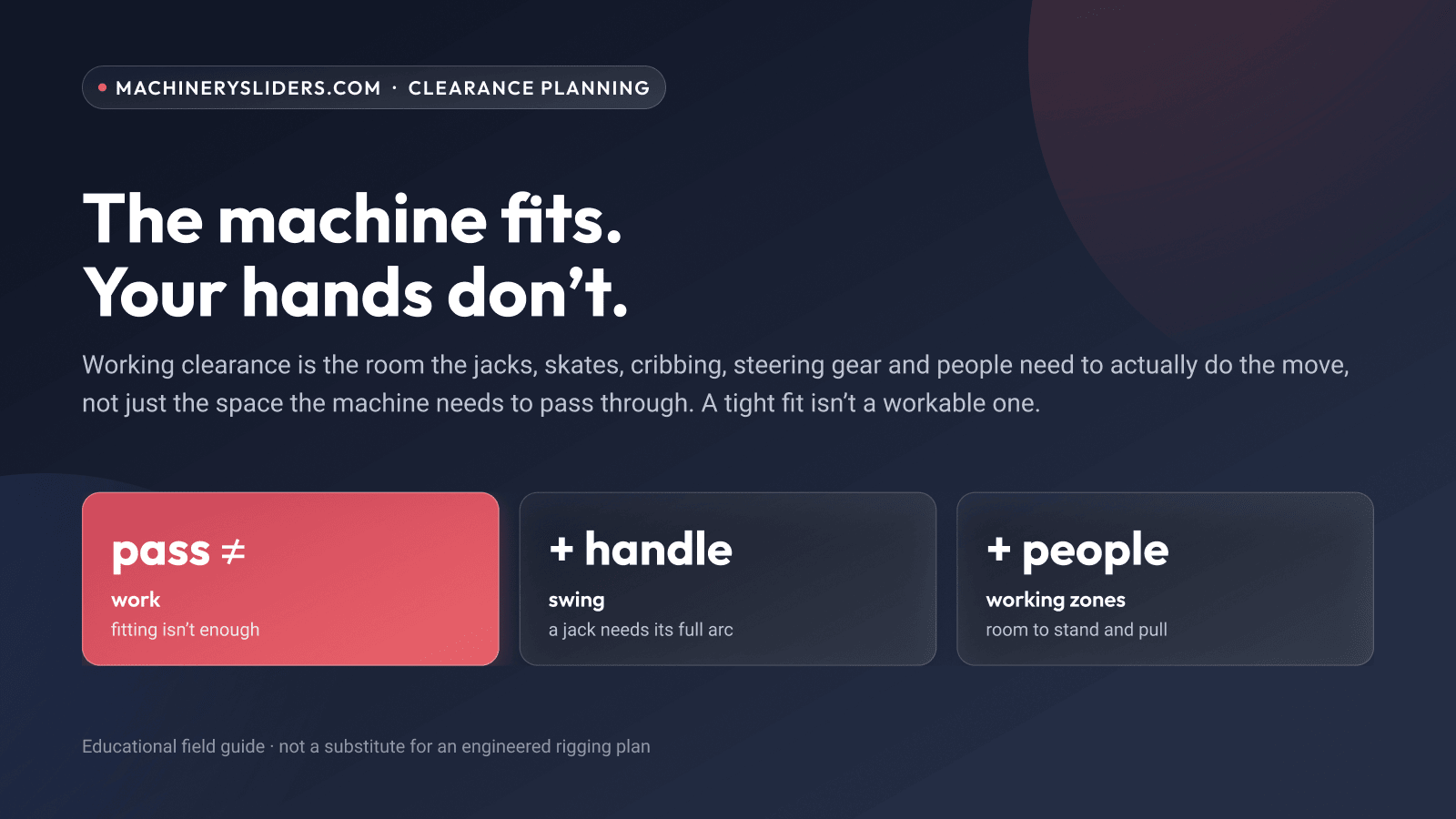
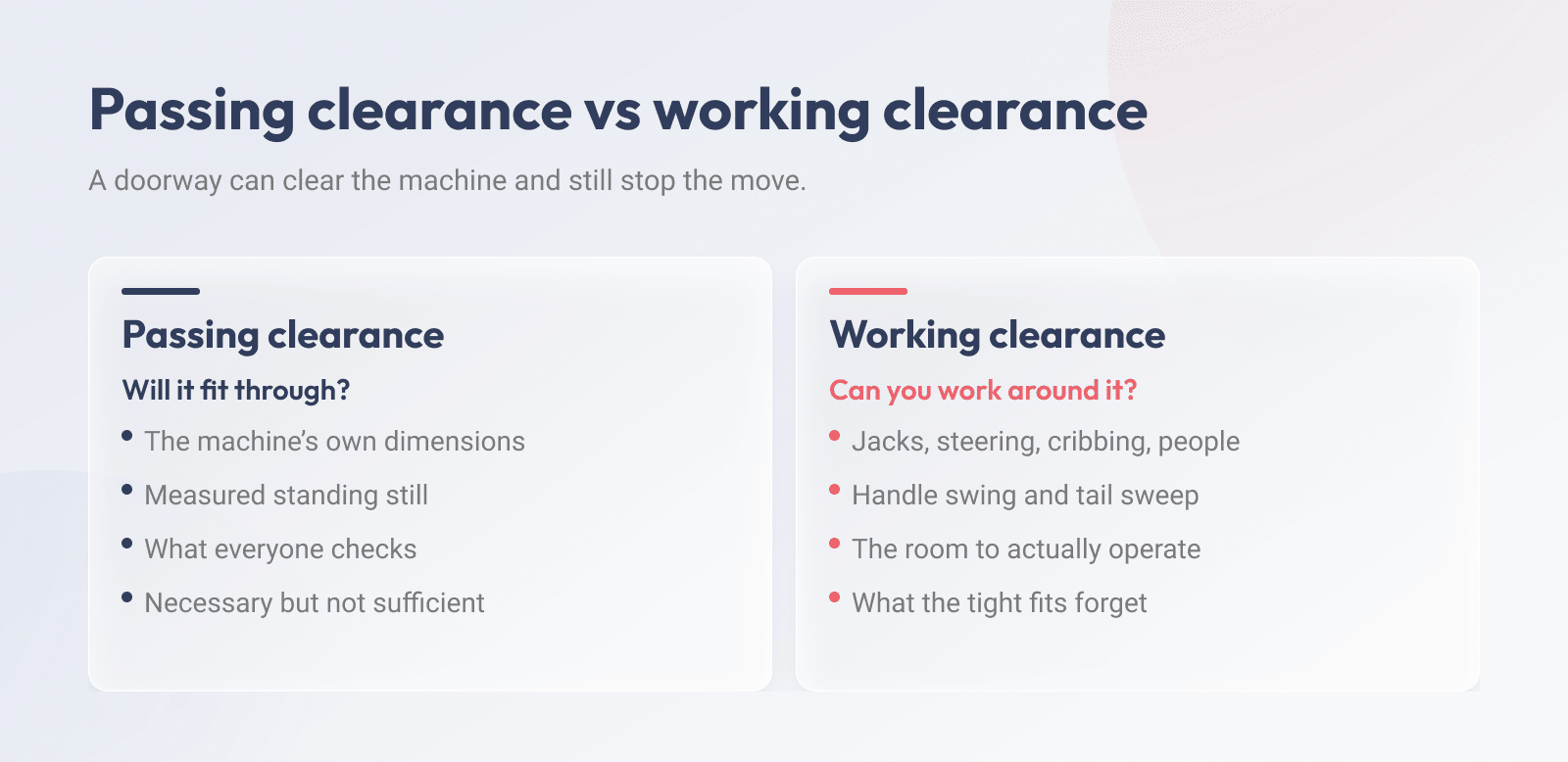
Direct answer Working clearance is the room needed for the jacks, skates, sliders, cribbing, steering equipment and personnel to actually perform the move, not just the space the machine itself needs to pass through. A machine can clear a doorway with room to spare and still be nearly impossible to move safely, if there is no room for a toe jack, a steering handle to swing, or a person to get a hand in and back out again. Machine clearance and working clearance are genuinely different questions, and only checking the first one is one of the easiest ways a move goes wrong.
“It fits” answers the wrong question
A machine only a few inches from a wall might have plenty of room for a jack’s toe to slide underneath, but that does not mean the jack body clears, the pump handle has room to swing, or the operator can actually reach it.
The same gap applies to a steerable skate positioned perfectly beneath the machine. If the steering handle needs several feet of swing and the wall is two feet away, the equipment fits beneath the machine but is functionally unusable right there. Equipment clearance and operating clearance are two different measurements, and the first one being fine tells you nothing about the second.
Hands need space too, and slow does not mean safe
Positioning skates, adjusting cribbing, or attaching rigging in a genuinely tight space creates a real temptation to put fingers, hands or feet somewhere with no safe way out if the load shifts. A 30,000 lb machine moving one inch can still crush a hand. Heavy machinery moving slowly feels controlled, but a pinch zone is still a pinch zone regardless of speed. The plan should minimize how often anyone needs to be positioned between the machine and a wall, column, or another piece of equipment in the first place.
Ask where the person goes if the machine shifts toward them. If there genuinely is not an answer, the plan needs to change before that person is ever in that position, not after.
Clearance that works straight can disappear on a turn
A machine does not rotate as a perfect rectangle. Corners sweep through an arc, and the rear of a long machine can swing toward a wall even while the front is clearing comfortably. Protruding components such as electrical cabinets, conveyors and control arms extend the effective footprint beyond the base dimensions. Someone with adequate standing room during straight travel can find that space gone the moment the machine starts to rotate, so personnel clearance needs to be evaluated through the whole movement, not just at the starting position.
A machine can also travel several inches while lightly contacting something before that contact becomes obvious, and a crew watching the floor may not notice it at all. If pulling resistance rises mid-move with no clear floor-level cause, check the whole machine envelope, including overhead: conduit, piping, a cable tray, or a duct can be quietly rubbing against a tall machine well above eye level, in a spot nobody at floor level would think to look. Sprinkler heads and fire-protection piping deserve particular caution here. A machine can clear the structural door frame or aisle cleanly and still contact a sprinkler line immediately before or after an opening, and that equipment can be seriously vulnerable to impact.
Direction matters too: a transition that worked moving one way is not guaranteed to work the same way in reverse. The same threshold or opening can mean uphill movement one direction and downhill the other, with different control requirements. That is relevant not just for the original installation but for any later relocation or servicing. It is also why “they got it through this door when it was installed” is worth treating as a data point, not proof. The building may have been unfinished then, a wall may have come out temporarily, or the threshold may not have existed yet.
The final position can be harder than the whole trip getting there
A machine might travel 200 feet through an open aisle without incident, then need to land two inches from a wall or tucked between two existing machines, and that last stretch still requires steering, stopping, jacking, removing skates, lowering, and aligning anchor holes.
Start by asking what the final position actually requires and how every piece of rigging equipment gets removed once the machine is there, then work backward from that, rather than planning forward and discovering the trap once you have already arrived. The load-transfer sequence that last stretch depends on is covered in cribbing stability, where support reactions keep changing right through the handover.
It is a classic trap to move a machine successfully through a narrow opening only to find the moving equipment itself is now stuck beneath it, with no room left to jack or steer it back out.
Pulling equipment needs its own working room
A come-along or pulling device that works cleanly in an open aisle can become nearly unusable near the final destination if there is no room to reach the handle or reset the attachment point.
Line angle also changes as the machine approaches the anchor point. A pull that starts nearly straight can end up pulling sideways or toward an obstruction, and tight spaces leave much less room to tolerate a poor angle than an open aisle does. Where that force actually goes, and why a rated point can still be in the wrong place, is set out in pulling point geometry.
Sometimes it is easier to shrink the machine than to find more rigging room
If removing a motor, guard, conveyor section or electrical cabinet creates the clearance a safer move actually needs, that can be a better answer than engineering an extremely tight rigging operation around the machine as it stands. Partial disassembly raises its own questions. Does it shift the center of gravity, is it something the manufacturer permits, can it be reassembled accurately? But sometimes removing six inches from the machine is genuinely easier than finding six inches of working clearance around it.
Low profile helps equipment clearance. It does not create working clearance.
Machinery Sliders run about 3/8 inch to 1 inch tall and have no wheel bearings, axles or steering assemblies underneath the machine, which can meaningfully reduce how much vertical and equipment clearance the moving system itself consumes. In some short, controlled moves, that can also reduce how often someone needs to steer or adjust equipment close to the machine. The height comparison against wheeled options is in low clearance machinery moving.
What sliders do not do is create hand clearance, an escape path, or room to jack and lower the machine at the final position. A slider fitting into a space where a conventional skate would not does not mean a person can safely reach underneath the machine. Equipment clearance and personnel clearance are still two separate questions, and solving one does not automatically solve the other.
What to measure before a tight-clearance move
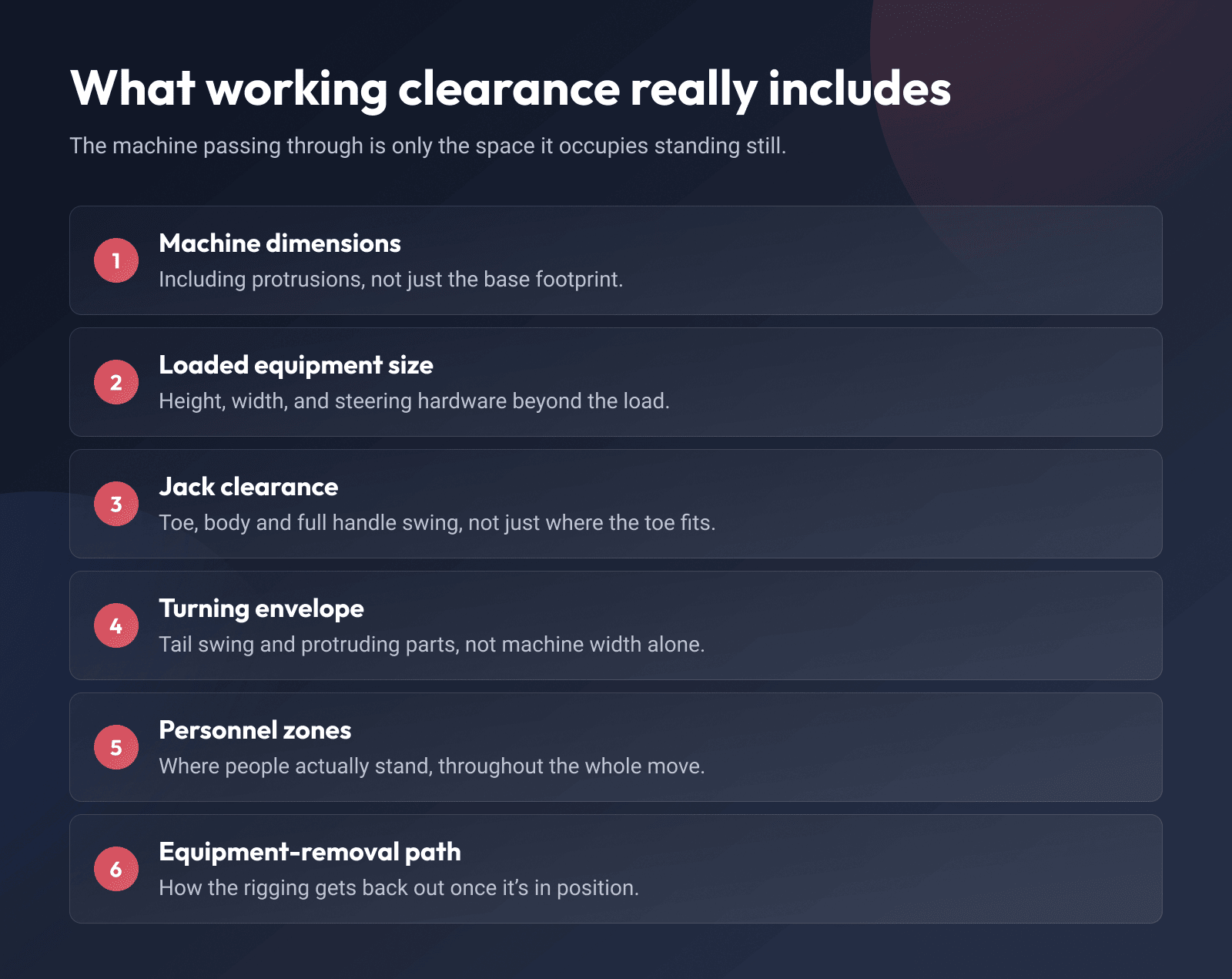
- Machine dimensions, including protrusions, not just the base footprint.
- Loaded moving-equipment dimensions: height, width, and any steering hardware that extends beyond the load.
- Jack clearance: toe, body, and full handle swing, not just where the toe fits.
- Turning envelope, not machine width alone. Account for tail swing and protruding components.
- Personnel working zones: where people actually need to stand, throughout the whole move.
- Final equipment-removal path: how the rigging gets back out once the machine is in position.
The narrowest point on the route is not always the doorway. It can be a column, an overhead pipe, or wherever the pulling equipment has to be reset. Measure the whole route, not just the obvious opening. What the moving equipment itself adds to that profile depends on which kind you are using, which is covered in what are machine skates.
The final inch deserves the same respect as the first
Two hundred feet without a problem can breed complacency right when it matters least. People move closer, someone puts a hand against the frame, someone tries to guide a skate with a foot. The machine weighs exactly what it weighed at the start. Do not let the human body be the clearance gauge. “I can squeeze in there” while the machine is stationary says nothing about whether that is a safe place to be while it is moving.
When to stop and reassess
Stop the move if personnel lose their escape path, steering equipment cannot be operated safely from where it needs to be reached, or a turn creates more tail swing than planned. Do not let “it fits” become the justification for unsafe access. Machine clearance and safe working clearance are different questions, and only one of them being fine is not good enough.
When this becomes an engineering question
Get qualified input when clearances are extremely tight relative to the machine’s center of gravity, machine tilt during the move could reduce overhead clearance further, or partial disassembly would change the machine’s structure or weight distribution. Some clearance problems are simple geometry. Others are genuine engineering questions. Know which one you are looking at before proceeding.
Frequently asked questions
What is the difference between machine clearance and working clearance?
Machine clearance is the physical space the machine itself needs to pass through. Working clearance includes the additional room needed for jacks, skates, sliders, cribbing, handles, tools and personnel to actually perform the move safely.
If the machine fits through the doorway, why would the move not work?
The moving equipment can raise or widen the effective profile, and steering handles, jacks, thresholds or turning geometry may need more space than the machine’s bare dimensions suggest.
What is tail swing in a machinery move?
Tail swing is the lateral movement of the rear of a long machine as the front turns. The rear can move toward a wall or nearby equipment even while the front appears to be clearing comfortably.
Can Machinery Sliders help with tight-clearance moves?
Their low profile can reduce the vertical and equipment clearance the moving system itself consumes, since there are no wheel bearings or steering assemblies underneath the machine. They do not automatically create personnel or hand clearance. That still needs to be planned separately.
Should a person stand between the machine and a wall to guide it?
No. Personnel should not be positioned where the machine’s movement could trap or crush them. The move should be planned to minimize exposure to pinch zones and preserve a clear escape path throughout.
What should I measure before a tight-clearance move?
Six things: machine dimensions including protrusions, the loaded moving-equipment size, jack clearance through the full handle swing, the turning envelope rather than machine width alone, the personnel working zones across the whole move, and the path the rigging takes to get back out once the machine is in position.
Less equipment underneath, more room to work around it
Machinery Sliders reduce how much space the moving equipment itself takes up, but the crew’s working room still has to be planned on its own. The full specification is on the what are Machinery Sliders page, and sets are in the store.
Machinery moving involves real risk of crushing injury, property damage, and equipment damage. This article is educational and does not replace an engineered rigging plan, the equipment manufacturer’s instructions, qualified supervision, or applicable workplace safety requirements. Consult a qualified engineer for extremely tight clearances, complex turning geometry, or moves where loss of control could trap personnel with no escape route.