
Direct answer: What is considered a low profile machine skate for industrial moving?
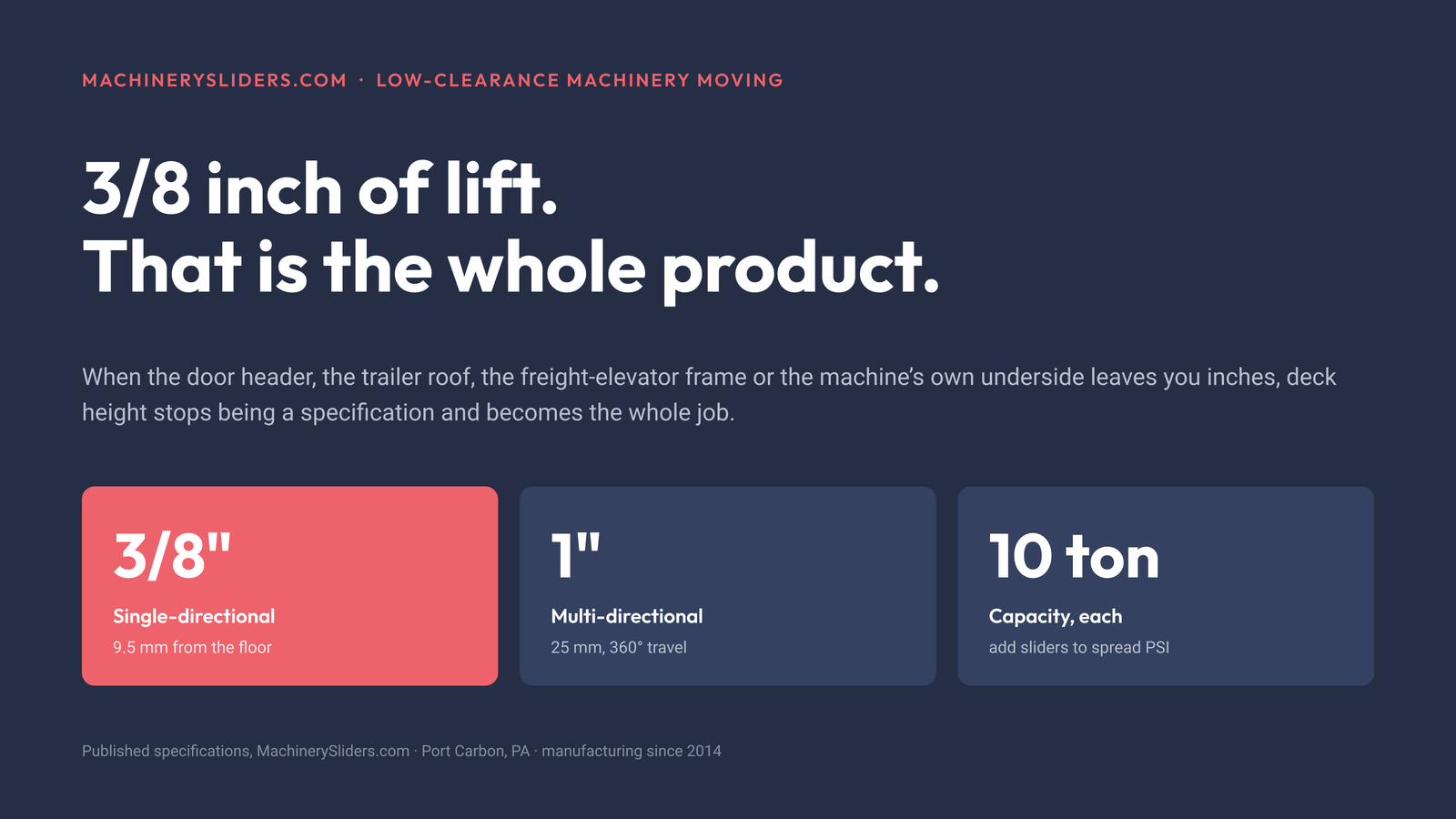
In industrial rigging, standard wheeled low profile skates dollies compress their deck heights down to a technical minimum of 3 1/2″ to 4.00″ off the floor. By completely eliminating wheels, bearings, and axles, nonmetallic Machinery Sliders™ bypass this physical barrier to achieve an ultra-low clearance profile of just 3/8″ (9.5mm) for single-direction pads and 1″ (25mm) for multi-directional disks — roughly 4.5× lower than the lowest wheeled skate on the US market, and 14× lower than a 5.35″ Hilman Bull Dolly. Each is rated by the manufacturer at approximately 10 tons and weighs about 1.3 lb and 1 lb respectively.
A low profile machine skate is one with a deck height low enough that the machine barely has to be lifted to get it underneath. Among wheeled skates, low profile means somewhere between 3 1/2 and 4 inches. Machinery Sliders are not wheeled: the single-directional model sits 3/8 of an inch off the floor and the multi-directional model sits 1 inch. When a door header, a trailer roof, an elevator frame or the underside of the machine itself leaves you inches, that is the difference between the move happening and the move being cancelled.
How low is “low profile”, really?
Every skate manufacturer describes their product as low profile, so the phrase has stopped meaning much. The published numbers do mean something:
- Hilman Bull Dolly BSP-3P: 5.35 inches (136 mm) per dolly.
- H-Lift CTA series, marketed specifically on low profile: as low as 101 mm, just under 4 inches.
- The lowest wheeled machine skate at a usable capacity: 3 1/2 inches, on Vestil and Beacon models.
- Machinery Slider, multi-directional: 1 inch (25 mm).
- Machinery Slider, single-directional: 3/8 inch (9.5 mm).
There is a physical reason wheeled skates stop at around an inch and a half. A wheel needs a diameter, an axle and a frame around it, and those three things have a floor below which they cannot go. Remove the wheel and the constraint disappears — which is exactly what a Machinery Slider does, at the cost of rolling resistance. For a full side-by-side against wheeled equipment, see machine skates, dollies and sliders compared.
The four places clearance runs out
Door headers and structural openings
A machine that fits through a doorway standing on its own feet does not necessarily fit through it standing on a mover. Five inches of dolly is often the entire margin.
Trailers, containers and dock plates
Shipping container door frames sit several inches lower than their internal ceilings. Loading an asset on tall wheeled machine moving skates causes the top of the load to strike the entry frame. True nonmetallic sliders glide cleanly over angled dock plates and entering low. Because they are cost-effective, they can be left beneath the load as transit dunnage, avoiding high-risk, confined-space tool extraction.
. There is a dedicated page on loading machinery into shipping containers.
Freight elevators and upper floors
Elevator car door frames are a fixed dimension, and the car floor has a load limit that punishes concentrated point loads. Low profile solves the first problem; non-point-loading helps with the second. See freight elevators and upper floors for the full treatment.
Under the machine itself
This is the one people forget. Some machines have almost no clearance beneath the base casting. If you cannot get a 5-inch dolly under it, the dolly’s capacity rating is irrelevant. You are either jacking the machine much higher than you wanted, or you are using something 3/8 of an inch thick.
The 84-inch door problem
The clearest way to see what deck height costs you is with real numbers. Take an 80-inch machine and an 84-inch door header — a completely ordinary combination in a machine shop.
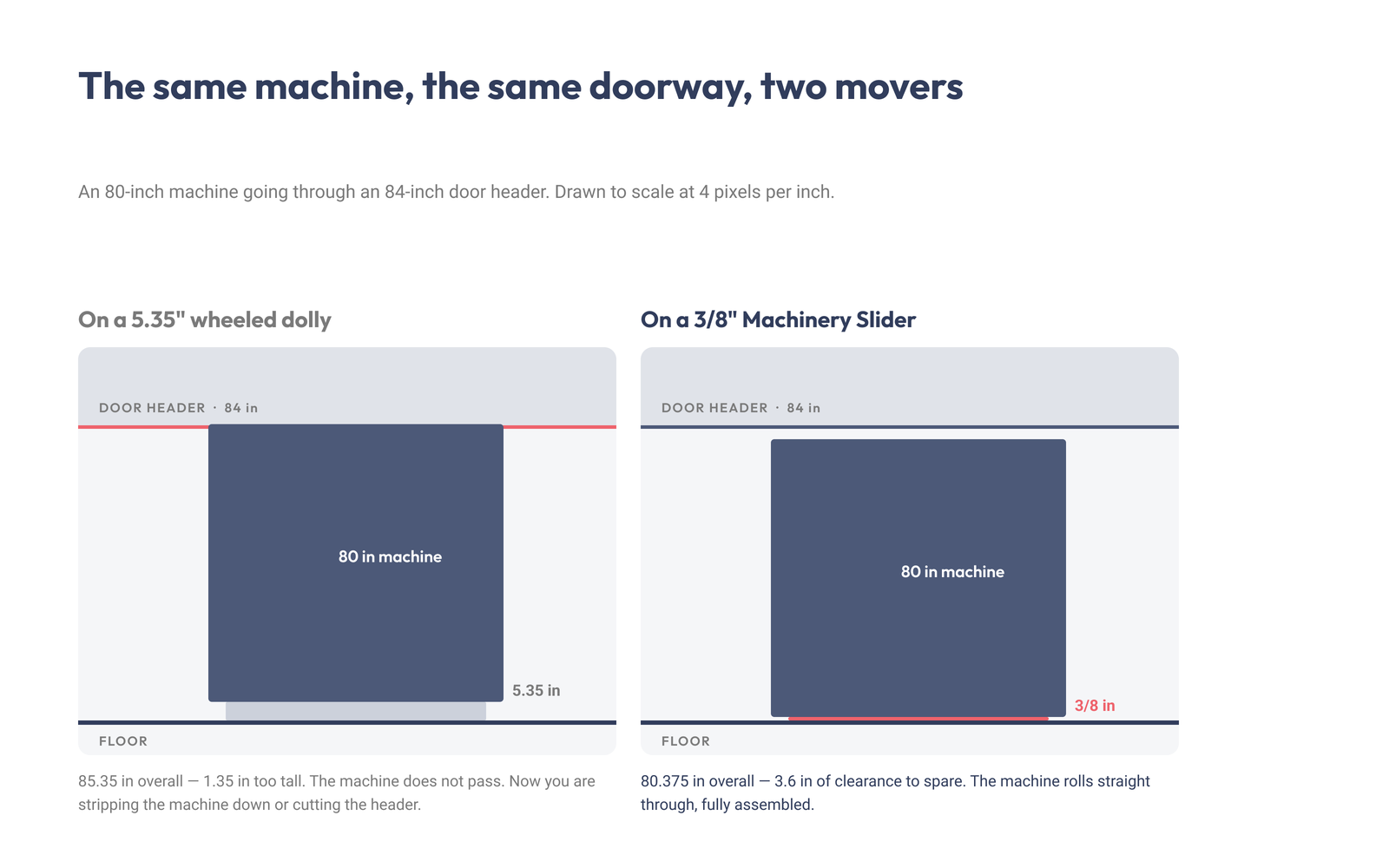
On a 5.35-inch dolly, the machine now stands 85.35 inches. It does not pass. Your options are stripping the machine down, cutting the header, or finding another route. On a 3/8-inch Machinery Slider, the same machine stands 80.375 inches and goes through fully assembled with 3.6 inches to spare. Nothing else about the job changed.
Why deck height and tip-over are the same problem
Riggers rarely lose machines because a mover fails under load. They lose machines because a mover shifts out from under one corner, that corner drops, and a top-heavy load passes its tilt point. The distance the corner falls is the deck height of whatever it was standing on.
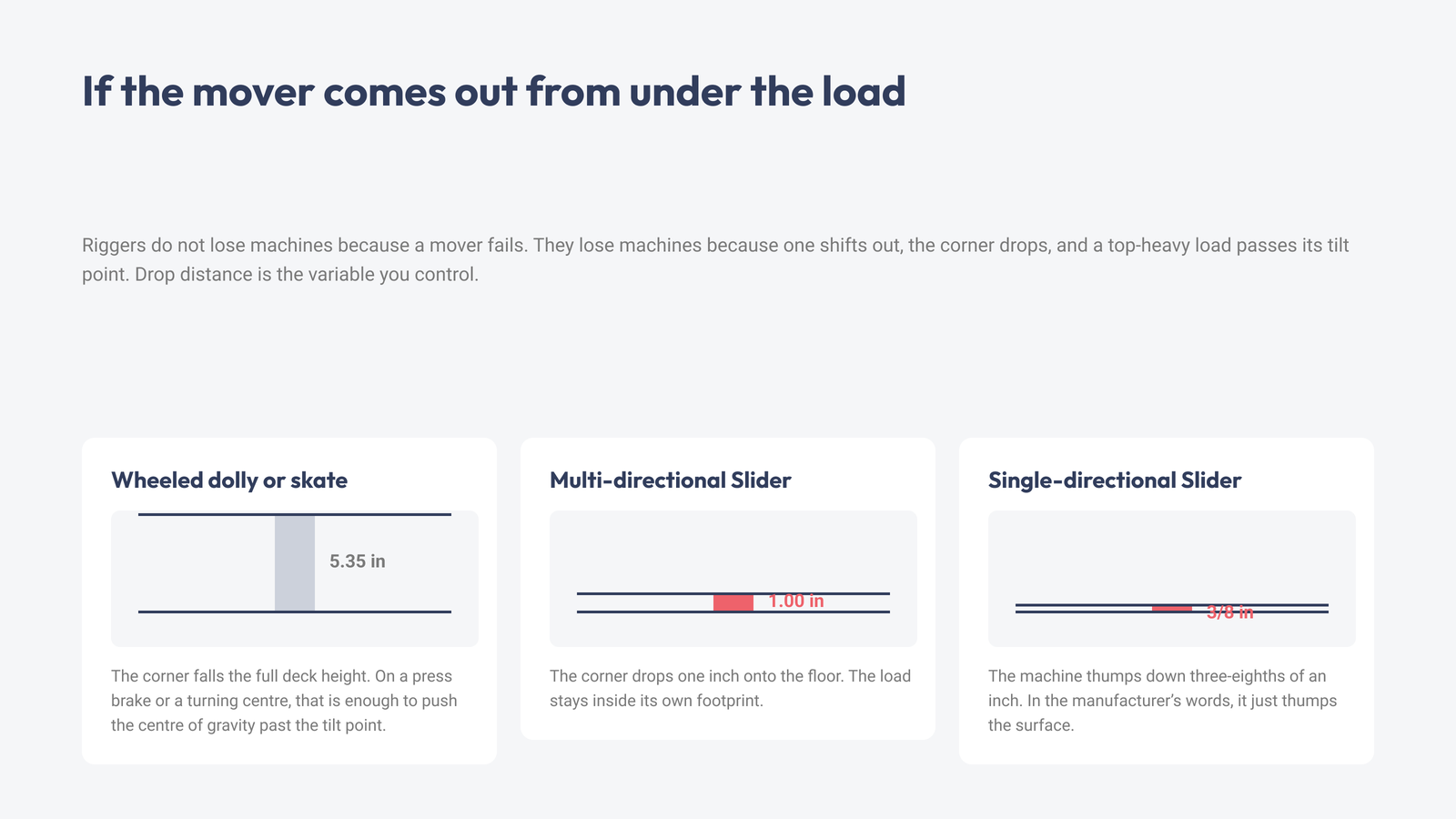
The manufacturer makes this argument directly, and the physics is straightforward. On a press brake or a turning center standing on 4 to 6 inches of steel dolly, losing a skate can drop the top of the machine past its tilt point. On sliders, in their own words, the machine just thumps the surface, dropping 3/8 of an inch to 1 inch. There is also less to lose in the first place: a slider has no wheels to shift, no bearings to seize and no axles to bend.
How many do you need?
Each Machinery Slider is rated by the manufacturer at approximately 10 tons. The sizing logic is not “pick a bigger slider” — there is no bigger slider. It is one under each leveling column as a starting point, then more added to spread the pounds per square inch over a wider area of floor. If you want the underlying numbers, see how much force it takes to move a machine.
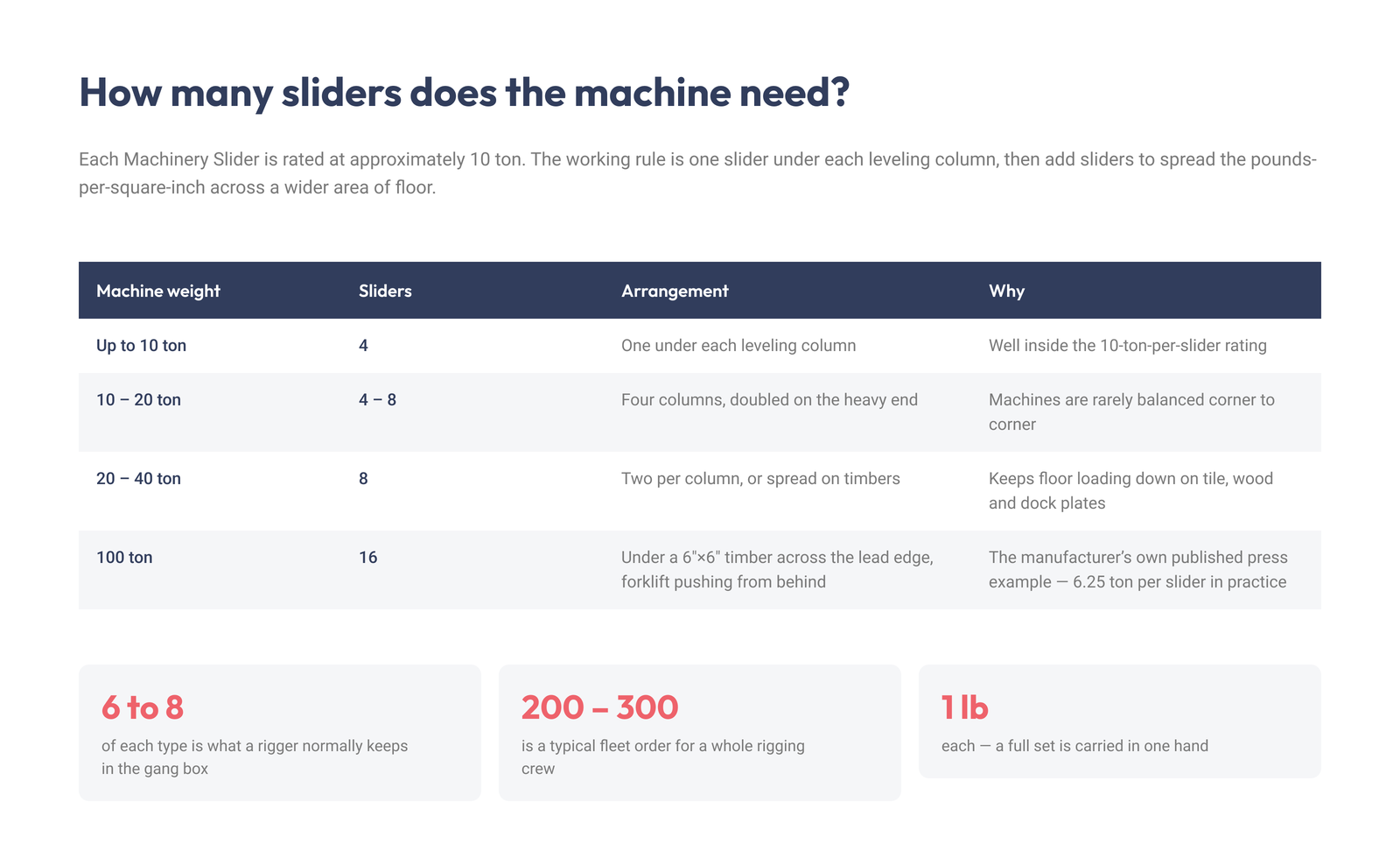
The 100-ton example is the manufacturer’s own and it is worth following exactly: a 6-inch by 6-inch timber laid perpendicular across the lead edge of the machine, sixteen single-directional sliders under that timber, and a forklift pushing from behind. That is 6.25 tons per slider in practice, well inside the ten-ton rating — which is how a rating should be used.
What low profile costs you
A page that only lists advantages is not a specification page, so here is the other side.
- You still have to lift the machine. 3/8 of an inch is much less lifting than five inches, but a toe jack is still part of the kit. Machinery Sliders do not include one.
- You slide instead of roll, so the pushing force is higher than on wheels. On a long straight run across sound concrete, a wheeled skate is less work.
- You cannot steer under load with a handle. The multi-directional slider gives 360-degree travel when a pin drops through the machine’s foot into its 1-inch center hole, but that is not the same as a swivel dolly with a steering bar.
- They are a wear item. Life depends on the surface and the load — long on carpet, considerably shorter on asphalt, because of the coarseness of the surface itself.
- They are semi-non-marking, not non-marking. Marks can occur on certain floors and can be removed. There is more on this on moving over floors and truck surfaces.
Frequently asked questions
What is the lowest profile machine skate available?
Among wheeled skates, roughly 3 1/2 inches. Machinery Sliders are lower still because they have no wheels at all: 3/8 inch (9.5 mm) for the single-directional model and 1 inch (25 mm) for the multi-directional.
How much clearance do I need under a machine to use Machinery Sliders?
Enough to get a 3/8-inch pad underneath for the single-directional model, or 1 inch for the multi-directional. In practice that means jacking the machine barely more than the thickness of the slider itself.
Are low profile machine skates less strong?
Not in this case. Each Machinery Slider is rated at approximately 10 tons, and capacity is increased by adding sliders rather than by using taller ones — sixteen under a 100-ton press is the manufacturer’s published example.
Can low profile sliders be used inside a shipping container?
Yes, and it is a common use. They clear low container door headers, glide over dock plates, and cost little enough to be left in place under the machine instead of being retrieved from a fully-loaded container.
Do I still need a toe jack?
Usually, yes. Something has to lift the machine far enough to place the slider, even if that is only three-eighths of an inch. Machinery Sliders are the mover, not the lift.
Where are Machinery Sliders made?
They are manufactured in the USA and shipped from Port Carbon, Pennsylvania. They were introduced in 2014, originally under the name Skid Plates.
Where to go next
For what a Machinery Slider is in full, and for moving machinery in and out of MRI suites, there are dedicated pages — both already link here. All five sets are listed in the store.