
Why a Jack Can Walk or Tilt While the Machine Looks Still
Home » Technical Library » Load Distribution & Final Positioning » Why a Jack Can Walk or Tilt While the Machine Looks Still
By Machinery Sliders™ Technical Team|Drawing on industry background in machinery rigging and moving equipment|Last Updated: September 27, 2026
Direct Answer: The Machine Isn’t Moving. The Jack Is.
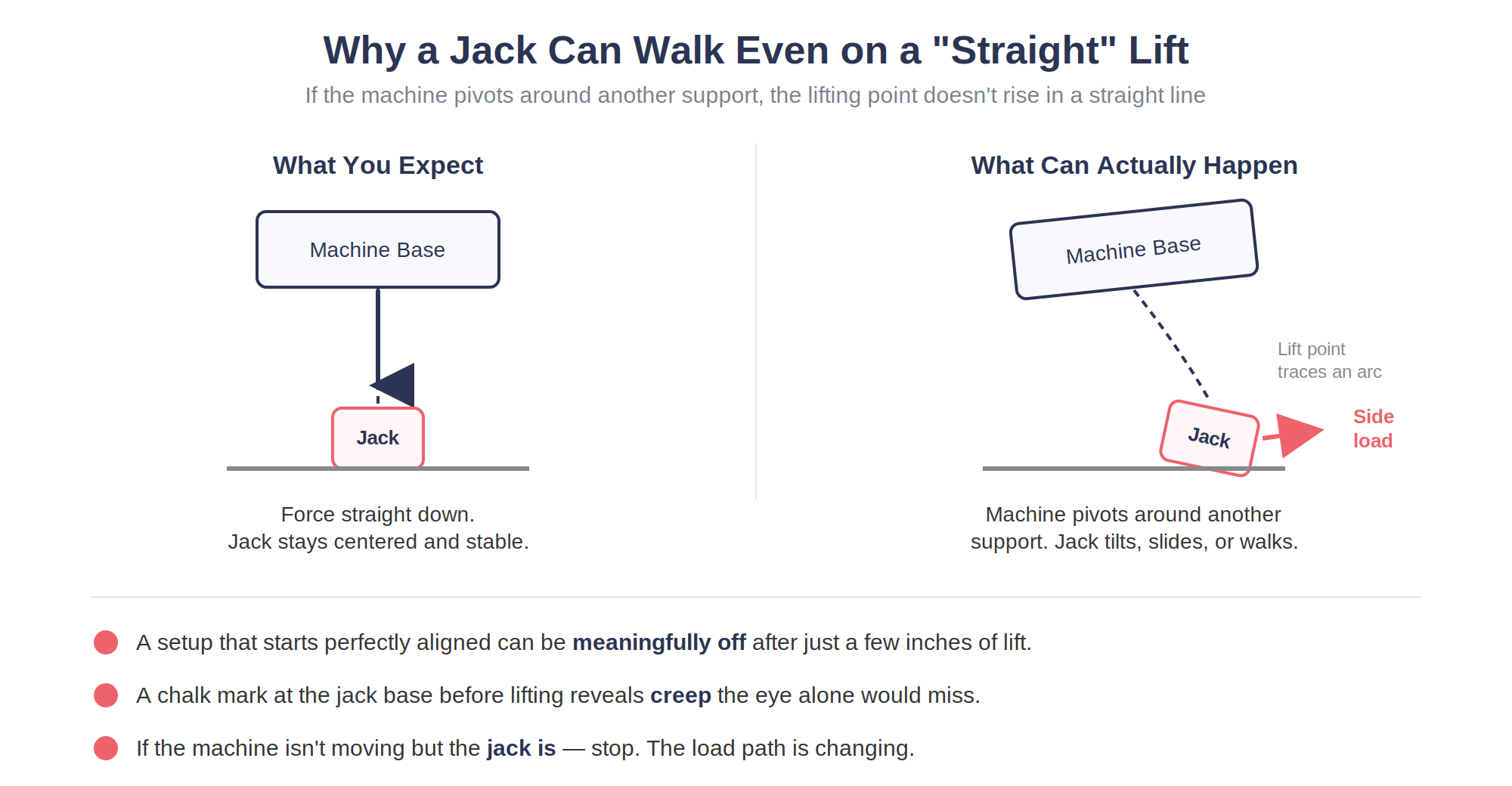
A jack can begin walking, tilting, or losing contact while the heavy machine it’s lifting looks almost completely still — because the machine rarely rises in a perfectly straight vertical line. If it pivots even slightly around another support, its lifting point follows a small arc rather than a straight path, and the jack has to somehow absorb that mismatch: by sliding, tilting, or shifting its contact toward one edge. The warning sign here isn’t always “the machine moved.” Sometimes it’s “the machine stayed put while the jack started going somewhere else” — and that’s just as serious.
Jack Carries Force Through a Path, Not Just a Point
Machines Rarely Rise in a Perfectly Straight Line
Edge Contact and a Walking Base Are Both Real Warning Signs
A toe jack’s lifting surface can start out fully engaged under the machine, then gradually migrate toward the edge of the toe as the machine’s lifting point shifts — reducing how much surface is actually supporting the load, even while the jack still appears to be doing its job. Don’t assume the machine’s weight alone will hold the jack in place: friction resists sliding, but it isn’t positive mechanical restraint, and enough lateral force can still move a jack base across concrete, especially if the floor has any oil, coolant, or contamination on it. A jack base can also settle unevenly into a soft spot or damaged concrete without much visible drama — but that small settlement tilts the jack, which increases side loading, which encourages more movement. It’s a feedback loop that can start with as little as a sixteenth of an inch.
Watch the Jack, Not Just the Machine
Most crews instinctively watch the machine during a lift — reasonably, since that’s the visible load. But the sequence that actually matters more often runs the other way: the machine stays nearly motionless while the jack slowly changes position, the geometry quietly worsens, and only at the end does the jack release and the machine finally move. By the time the machine visibly shifts, the warning has often already come and gone. A simple chalk mark or reference line next to the jack base before lifting can reveal slow “creep” that’s very hard to catch by eye alone — human vision is genuinely poor at detecting movement that happens a sixteenth of an inch at a time.
Never Correct a Walking Jack While It's Loaded
If a jack starts shifting, don’t kick it back into position, hit it with a hammer, or brace it with your foot — a jack capable of being pushed sideways by a heavy machine is more than capable of injuring a foot or hand in the process. If the jack’s movement gets stopped by pinning it against a wall or a piece of cribbing, the lateral force driving that movement doesn’t disappear — it just transfers into whatever obstruction stopped it, which can increase bending or contact stress somewhere else in the system. The right response to unexpected jack movement is to stop, safely unload or secure the load per your lift plan, and find the actual cause — not to treat the symptom while the load stays up.
Multiple Jacks Can Make This Stranger, Not Safer
Lifting a machine on four jacks doesn’t automatically mean more stability — if the jacks aren’t synchronized, one can get ahead of the others, tilting the machine and shifting load away from a second jack while increasing reaction on a third. A jack that becomes lightly loaded this way can shift easily (it’s barely carrying anything), and then reload abruptly once the machine’s geometry brings weight back onto it — landing on a jack that’s no longer exactly where it started. This connects to the same underlying idea covered on our page about how load distribution shifts across skates: a support being present isn’t the same as a support actually carrying weight, and that’s just as true while jacking as it is while traveling.
Machinery Sliders Can Reduce How Much Jacking Is Needed
This is a genuine practical advantage of a low-profile system: if a Machinery Slider only requires a small lift to install, the machine needs less vertical travel than a taller conventional setup would demand — which means less rotation, less geometric change, and shorter overall exposure during the jacking phase. But a smaller lift height doesn’t make a bad load path safe. A jack still needs a firm foundation, centered loading, and full appropriate contact regardless of whether the total lift is three inches or three-eighths of an inch. Minimizing unnecessary jacking and support transfers throughout a move is a real safety advantage, not just a convenience — every additional lift or transfer is another chance for something to go quietly wrong.
Before the First Pump: A Quick Checklist
- Is the jack rated for the actual expected reaction at this point, not just the machine’s total weight?
- Is the base resting on a firm, level, adequate surface — clean of oil, coolant, or debris?
- Is the jack centered with the intended load path, with full saddle or toe contact available?
- Will the machine’s lifting point move laterally as it rises — what will it pivot around?
- If multiple jacks are involved, are they synchronized or otherwise controlled together?
- Is blocking or cribbing ready before the machine goes up, not searched for afterward?
Stop and reassess if: the jack base moves even slightly, the jack begins leaning, toe or saddle contact shifts toward an edge, the machine moves laterally while rising, or a jack in a multi-point lift becomes unexpectedly loose. Don’t respond by pushing the jack back into place, hammering it under load, or increasing pressure and hoping it settles — secure the load first, then find the actual cause. Any load raised by a jack should be properly blocked or cribbed before anyone works under or between it — a hydraulic jack is a lifting device, not a permanent support.
Learn More: Frequently Asked Questions
Not automatically. A plate adds another interface that itself has to remain properly supported and stable — it doesn’t eliminate the underlying geometry problem.
No. Unexpected jack movement should trigger a full stop and reassessment, not an improvised correction while the load remains up.
Yes. Unequal or unsynchronized lifting can redistribute load away from one jack and onto others, sometimes abruptly.
No. Pressure gives useful load information, but it doesn’t reveal physical alignment, tilt, or contact — those still need to be observed directly.
Their low profile can reduce the amount of lift height needed to install them, which shortens exposure — but a shorter lift still requires the same firm foundation and correct contact as a taller one.
Final takeaway: the object that moves unexpectedly during a lift isn’t always the load. Sometimes it’s the jack, and if a jack begins changing position under tens of thousands of pounds, waiting for the machine to move before deciding something is wrong means the actual warning has already passed. If the machine isn’t moving but the jack is — stop. The load path is changing.