
Rigging Anchors: Why "It's Holding" Isn't the Full Story
Home » Technical Library » Foundation & Structural Capacity » Rigging Anchors: Why “It’s Holding” Isn’t the Full Story
By Machinery Sliders™ Technical Team|Drawing on industry background in machinery rigging and moving equipment|Last Updated: September 27, 2026
Direct Answer: The Anchor Held. The Building Didn’t.
A pulling anchor can hold perfectly while whatever it’s attached to quietly fails behind it. The steel eye, shackle, or clamp isn’t the end of the load path — force continues through the concrete, the beam, the column, the foundation, and sometimes into the soil beneath it. A rigging anchor is only as strong as the structure that makes it an anchor. Concrete can break away in a cone around a perfectly intact fastener, a beam can twist or its web can deform, and a column base can begin lifting — all while the visible attachment point never shows a sign of trouble.
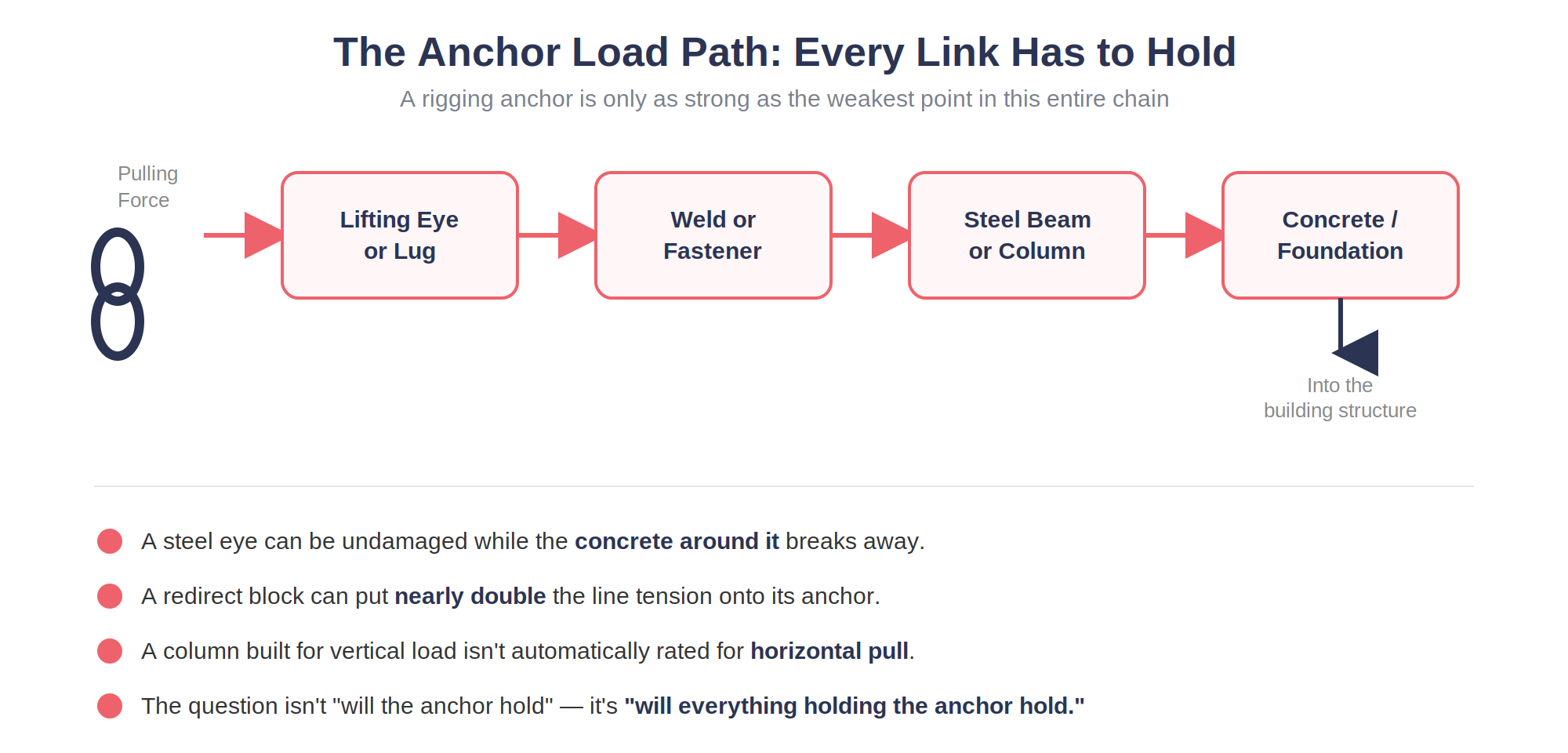
The Visible Anchor Is Only the End of a Much Longer Chain
A one-inch steel eye looks massive next to the chain hooked to it, which can trick a crew into treating the eye as the strongest part of the system — but that eye might be attached to four inches of questionable concrete, an old weld, or a beam never designed to take horizontal machinery-moving force. Structural capacity isn’t determined by appearance, thickness, or how confident everyone feels about it. A massive-looking component can have an unfavorable load path behind it; a smaller, properly engineered anchor can be far stronger.
Concrete Can Fail Around a Perfectly Good Anchor
The steel fastener doesn’t have to break for an anchor to fail — concrete around it can break away in a cone or section, pull the anchor free with a chunk of floor still attached, or crack progressively near an edge, a pit, or an old trench that isn’t visible from above. Anchors positioned close to a free edge have less surrounding concrete available to resist load than one placed well into a large slab, and a floor that looks solid from the surface may actually be a thin topping over fill or an older slab — meaning you may not actually know what the anchor is engaging at all.
Redirect Blocks Can Load the Anchor More Than the Line Itself
This surprises a lot of people: if a snatch block redirects a pulling line, the block’s anchor doesn’t just see the line tension — it sees the combined resultant of both rope legs pulling on it, which depending on the angle between them can approach roughly double the actual line tension. The rigging attached to the machine may only be carrying the line tension; the anchor holding the redirect block, the thing that never visibly moves, can be carrying significantly more. Mechanical advantage doesn’t create free force — it redistributes it, and every point where that redistribution happens needs its own honest evaluation.
Columns and Beams Are Directional — Vertical Strength Isn't Lateral Strength
A building column carrying enormous vertical load isn’t automatically a safe horizontal pulling anchor — a lateral pull applied several feet above its base creates a bending moment (force times the height above the base) that the column’s vertical design may never have accounted for. A beam attached off-center relative to its shear center can twist under load, which changes the geometry of everything connected to it: block alignment, rope angle, and the anchor load itself all shift together. None of this requires dramatic movement to matter — a column can deflect a fraction of an inch under load, and if that deflection keeps increasing as pull increases, the structure is quietly accepting force it was never intended to carry.
Watch for the Same Warning Signs as a Stored-Energy Event
This connects directly to our page on stored energy in rigging systems — if a machine is stuck and the anchor structure begins deforming while pulling force keeps building, you now have stored elastic energy combined with a failing structure, which is a genuinely dangerous combination. Watch for small, easy-to-miss signs during any high-load pull: a hairline crack near a loaded anchor, fresh concrete dust or chips, a bolt hole slowly elongating into an oval, paint cracking around a weld or base plate, or rust scale falling from an old connection. None of these prove failure by themselves, but any of them during an active pull deserve an immediate stop, not a wait-and-see approach.
Machinery Sliders Don't Remove the Need for a Sound Anchor
A low-profile slider can reduce rolling resistance and keep the machine closer to the floor, but if a forklift is providing the pulling force, that system still needs a genuinely adequate anchor and load path behind it — the slider only affects how much force is required, not whether the structure receiving that force can safely hold it. See our page on why a jack can walk while the machine looks still for the same underlying lesson applied to lifting instead of pulling: the visible component isn’t always the one telling you something’s wrong.
Before Pulling: An Anchor Checklist
- What exactly is the anchor — not “the column,” but the specific component actually transferring the load?
- What is it attached to, and where does the force go from there, all the way to the foundation?
- What direction does the force actually act — horizontal, vertical, or a combination, especially if a redirect block is involved?
- Is the anchor near a concrete edge, pit, or trench that reduces the material available to resist load?
- Do you have a predetermined maximum pull limit, and a plan to stop and investigate if the machine hasn’t moved by then?
- Can the anchor be observed safely, from a position outside its potential failure zone?
Stop and reassess if: concrete cracks near the anchor, a beam or column visibly deflects, a connection begins deforming, a bolt hole elongates, or pulling force exceeds your planned limit without the machine moving. “The anchor is still holding” is exactly the assumption this guide is warning against — the anchor is rarely the weak link. The structure behind it is.
Learn More: Frequently Asked Questions
Not necessarily. The surrounding concrete, steel, connection, and supporting structure all need to be adequate too — the bolt’s rating is only one link in the chain.
Yes. Concrete can break away around a perfectly intact fastener, pulling out a cone or section of the floor along with it.
Only after confirming the structure and attachment are actually suitable for the force and direction involved — vertical strength doesn’t establish lateral pulling capacity at an arbitrary height.
Because it carries the combined resultant of both rope legs’ tension, which depending on the angle can approach roughly twice the actual line tension.
Yes. It should trigger an immediate stop and reassessment, not a wait-and-see approach.
Not safely assumed. Machine weight isn’t the same as anchor capacity — that machine and its own foundation become part of the load path too.
No. If a forklift is providing pulling force, that force still needs a genuinely adequate structural anchor and load path, regardless of what the machine is riding on.
Final takeaway: a rigging anchor is a structural load path, not just a piece of steel to hook onto. The real question isn’t “will the anchor hold” — it’s “will everything holding the anchor hold.” Trace the path from the chain to the eye to the steel to the concrete to the foundation, because sometimes the warning comes too late: the anchor held, and the building didn’t.