
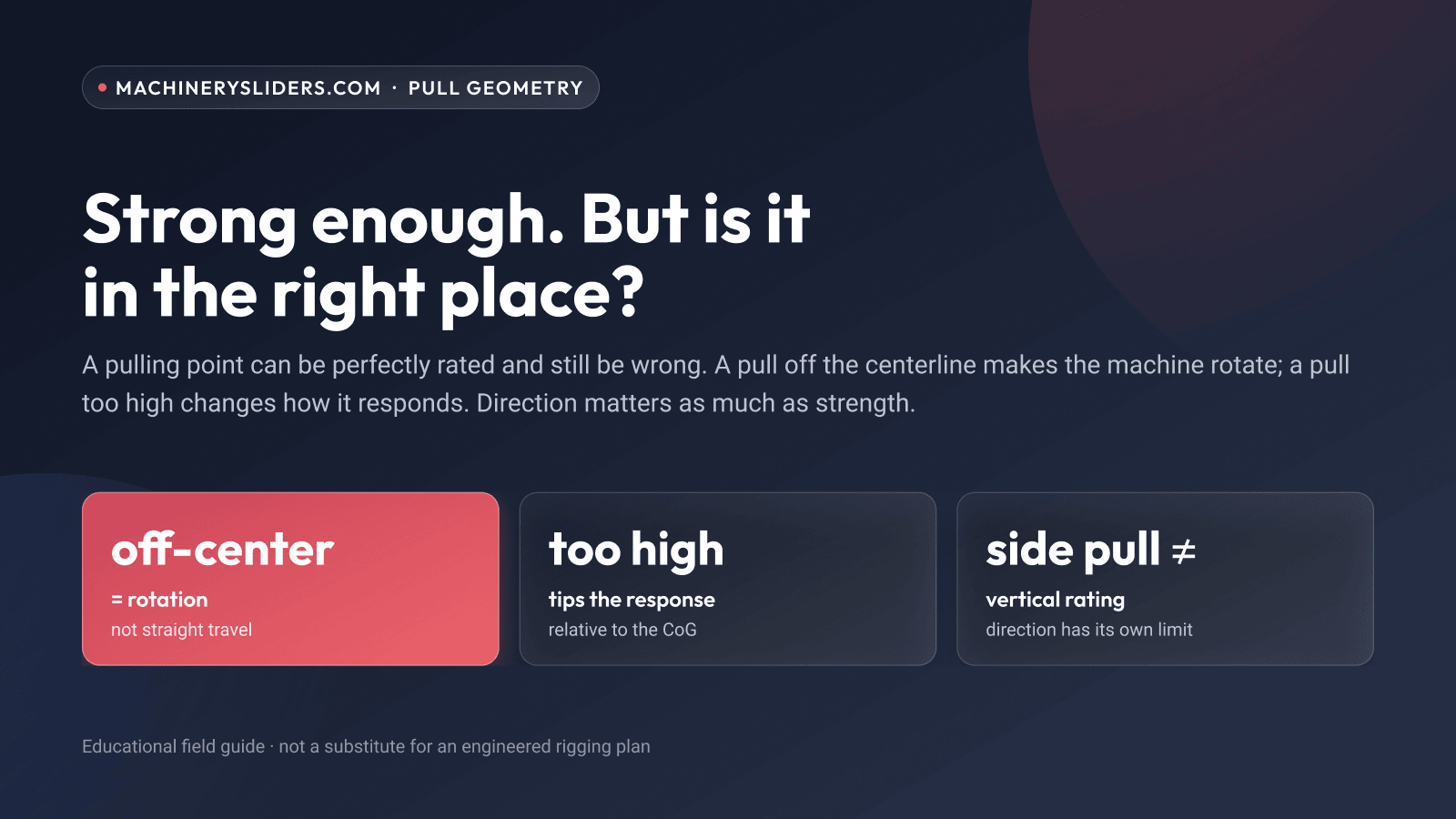
Direct answer A pulling point can be perfectly rated and still be in the wrong place. Where the force is applied matters as much as how strong it is. A pull off to one side of the machine’s centerline can make it rotate. A pull applied well above the center of gravity can create a tipping tendency. An angled line introduces sideways or vertical force alongside the forward pull you actually wanted. None of that shows up on a capacity rating. It only shows up once the machine starts moving in a direction nobody planned.
A pull off-center can rotate the machine even if every skate is aligned
Attach a pulling line to the front-left corner of a rectangular machine and pull it straight ahead, and the force is not actually acting through the machine’s effective centerline. It is creating forward motion and a turning moment at the same time. The machine can start rotating toward the pull even though every skate underneath it is perfectly aligned.
It is easy to blame the skates for not tracking when the real cause is that the machine is being pulled off-center in the first place. Where practical and structurally appropriate, pulling closer to the intended direction of travel and the machine’s effective centerline reduces this tendency, though the geometric centerline and the actual center of gravity are not always the same thing, so a heavily offset machine can still behave asymmetrically even with a centered-looking pull.
What matters is pull height relative to center of gravity, not height alone
The machine does not care whether a pulling point is 2 feet or 6 feet off the floor in isolation. What matters is where that point sits relative to the center of gravity, the support footprint, and the direction of force.
A pull applied well above the center of gravity can create a different rotational tendency than one applied below it, and a very low pull is not automatically the safer choice either. It still has to be structurally suitable and aligned with the actual route, not just conveniently close to the ground. Tall, narrow machines are more sensitive to this than low, wide ones, since the same pull geometry produces a larger angular effect at height.
A bigger tugger does not fix bad geometry. It makes the consequences bigger.
If the machine is not moving, reaching for more pulling capacity feels like the obvious fix. But if the actual problem is poor pulling geometry, whether off-center, angled wrong, or too high relative to the center of gravity, increasing force amplifies the side load, the rotation, and the tipping moment right along with it. More capacity does not correct bad geometry. It makes whatever that geometry was already doing happen harder and faster. How much force the move genuinely needs in the first place is covered in the force required to move a machine.
Follow the force path before adding more of it. Machine attachment, then rigging, then pulling device, then anchor, then structure. If any link in that chain is not right, more force just stresses every link more, not only the one you are trying to overcome. The same principle applies to every path a load travels through on a move: machine, support point, skate, wheels, floor for rolling, or machine, jack point, jack, load spreader, floor for jacking. A system is only as reliable as its weakest link, and oversizing one component does not fix weakness in another. The same weakest-link logic runs through cribbing stability, where a stack strong enough to never crush can still fail on geometry.
A lifting lug is not automatically a pulling point
A lug designed for vertical lifting, at a specific sling angle, is not necessarily rated for a horizontal or side pull. The direction of the load matters, and a connection built for one load case is not automatically suitable for a different one.
The same caution applies to side loading generally. Rigging hardware and machine attachments are often rated with an assumption about how the load gets applied, and a component designed for straight-line tension can behave very differently under bending, prying, or angled force than its capacity marking might suggest.
The anchor needs to match the actual force direction, and that direction can change
An anchor strong in a straight pull may be genuinely unsuitable loaded sideways or upward. Capacity is not a direction-independent number; it belongs to a specific load condition.
Line angle also shifts as the machine approaches a fixed anchor point. Good geometry at the start of a pull can become poor geometry by the end, so evaluate the angle throughout the whole move, not just at the moment you set up the rigging. Whether the crew has room to reach the handle and reset the attachment point at all is a separate question, covered in working clearance.
A forklift is not just a generic pulling machine
Using a forklift to pull a machine introduces its own considerations: connection point, vehicle traction, braking, operator visibility, and whether the pull direction creates forces the forklift is actually designed to handle. Improvised attachments or side pulls with a forklift can introduce real risk, so stay within the manufacturer’s operating limits rather than treating it as a universal pulling tool. Where no forklift is available at all, the alternatives are set out in how to move heavy machinery without a forklift.
Pulling and pushing are not interchangeable either. A push point can sit at a different height, create different rotation, and change how much steering control the crew has, so the same direction-relative-to-center-of-gravity principle applies whether the machine is being pushed or pulled.
Off-center pulling is not always wrong, sometimes it is the plan
Controlled rotation is sometimes exactly what you want: pivoting into a final position, or correcting orientation partway through a move. The difference between that and a problem is whether the rotation is intentional and controlled, or a surprise the crew is now reacting to. The geometry is the same either way. What matters is whether someone chose it on purpose.
Bad geometry often shows up right when the machine breaks free
A stalled machine can have real force built up in the pulling system. When resistance finally drops and the machine starts moving, an off-center or overly high pull can produce a rotation or lateral jump right at that first moment of movement. That is exactly why nobody should be standing in the machine’s likely path or a pinch zone while it is stalled and under tension.
Two pulling systems can fight each other if they are not coordinated
Pulling from two points at once, one tugger forward-left and another forward-right, can give genuinely excellent directional control when it is planned and coordinated. But the machine responds to the combined effect of both systems, and if one operator changes tension faster than the other, that mismatch itself can cause unwanted rotation. Multi-point pulling needs real coordination between operators, not two people independently pulling until it looks straight.
If the machine is rotating and the pull is not the cause
Pulling geometry is one of several things that can turn a machine unexpectedly. It is also worth checking whether one support is carrying more load than the others, which the machinery skates guide covers under sizing on the most heavily loaded corner, whether the floor has a compound slope pulling the machine sideways, or whether a piece of debris has stopped one support while the others keep moving. When rotation starts, work through this before assuming it is the pull:
- Stop the move. Do not keep correcting while it is still in motion unless the plan specifically calls for it.
- Stabilize the machine and maintain control before doing anything else.
- Check pulling geometry. Is the force still aligned the way it was set up?
- Inspect support points. Is one skate or slider carrying noticeably more load?
- Inspect the floor. Any obstruction, slope, or transition where the rotation started?
- Correct the actual cause, not just the angle the machine is currently sitting at.
Machinery Sliders do not remove the need to get this right
Sliders eliminate wheels and bearings, but they do not eliminate pulling geometry. If anything, since a slider move can require meaningful sustained pulling force, where and how that force is applied deserves just as much attention as it would with skates. An off-center pull can still rotate the machine or load individual sliders unevenly. The physics of pull direction and center of gravity do not change just because the moving equipment underneath does, as the side-by-side in machine skates versus dollies versus Machinery Sliders sets out.
Before attaching a pulling device
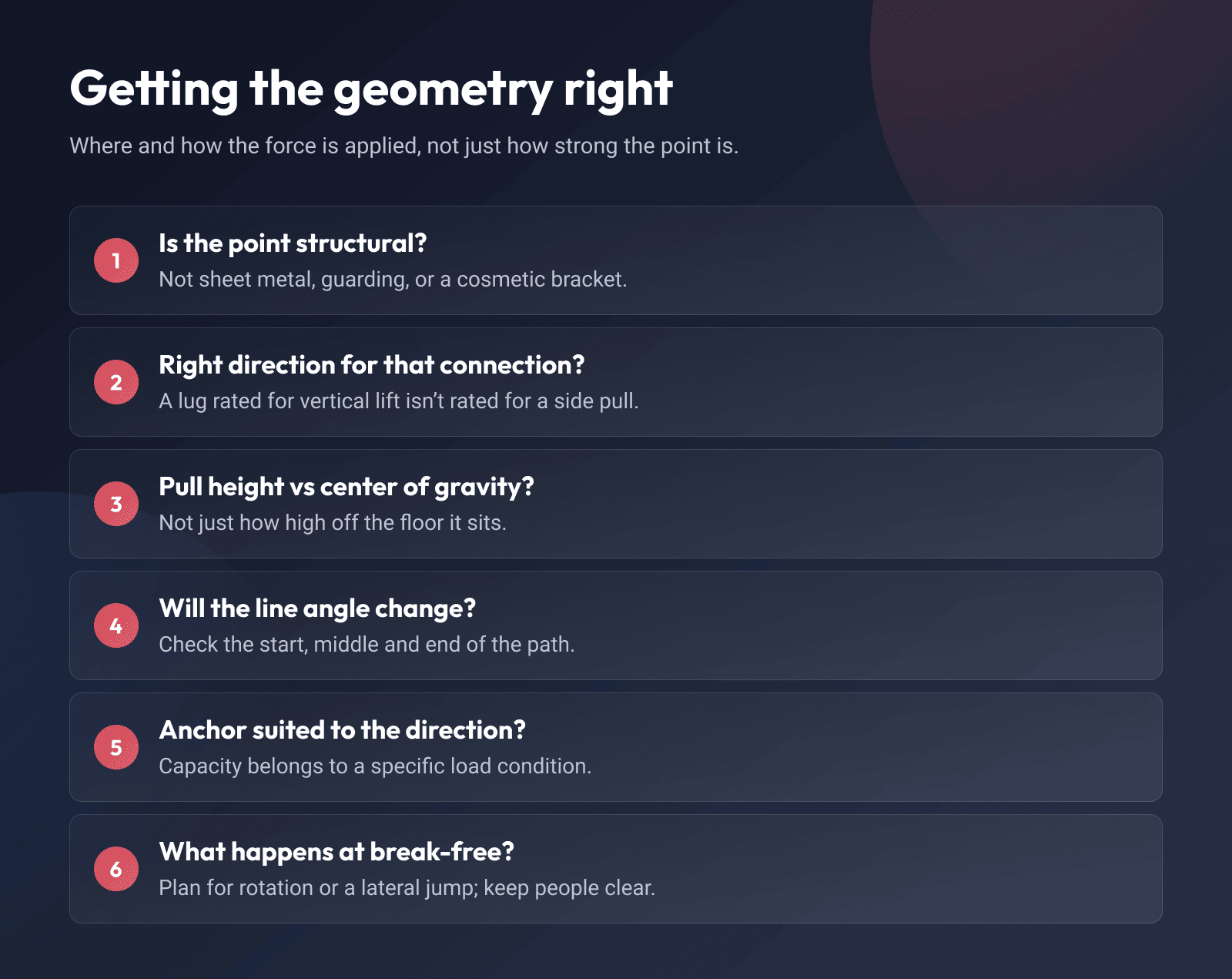
- Is the attachment point actually structural? Not sheet metal, guarding, or a cosmetic bracket.
- Is the pull direction appropriate for that connection? A lug rated for vertical lifting is not automatically rated for a side pull.
- How does the pull height relate to the center of gravity? Not just how high it is off the floor.
- Will the line angle change meaningfully as the machine moves? Check the start, middle and end of the planned path.
- Is the anchor suitable for the actual direction of force, not just its rated capacity in general?
- What happens the instant the machine breaks free? Plan for rotation or a lateral jump, and keep people clear of the path.
When to stop and reassess
Stop if the machine begins rotating unexpectedly, one support becomes heavily loaded while another unloads, the line angle drifts well beyond what was planned, or the attachment point itself shows any sign of deforming. Do not try to solve any of that with more pulling force. Trace the geometry first.
When this becomes an engineering question
Get qualified input when pulling points are undocumented, the attachment structure is genuinely uncertain, center of gravity is unknown on a tall or sensitive machine, or significant side loading is unavoidable given the site’s constraints. The stronger the pulling equipment involved, the more it matters to know exactly where that force is actually going.
Frequently asked questions
Why does a machine rotate when I am trying to pull it straight?
The most common cause is an off-center pull, where the force is not acting through the machine’s effective centerline, creating a turning moment alongside the forward motion. Floor slope, uneven skate resistance, or an offset center of gravity can also contribute.
Is it better to pull heavy machinery from a low point?
Not automatically. A lower pull can reduce tipping moment in some situations, but the point still has to be structurally suitable and correctly aligned with the route. There is no universal best height independent of the machine’s actual center of gravity.
Can I use a lifting lug as a pulling point?
Only if it is rated for that specific load direction. A lug designed for vertical lifting at a particular sling angle is not automatically suitable for a horizontal or side pull. Verify the intended use before relying on it.
Should I use a bigger winch if the machine keeps rotating instead of moving straight?
No. More force amplifies the effects of bad pulling geometry rather than correcting it. Determine why the machine is rotating, usually an off-center or poorly angled pull, before increasing the force applied.
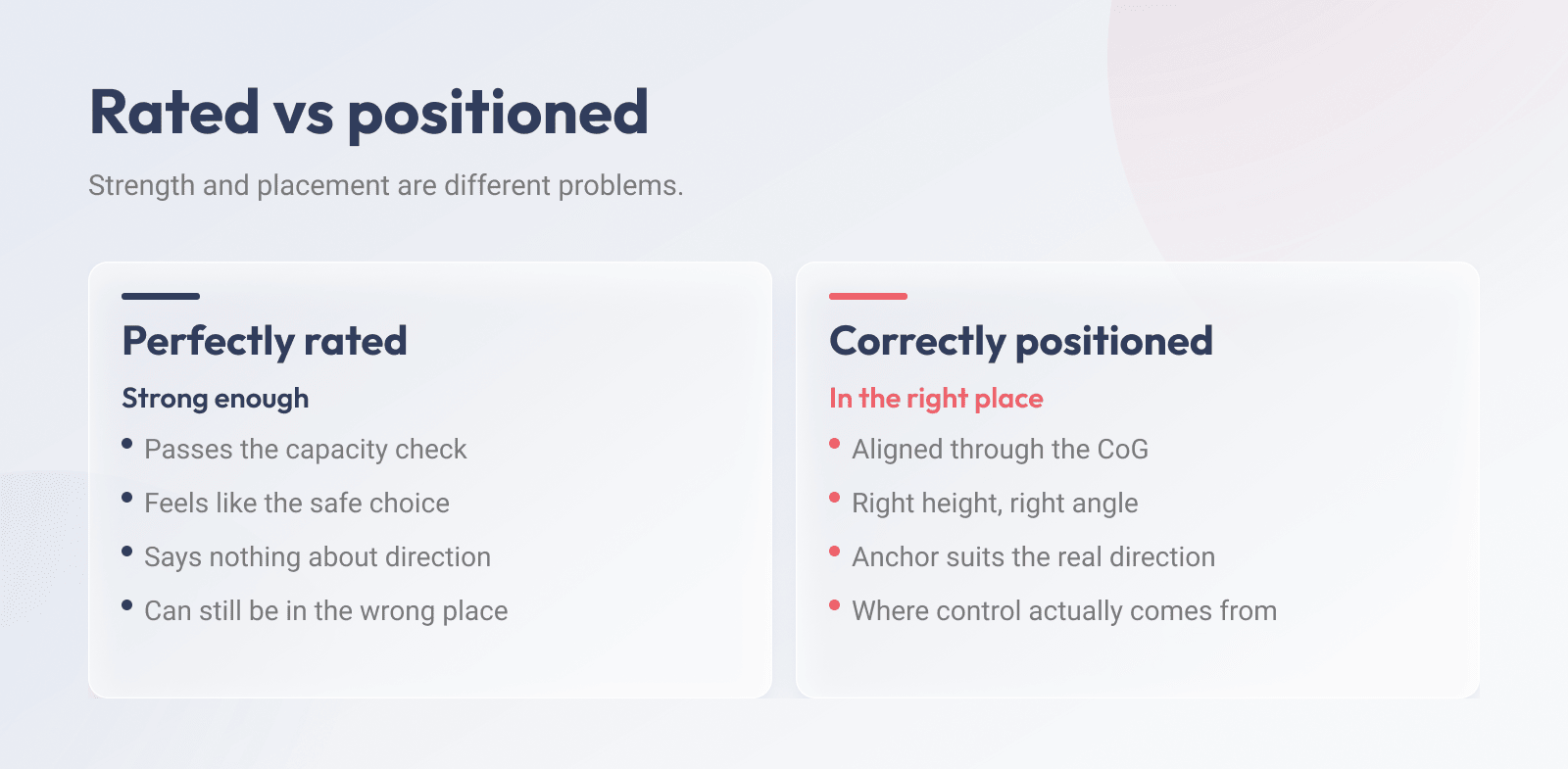
What is the difference between a rated pulling point and a correctly positioned one?
A rated point passes the capacity check, which says nothing about direction. A correctly positioned point is aligned through the center of gravity at the right height and angle, with an anchor that suits the real direction of force. Strength and placement are separate problems, and control comes from the second one.
Do Machinery Sliders eliminate pulling geometry problems?
No. They remove wheel steering components, but the machine can still rotate or load individual sliders unevenly if the pulling force is off-center or poorly angled. Pull direction relative to center of gravity matters regardless of the moving equipment underneath.
Trace the force before you add more of it
Machine, attachment, rigging, anchor, structure. Every link in that chain matters as much as the rating on the pulling device. The full specification is on the what are Machinery Sliders page, and sizes and pricing are in the store.
Machinery moving involves real risk of crushing injury, property damage, and equipment damage. This article is educational and does not replace an engineered rigging plan, the equipment manufacturer’s instructions, qualified supervision, or applicable workplace safety requirements. Consult a qualified engineer when pulling points, attachment structure, or center of gravity cannot be established with confidence.