
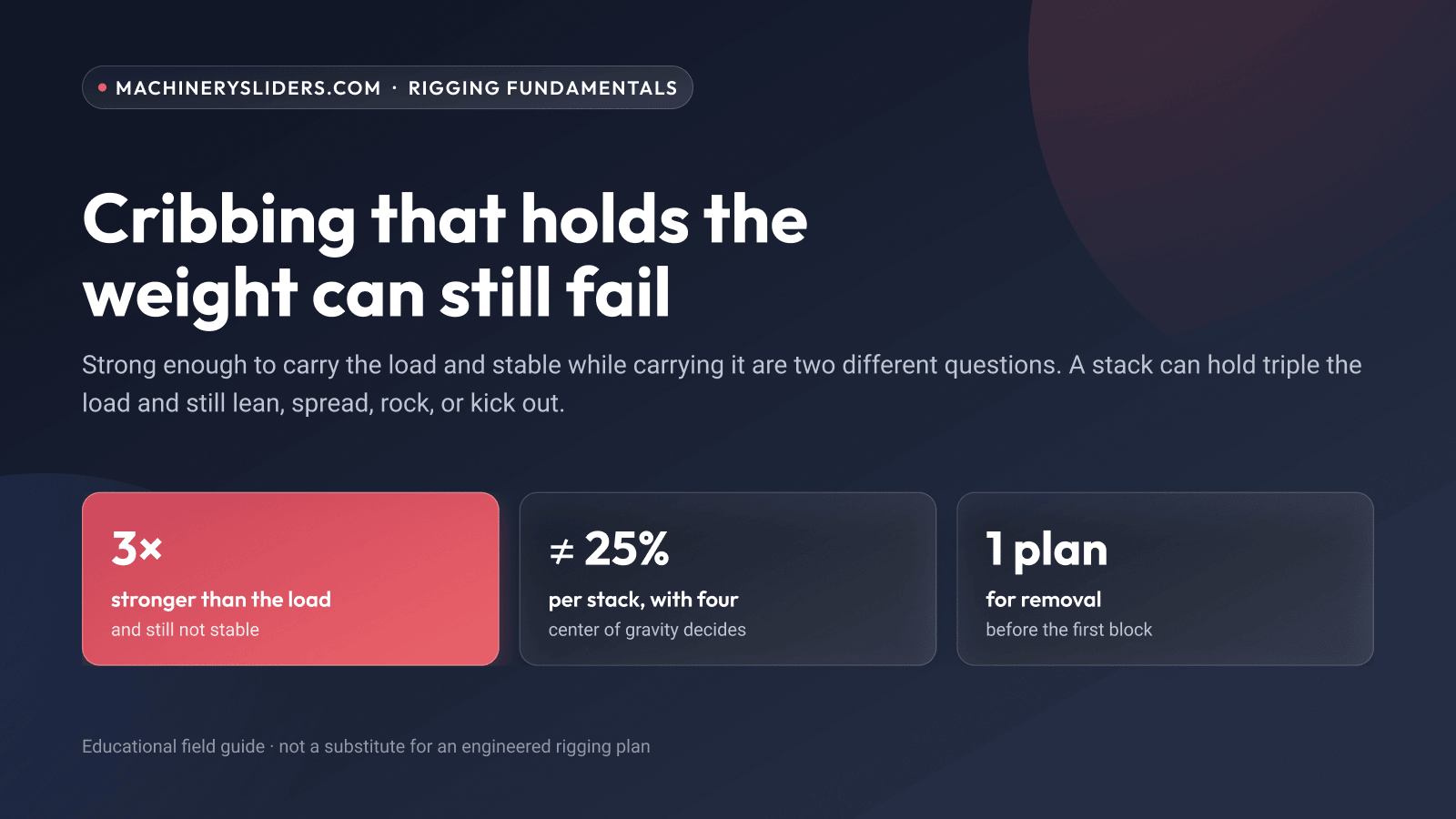
Direct answer Whether the cribbing material can carry the weight and whether the cribbing stack stays stable while carrying it are two genuinely different questions. A stack can be built from wood strong enough to hold three times the load and still lean, spread, rock, or kick out from underneath the machine because of stack geometry, an uneven floor, or an off-center reaction, none of which has anything to do with whether the wood itself would crush. Capacity answers whether the material fails. Stability answers whether the whole arrangement stays where you put it.
Cribbing is a temporary structure, not just pieces of wood
A completed stack has a foundation, a footprint, a height, load paths through every layer, and real stability limits. Those are the same properties any structural support has, just built for a few hours instead of a few decades.
The load travels through every single interface on its way down: machine, top layer, each layer beneath it, the floor. A problem at any one of those interfaces can compromise the whole support, which is exactly why “the wood can hold it” is not the same question as “the stack will hold it.”
Height changes the problem, not just the elevation
A steel column can carry enormous compression and still become unstable if you make it tall and slender enough. Cribbing follows the same broad principle. As a stack gets taller relative to its footprint, lateral stability matters more, regardless of whether the material itself is anywhere close to its load limit.
This is another reason never to lift higher than the operation actually requires. More height means a taller stack, a higher machine center of gravity, and more opportunity for any small movement to become a real instability. Machinery Sliders can help here directly, because their low profile can mean less lift is needed in the first place, which means shorter stacks, fewer layers, and a simpler support condition overall. The same logic runs through low clearance machinery moving, where the height you never have to create is the height you never have to support.
The bottom of the stack matters as much as the top
A perfect cribbing stack sitting on an inadequate foundation is still inadequate. Check what is actually underneath it before worrying about what is on top. A concentrated reaction hitting a small contact area at the bottom of the stack has to be carried by whatever is below, and the cribbing surviving perfectly does not mean the floor will.
On an uneven or sloped floor, the bottom block may only make partial contact, and as the machine settles that block can rotate, with every layer above it following along, sometimes all the way into a visibly leaning stack. Do not use the machine’s own weight to force an unstable stack into conforming with an uneven floor.
Full, flat contact at every layer matters more than it looks like it should. A block that appears flat can still have one small high spot that ends up carrying nearly the entire reaction at that layer. The apparent contact area and the actual contact area are not always the same thing, and that difference changes crushing and stability behavior in ways that are not visible just looking at the stack.
Inspect the cribbing itself before trusting its history
“We’ve used that piece for years” is a reason to inspect a block more carefully, not less. Check for cracks, splits, crushing, rot, deep gouges, or contamination before it goes under a heavy machine. The timber’s appearance today does not necessarily reveal what it has already been through: heavy compression, forklift impact, oil saturation, old nails, or previous splitting.
A professional cribbing inventory that is dimensionally consistent, inspected, and kept separate from general scrap lumber makes the whole operation more predictable than reaching for whatever wood happens to be lying around. Retire anything damaged completely rather than letting it drift back into rotation.
Interlocking layers changes how the stack behaves
Alternating layers, one row front to back, the next left to right, and so on, creates a broader, box-like structural stack than simply piling every timber in the same direction. That helps with lateral stability, load distribution, and resistance to spreading. That said, “it looks like a box crib” is not automatically the same as “it is safe.” The specific arrangement still needs to fit the actual load, material, height, and supporting surface in front of you.
Watch for low-friction interfaces the cribbing could slide against. Painted steel, an oily machine base, or polished concrete can let a structurally adequate stack slide even though it would never crush. Capacity does not prevent sliding. That is a separate problem the support arrangement needs to address on its own.
The load needs to actually sit over the stack
A beautiful cribbing stack with the machine reaction sitting near one edge is carrying an eccentric load. One side compresses more than the other, and stability keeps decreasing the farther that reaction sits from center. The footprint only helps if the load actually acts within it.
This connects to the same load distribution reality covered in the machinery skates specification guide: four cribbing stacks under a machine do not automatically carry 25 percent each any more than four skates do. Center of gravity and frame stiffness determine the real split, and one stack can end up carrying far more than the others.
The machine support point matters too. Perfect cribbing under sheet metal, a coolant pan, or a thin enclosure member is still supporting the wrong thing. Identify the actual structural member and follow its load path down, not just the nearest convenient surface. And if stacks end up at different heights, that is not only a cribbing stability question anymore. It becomes a frame distortion risk, where uneven temporary support can twist a long or precision machine without ever tipping it.
Wedges solve one problem and can create another
A wedge fills a controlled gap or makes a fine adjustment. That is useful, but it also creates an inclined interface, which introduces horizontal force and a sliding tendency that a flat block does not have. Use wedges deliberately, as part of a planned support system, not as an improvised fix.
If a small adjustment turns into a tower of thin plates, wood scraps, and miscellaneous wedges stacked together, that is a sign to stop and rebuild the support properly rather than keep adding to an increasingly complex, increasingly unpredictable interface.
A stack built for vertical support may not resist horizontal force
Cribbing is usually strongest carrying the compressive load it was built for. The moment a forklift starts pulling on a machine that is still bearing against cribbing, horizontal force enters the picture, and that force can shift blocks, rack the stack, or move the machine relative to its support in ways the vertical capacity never accounted for.
Know what is supporting the machine and what is actually restraining it before applying any horizontal force. A stack that comfortably carries 20,000 lb straight down was never necessarily built to resist thousands of pounds sideways.
The jack is a lifting device. The cribbing is your safety support.
Once the machine reaches height, secure it. Do not leave it resting on hydraulic pressure alone. Hydraulic systems can leak, bypass, settle, or fail. For larger lifts, build support incrementally: lift a controlled amount, crib it, secure it, then continue. Keeping the secured support close to the load minimizes how far anything could travel if a lifting component ever failed.
Hands are especially vulnerable during this exact process, since cribbing naturally tempts people to reach underneath the machine right when it is least supported. Use tools and methods that keep hands and bodies out of the crush zone, and never try to shove a block under a machine that has already started moving. Nobody reacts faster than a settling industrial machine. The same discipline applies to any lift where a forklift is not available, which is covered in how to move heavy machinery without a forklift.
Support reactions keep changing during load transfer
As a machine moves from cribbing onto skates or sliders, the split between the two support systems changes continuously. Cribbing carries nearly everything at first, then shares the load, then carries nothing at all once the transfer completes. The cribbing arrangement has to remain stable through that entire transition, not just at the beginning and the end of it.
Do not assume a block that feels loose is actually free. A small change in jack height or machine geometry can reload it instantly. Wiggle it, find it loose, and a moment later another jack lowers slightly and that same block is carrying thousands of pounds again. Keep hands out of the load path until a block is genuinely, verifiably free to remove.
Plan the removal sequence with the same care as the build sequence. Access that is wide open while raising the machine can disappear entirely once it is in final position: a wall closer than expected, equipment already installed, the forklift already gone. Think through how every layer comes back out before the first block ever goes in, not once you are standing there trying to figure it out.
For anything with more than one or two support points, label them, A/B/C/D or front-left/front-right/rear-left/rear-right, before the lift starts. “Hold B, lower A a quarter inch” is a clear instruction. “Lower that one a little” is not, and the moment you are coordinating several people around a loaded stack is the worst possible time to be relying on vague pointing and hoping everyone means the same corner.
One more dynamic is worth watching: the machine’s resistance to movement can change mid transfer, not just its support reactions. Going from high friction cribbing onto low resistance skates can make the machine noticeably easier to move before the cribbing is even fully clear, and the reverse happens moving the other direction, where skates rolling easily suddenly meet resistance as cribbing starts taking load. If pulling force is still being applied during either transition, that changing resistance can introduce horizontal load into supports that were never meant to take it. Know which system is actually carrying the load at each moment, not just which ones are technically still in contact. The behavior differences between the two are set out in machine skates versus dollies versus Machinery Sliders.
A stack performing perfectly under partial load does not prove it will perform under the full load. If a crane, forklift, or jack is still carrying even 10 percent of the machine’s weight while the cribbing looks flawless, with no compression, no movement and no lean, that is not the real test. The moment that remaining support fully releases, the cribbing has to accept the entire reaction, and that final increment is sometimes exactly when a block crushes or a stack settles that looked completely fine a moment earlier. Unload the last piece of supporting rigging gradually and watch the stack’s response the whole way, rather than releasing it all at once and finding out after the fact.
Tensioned rigging can also store real energy even while the machine looks completely stationary. A chain, sling, or hydraulic system under load does not release that tension just because nothing appears to be moving. When that tension finally comes off, the resulting settlement or shift can happen with no warning. Keep hands and bodies clear of the load path during this final release, the same as during the initial lift.
What a stack is telling you
Cracking, popping, crushing, leaning, or rocking are the stack communicating that something is wrong, not background noise to work around. Do not try to straighten a leaning, heavily loaded stack by kicking, hammering, or prying it. The load needs to come under control through a planned method, not a physical correction applied by hand.
If one block starts crushing, stop and find out why before simply adding another block beside it. Excessive load, poor material, a small contact area, or edge loading are all real possibilities, and none of them get fixed by adding capacity next to the actual problem.
Before placing machinery on temporary cribbing
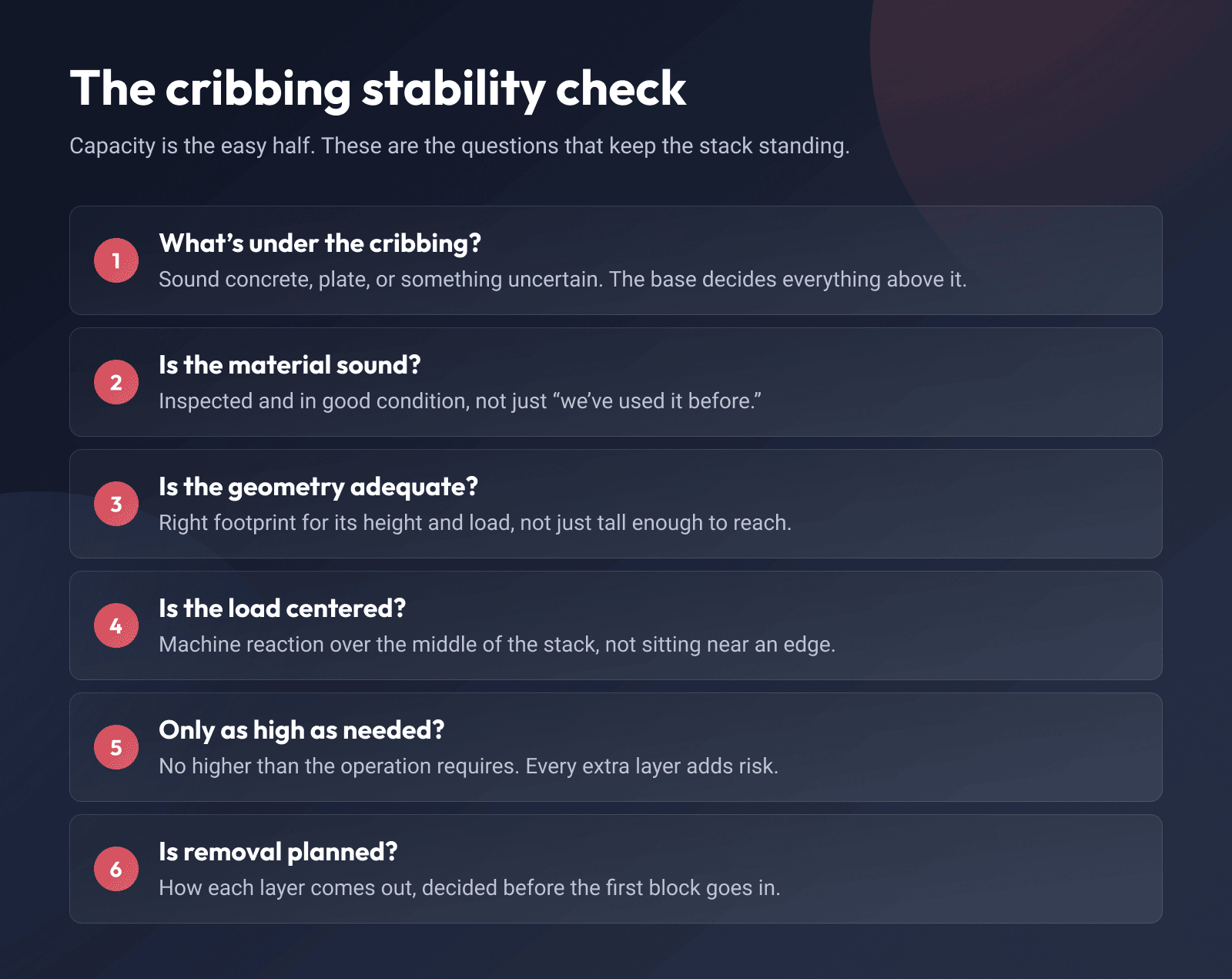
- What is actually under the cribbing? Sound concrete, plate, or something uncertain?
- Is the material inspected and in good condition, not just “we have used it before”?
- Is the stack geometry adequate for its height and load, not just tall enough to reach?
- Is the machine reaction centered over the stack, or sitting eccentrically near an edge?
- How high does the machine actually need to go, no higher than the operation requires?
- How will each layer be removed, planned before the first block goes in?
When to stop and reassess
Stop if cribbing begins leaning, a block splits or shows crushing, the stack rocks, or the support arrangement no longer matches the plan. “It has held so far” is not the question. Whether it stays stable through the next load change is.
When to call a qualified rigger or engineer
Get specialist input when the machine is extremely heavy, cribbing needs to be unusually tall, the machine’s center of gravity is high, or floor capacity underneath the stack is questionable. Temporary does not mean unimportant. For a few critical minutes the cribbing may be the only thing standing between the machine and the floor, and it deserves to be treated with exactly that level of seriousness.
Frequently asked questions
Is cribbing safe just because the wood is strong enough to hold the weight?
No. Material capacity is only one factor. The complete stack also has to remain stable. Geometry, floor contact, load placement, and material condition all matter independently of whether the wood itself would ever crush.
Can I leave a machine supported only by a hydraulic jack?
No. A raised load should be secured with cribbing or blocking rather than relying on hydraulic pressure alone, since hydraulic systems can leak, bypass, or fail without warning.
Can four cribbing stacks be assumed to each carry 25 percent of the machine’s weight?
No. Actual reactions depend on the machine’s center of gravity, frame stiffness, and support geometry. One stack can end up carrying substantially more than the others, the same way skates do not automatically share load equally either.
Can uneven cribbing height distort a precision machine?
Yes. Unequal temporary support elevation can twist a long or precision machine’s frame without ever causing it to tip, which is why matching stack heights matters beyond basic stability.
Do Machinery Sliders eliminate the need for cribbing?
No. Cribbing or blocking may still be required while lifting or installing the moving equipment. Their low profile can reduce how high the machine needs to be raised, which can mean shorter, simpler stacks, not the elimination of cribbing itself.
What is the difference between cribbing capacity and cribbing stability?
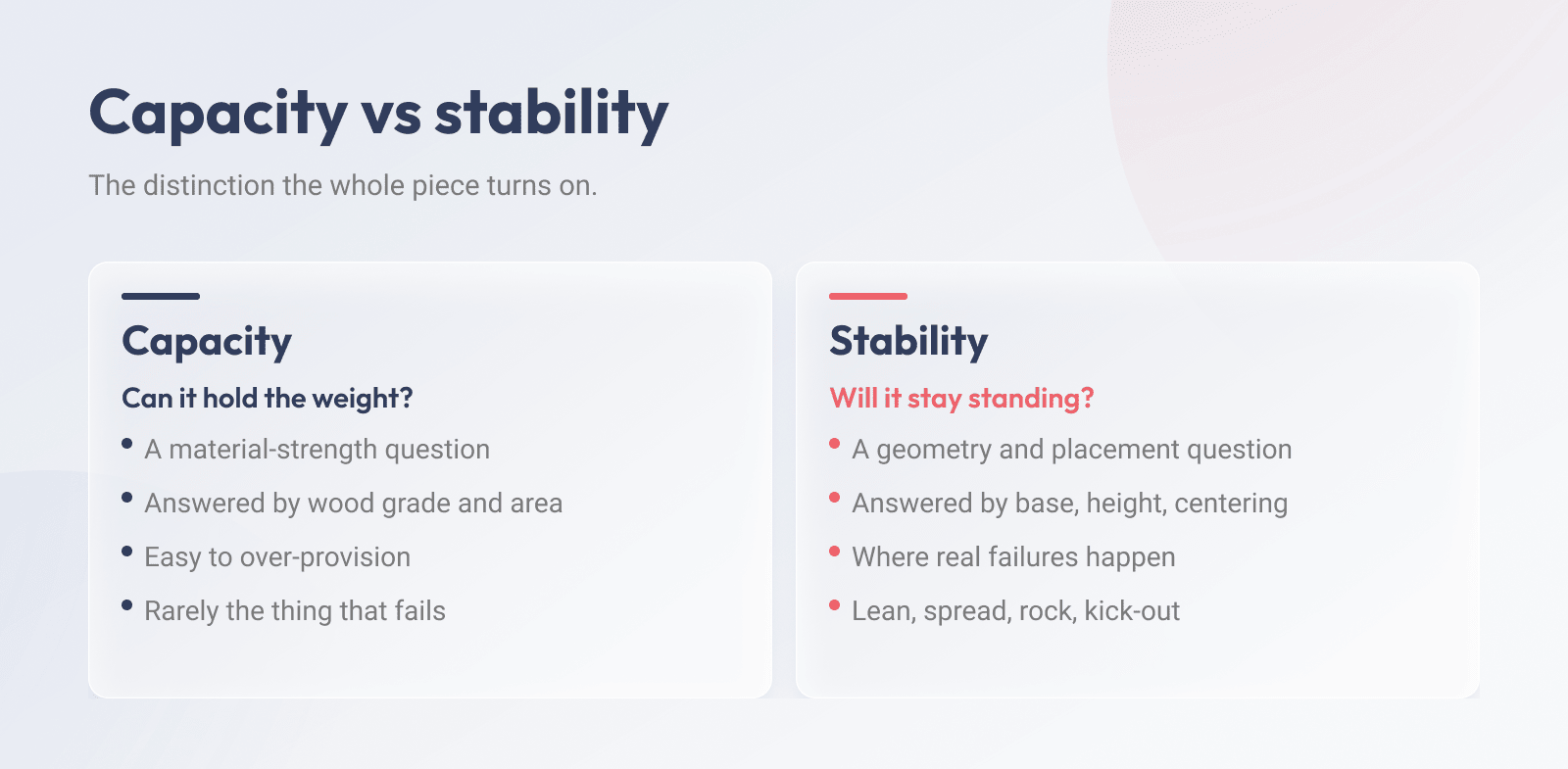
Capacity is a material question, answered by wood grade and contact area, and it is easy to over-provision. Stability is a geometry and placement question, answered by the base, the height, and where the load sits. Real failures are far more often stability failures: lean, spread, rock, or kick-out.
Less height, fewer layers, one less thing to get wrong
Reducing how far the machine needs to rise simplifies the whole temporary support problem, not just the moving equipment underneath it. The full specification is on the what are Machinery Sliders page, and sizes and pricing are in the store.
Machinery moving involves real risk of crushing injury, property damage, and equipment damage. This article is educational and does not replace an engineered rigging plan, the equipment manufacturer’s instructions, qualified supervision, or applicable workplace safety requirements. Consult a qualified rigger or engineer when machine weight, center of gravity, or floor capacity beneath the cribbing cannot be established with confidence.