
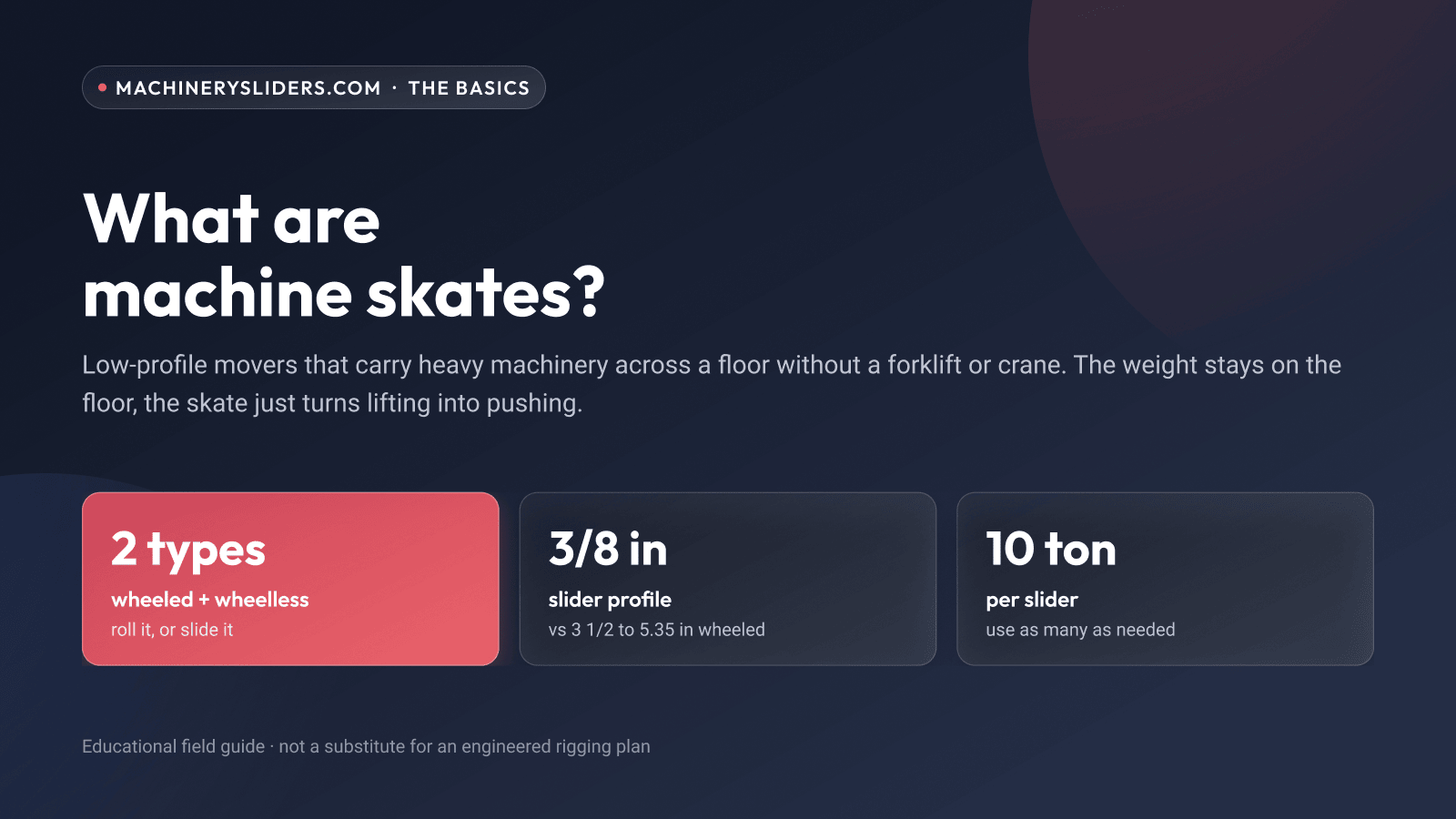
Direct answer Machine skates are low-profile movers that carry heavy machinery across a floor without a forklift or crane. Traditional skates are steel frames on rollers that lift the load 3 1/2 to 5.35 inches and roll it. Machinery Sliders are low-profile machine skates of a different kind: solid engineered-plastic pads with no wheels that slide the load at just 3/8 inch off the floor. Both do the same job, which is to move a machine that is too heavy to lift, by keeping its weight on the floor.
If you have searched “machine skates,” you are looking for a way to move a heavy machine across a shop without picking it up. This page explains what machine skates are, the two main types, and how to choose, in plain terms, before you spend anything.
The short definition
A machine skate is a device you place under a heavy machine so it can be pushed or pulled across the floor instead of lifted. The machine’s weight stays on the floor the whole time. The skate turns the problem from lifting into pushing, and that is why a machine no forklift can lift can still be moved by a small crew.
The two types of machine skate
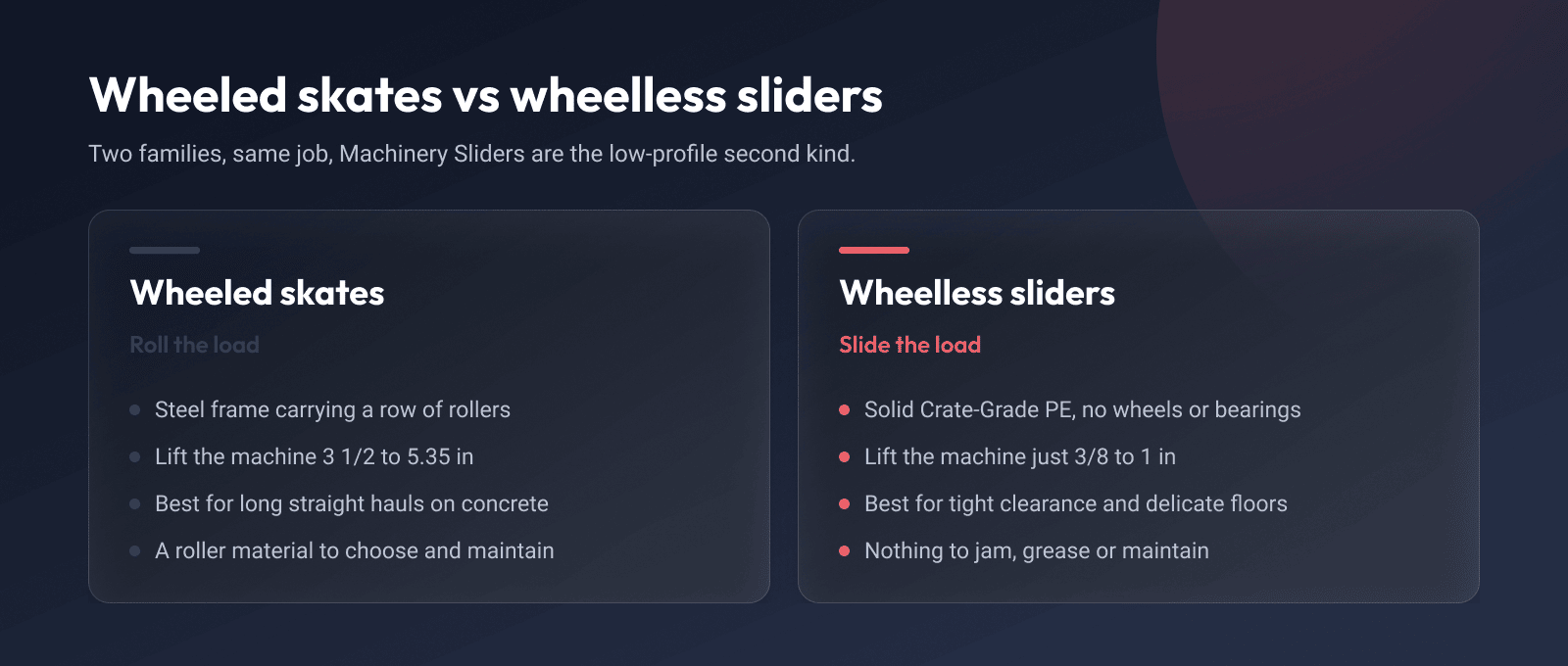
Everything sold as a “machine skate” falls into one of two families:
- Wheeled skates. A steel frame carrying a row of rollers in steel, nylon or polyurethane. They roll the load and lift it 3 1/2 to 5.35 inches off the floor. Best for heavy, repeated, straight-line moves on sound concrete. Which roller material to pick is covered in steel vs nylon vs polyurethane rollers.
- Wheelless sliders. Solid engineered-plastic pads with no wheels, axles or bearings. They slide the load and lift it just 3/8 inch to 1 inch. Best for tight clearance, delicate floors, top-heavy machines and container loading.
Machinery Sliders are the second kind, low-profile machine skates that slide rather than roll. Same job, different method, and a far lower profile.
How machine skates work
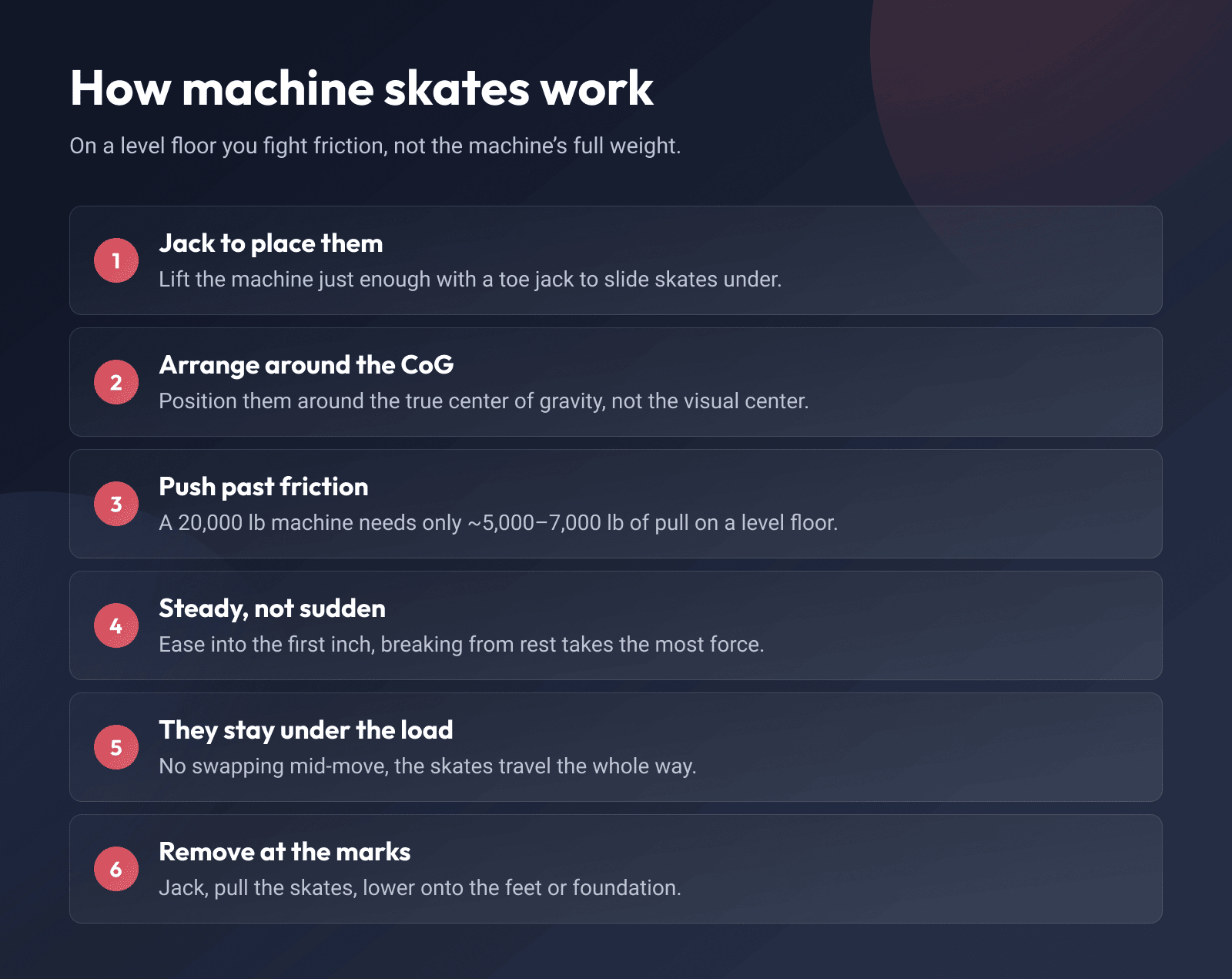
On a level floor you are not fighting the machine’s weight, only friction, which is a fraction of it. You lift the machine just enough with a forklift or toe jack to place the skates under it, arranged around its center of gravity or under the columns, then push or pull.
A 20,000 lb machine needs only about 5,000 to 7,000 lb of horizontal force to move on skates, which is why hand-powered gear or a forklift pushing can move machines rather than lifting them. The arithmetic behind that, and how floor condition changes it, is set out in how much force it takes to move a machine. The skates stay under the load the whole way and come out once it is on its marks.
Which type do you need?
A quick way to decide:
- Long straight hauls across sound, smooth, clean concrete, moved often: wheeled skates.
- Low clearance, delicate floors, top-heavy loads, rough concrete, carpet, tile, asphalt, or container loading: wheelless Machinery Sliders.
Each Machinery Slider carries roughly 10 tons, sits at 3/8 inch for the single-direction pad or 1 inch for the multi-directional one. For the full head-to-head with dollies and rollers, see machine skates versus dollies versus Machinery Sliders. To size a set and check per-skate ratings, the specification reference is the machinery skates guide.
Frequently asked questions
What are machine skates used for?
Moving heavy machinery across a floor without a forklift or crane. You place them under a machine, then push or pull it. The machine’s weight stays on the floor the whole time, so a load too heavy to lift can still be moved.
Are Machinery Sliders machine skates?
Yes. They are low-profile machine skates that slide rather than roll. Instead of a steel frame on wheels, they are solid engineered-plastic pads with no wheels or bearings, sitting just 3/8 inch off the floor.
How much weight can a machine skate move?
Wheeled skates span roughly half a tonne to 100 tons per skate depending on the model. Each Machinery Slider carries about 10 tons, and you use as many as the machine’s weight requires. Divide the weight by 20,000 lb and round up, then size on the most heavily loaded corner rather than the total.
What is the difference between rolling and sliding machine skates?
Wheeled skates roll the load on rollers and lift it 3 1/2 to 5.35 inches. Wheelless sliders slide the load on a broad pad and lift it just 3/8 to 1 inch, which means a lower profile, gentler treatment of the floor, and no bearings to maintain.
Do I need a forklift to use machine skates?
No. On a level floor you only overcome friction, so a come-along, chain hoist or a forklift pushing can move the load. You do need a way to lift the machine slightly, a toe jack or forklift, to place the skates underneath.
What is the lowest profile machine skate?
Among wheeled skates, 3 1/2 inches at a capacity most people can use, on Vestil’s MDSKT-2 and Beacon’s BVHMS-2. The absolute lowest in any manufacturer catalogue is 3 7/16 inches, on Hilman’s N.5-SP at half a tonne. A wheelless single-direction Machinery Slider sits at 3/8 inch, roughly nine times lower, because there is no wheel or deck to lift the load.
Where to go next
If you know you need the low-profile kind, the full specification is on the what are Machinery Sliders page, and sizes and pricing are in the store.