
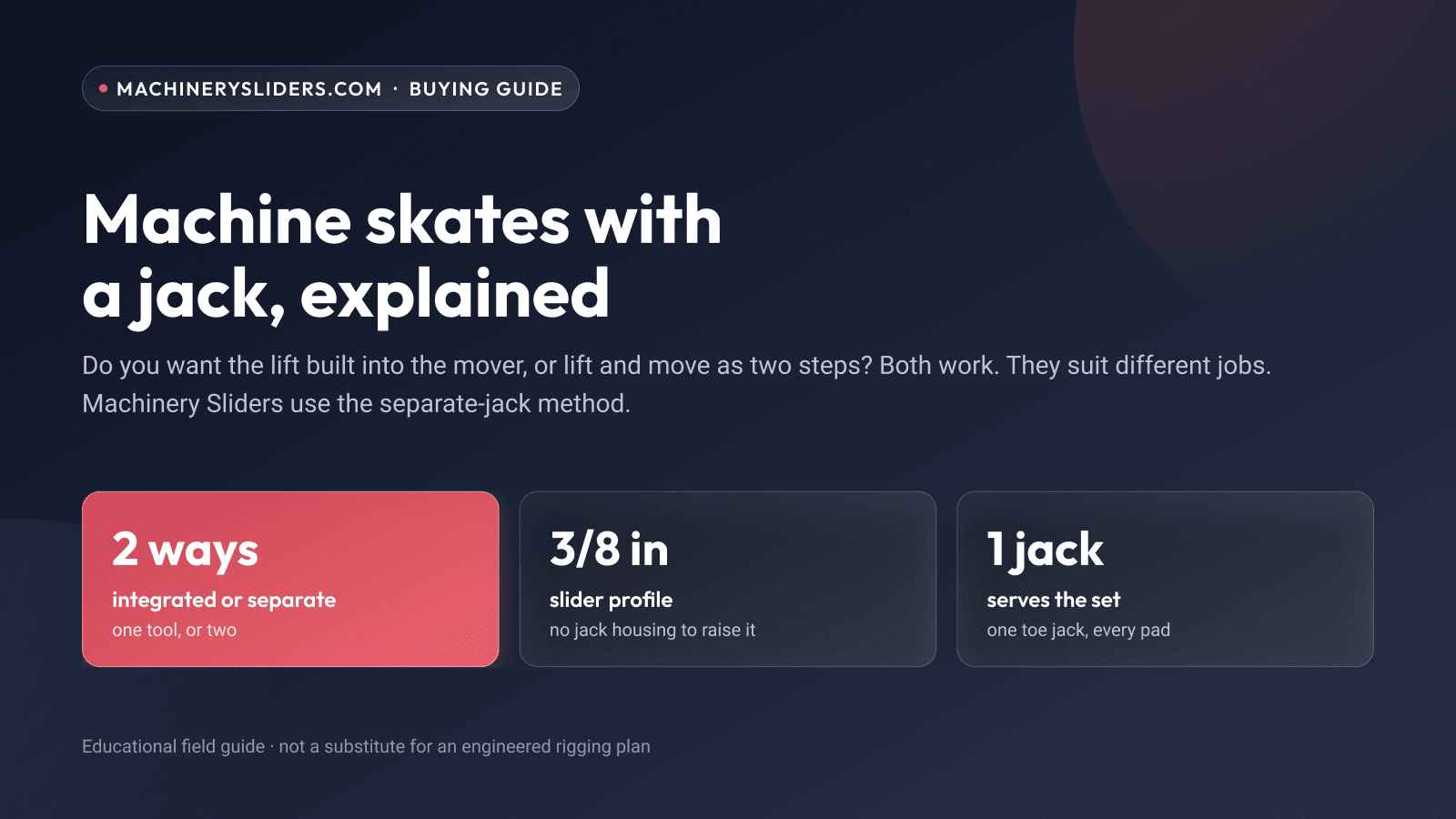
Direct answer Some machine skates build a lifting jack into the skate itself, so one tool both raises the machine and carries it. Others keep the two jobs separate: you lift with a toe jack, then place the mover. Machinery Sliders use the separate method. You raise the machine just enough with a toe jack, slide the Crate-Grade PE pads underneath, and pull the jack out. That keeps each slider low, at 3/8 inch to 1 inch, cheap, and simple, with no hydraulics to maintain. Integrated-jack skates suit repeated in-place lifts. Separate sliders suit low clearance, delicate floors, and moving many points at once.
If you have searched “machine skates with jack,” you are weighing one real decision: do you want the lift built into the mover, or do you want to lift and move as two separate steps. Both work. They suit different jobs. This guide explains the difference honestly, including where Machinery Sliders fit and where they do not. If you are still working out what these tools are, start with what are machine skates.
Two ways to lift and move
Every machine move has the same two phases. First you lift the machine a little, enough to get a mover underneath it. Then you move it. The question is whether one tool does both, or two tools each do one.
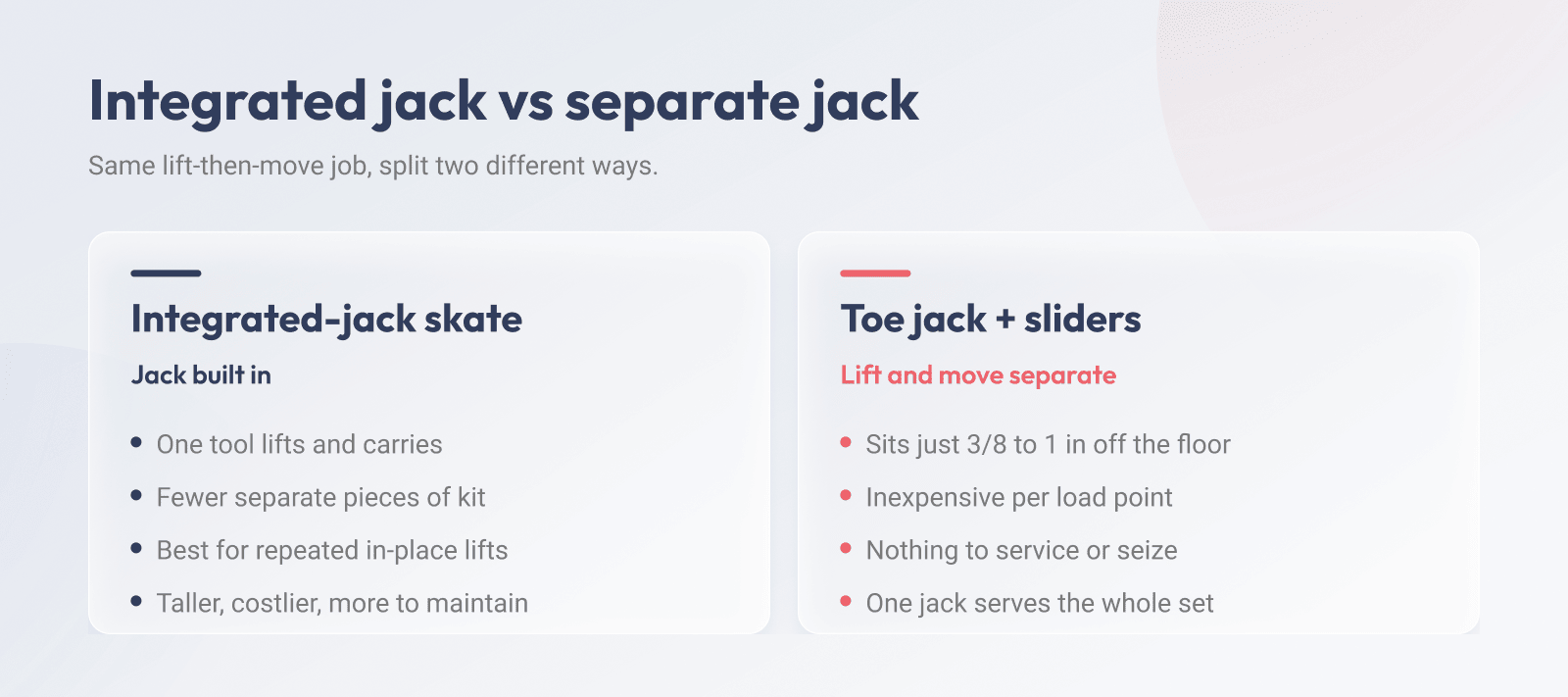
- Integrated-jack skates. The jack is part of the skate. You position the unit, raise the machine with the built-in jack, and the same unit then carries the load. Fewer separate tools, and handy when you lift the same machine in place again and again.
- Separate lift and mover. A toe jack does the lifting, a low pad does the carrying. You raise the machine just enough to slide the pad under, then remove the jack. This is how Machinery Sliders work.
How the separate method works with sliders
The workflow is short and needs no hydraulics in the mover itself:
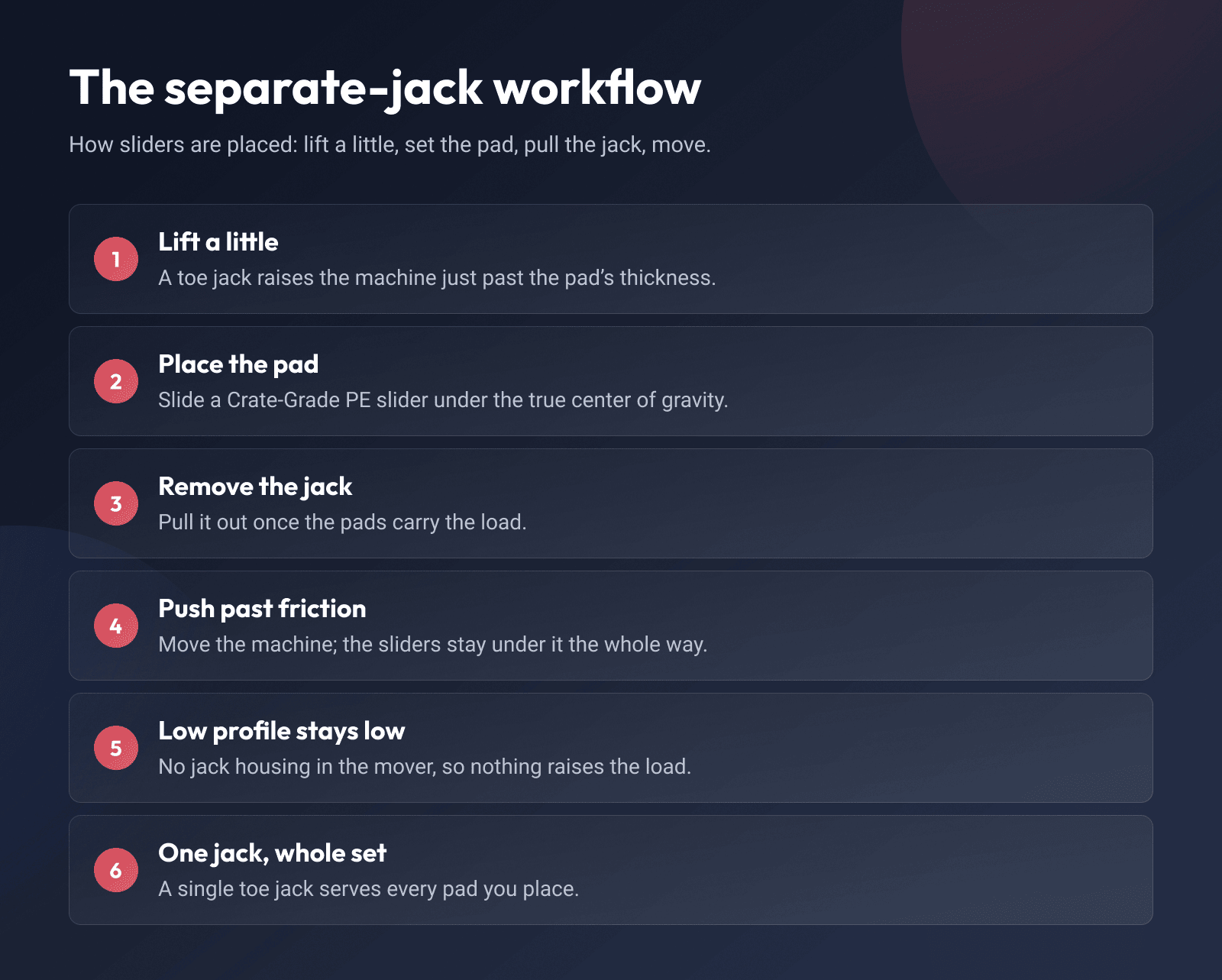
- Lift a little. A toe jack raises the machine just enough to clear the pad, usually barely more than the pad’s own thickness.
- Place the pad. Slide a Crate-Grade PE slider under the load, arranged around the true center of gravity.
- Remove the jack, then move. Pull the jack out and push or pull the load. The sliders stay under the machine the whole way and come out once it is on its marks.
Two parts of that workflow deserve their own attention. The jack is a lifting device, not the thing that holds the machine up while you work underneath it, which is covered in cribbing stability. And a toe jack needs room for its body and its full handle swing, not just room for the toe, which is the point of working clearance.
Why separate can be the better choice
Building a jack into the mover adds height, cost and moving parts. Keeping them separate avoids all three, which matters more than it sounds:
- Lower profile. A slider sits 3/8 inch for the single-direction pad and 1 inch for the multi-directional one. An integrated-jack skate has to house a jack, so it sits taller, raising the machine’s center of gravity.
- Lower cost per point. Sliders are inexpensive, so putting one under every load point is affordable. Integrated-jack units cost more each, so covering many points gets expensive fast.
- Nothing to maintain. No hydraulics or bearings in the mover means nothing to service, seize or leak. One toe jack serves an entire set of pads.
- Many points at once. A heavy machine needs its weight spread across several movers. It is far cheaper to place eight sliders than eight integrated-jack skates.
When an integrated-jack skate makes more sense
Honesty first: the integrated approach is genuinely better for some jobs. If you lift and reposition the same machine repeatedly, in the same spot, having the jack built in saves setup every time. If you only ever move on sound, level concrete and want the fewest separate pieces of kit, an integrated unit is convenient. Sliders are the wrong tool for a job that is really about repeated in-place lifting rather than travel.
Which should you buy?
A quick decision:
- Repeated in-place lifts, sound concrete, few load points: pick integrated-jack skates.
- Low clearance, delicate floors, top-heavy loads, or many points to support: pick a toe jack plus Machinery Sliders.
A set of four Machinery Sliders starts at $142.97, and one toe jack serves the whole set. To size how many pads you need and check per-skate ratings, see the machinery skates guide. For how much force the move will actually take once the pads are under it, see the force required to move a machine. For the full mover comparison, see machine skates versus dollies versus Machinery Sliders.
Frequently asked questions
Do machine skates come with a jack?
Some do. Integrated-jack skates build the lift into the mover. Others, including Machinery Sliders, keep lifting and moving separate: you lift with a toe jack, place the pad, then remove the jack before moving.
Do Machinery Sliders have a built-in jack?
No. They are solid Crate-Grade PE pads with no hydraulics or moving parts. You lift the machine with a separate toe jack just enough to place the sliders, which keeps each pad low, inexpensive and maintenance-free.
What is the advantage of a separate jack and mover?
Lower profile, lower cost per load point, and nothing to maintain in the mover. One toe jack serves an entire set of pads, so covering many load points on a heavy machine stays affordable.
When is an integrated-jack skate better?
When you lift and reposition the same machine repeatedly in one spot, or you want the fewest separate tools for moves on sound, level concrete. For those jobs the built-in jack saves setup each time.
How do you lift a machine to place skates under it?
With a toe jack, which slips under a low edge and raises the machine a small amount, usually just past the thickness of the mover. You place the pads around the center of gravity, remove the jack, and move.
How much clearance does a toe jack need?
More than the gap its toe fits into. The jack body has to clear, the handle needs its full swing, and the operator has to be able to reach it from a safe position. A machine can sit a few inches from a wall with plenty of room for the toe and still leave no room to work the jack.
One jack, a set of pads
If the job is travel rather than repeated in-place lifting, the separate method is cheaper per load point and lower under the machine. The full specification is on the what are Machinery Sliders page, and sets are in the store.