
Machinery Moving Safety:
5 Controls That Reduce Risk
Home » Technical Library » Five Controls That Reduce the Risk of Moving Heavy Machinery
By Machinery Sliders™ Technical Team|Drawing on industry background in machinery rigging and moving equipment|Last Updated: November 8, 2026
Direct Answer: Moving the Machine Is Not the Objective. Keeping Control Is.
Machinery moving safety rests on five controls that work together: understand the machine and its load path, verify the whole route including the floor, control movement and stopping, keep people out of the line of fire, and run one coordinated plan with the authority to stop. None of them substitutes for another. A useful test before any move: what could move, shift, break, or fail unexpectedly, and who or what would be in its path?
This guide is educational. It does not replace manufacturer instructions, applicable safety requirements, qualified engineering, or a site-specific move plan.
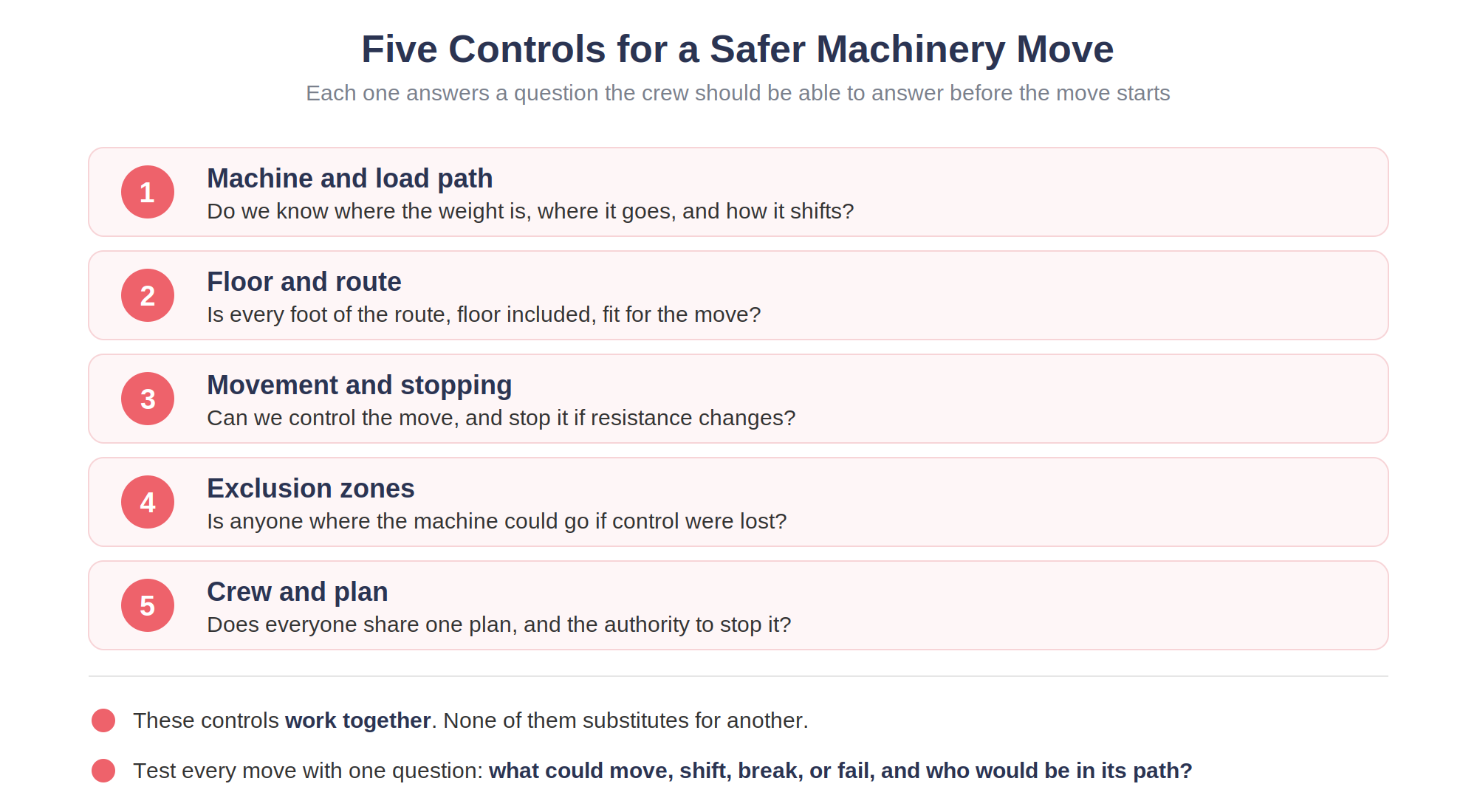
Machinery moving safety is not about distance. A machine may travel only 20 feet, yet in those 20 feet a crew can meet more serious hazards than the machine saw in 20 years of operation. The goal is not merely to move it, but to move it without losing control of the load, exposing people to dangerous forces, or damaging the equipment and the building.
1. Understand the Machine Before Applying Force
A 40,000 lb machine on four skates does not put 10,000 lb on each one. A heavy motor or casting shifts the weight, and loads change again on an uneven floor or in a turn. See why four skates rarely share weight equally and how a level machine can still shift load. The center of gravity also rarely sits mid-base, so a tall machine or one with an offset head can be less stable than its weight suggests.
The load path matters too: from the machine’s structure through its support points and the moving equipment into the floor. A jack under a coolant pan or cosmetic skirt can fit perfectly while pressing on a part never meant to carry the machine, and a rated device does not make the spot above it a rated spot (bearing pressure). Capacity and stability are different questions
Illustration: raising one corner to install a skate changes the reactions at the other supports, and an already heavy one can end up overloaded. Corner jacking shows the math.
2. Verify the Entire Route, Especially the Floor
The floor is part of the rigging system. A slab that safely carries a machine in place can behave differently under the concentrated load of a jack or skate wheel, and a temporary steel plate spreads load only if it and its supports are suitable (bridge plates). Walking the whole route can reveal joints, cracks, trenches, slopes, coatings, thresholds, and tight clearances. Small things stop loaded skates: a small floor joint can stop heavy machinery, a dry-looking floor can still be slick, and clearance covers more than the machine’s width.
The destination deserves the same attention: lowering, leveling, and removing jacks and cribbing can expose people to an uncontrolled load (the last quarter inch). Suspended floors, freight elevators, and questionable slabs may need engineering evaluation.
3. Control the Movement and Plan How to Stop It
A pulling arrangement can overcome resistance and still be unable to stop the load, especially on ramps, slopes, and surface transitions. Starting a heavy load often takes more force than keeping it moving, so a machine can break free and travel farther or faster than intended (the first inch needs its own plan). Pulling harder against unexpected resistance can make the problem worse; the cause may be a trapped wheel, a binding slider, a shifted support, or an anchor still holding. A sudden drop in resistance is a warning sign too, and stored energy in the line can carry the machine farther than planned.
The pulling system is more than the forklift. Attachment points, connectors, lines, anchors, and the direction of pull all count, and a strong anchor can pass destructive force into the structure behind it (rigging anchors). A forklift’s lifting rating is not a pushing or towing rating (moving machinery with a forklift), and friction alone is not a reliable way to hold or brake a load.
4. Keep People Out of the Line of Fire
A heavy machine does not need to fall to cause a crush injury. A small movement is enough when a hand, foot, or body sits between the machine and a wall, column, or doorway, beneath an inadequately supported load, around jacks and cribbing, or near tensioned lines. The most effective protection is removing the exposure: remote observation, planned access, barriers, and exclusion zones based on the actual hazards. A hydraulic jack alone should not be relied on to protect a person beneath a raised machine, and a jack can walk or tilt while the machine looks still. PPE has its place, but it cannot reliably protect a worker caught between a machine and a concrete wall.
Illustration: a crew member reaches between the base and a wall to guide the last inch by hand. The machine shifts slightly and the clearance disappears. The hazard was not the distance traveled. It was the worker’s position.
5. One Plan, Clear Communication, and the Authority to Stop
Experience does not replace coordination. A crew of skilled forklift operators, riggers, and millwrights can still be working from different plans: one expects a straight move, another a turn, and the forklift operator may not see a support begin to shift. A pre-move briefing, a named person directing the move, a signal person where needed, and an emergency-stop signal everyone knows keep the crew on one plan.
Common stop-work conditions include:
- A support shifts, unloads, or becomes unstable.
- The machine tilts, rotates, or moves differently than planned.
- A jack, plate, floor, or structural member shows distress.
- Pulling force rises unexpectedly, or a wheel or slider behaves abnormally.
- A worker enters a hazardous area, or communication is lost.
A stop should start an assessment, not a pause before more force is applied. A deadline does not change the center of gravity, strengthen the floor, or raise the capacity of a pulling connection.
Remove Hazards Before Relying on People to Avoid Them
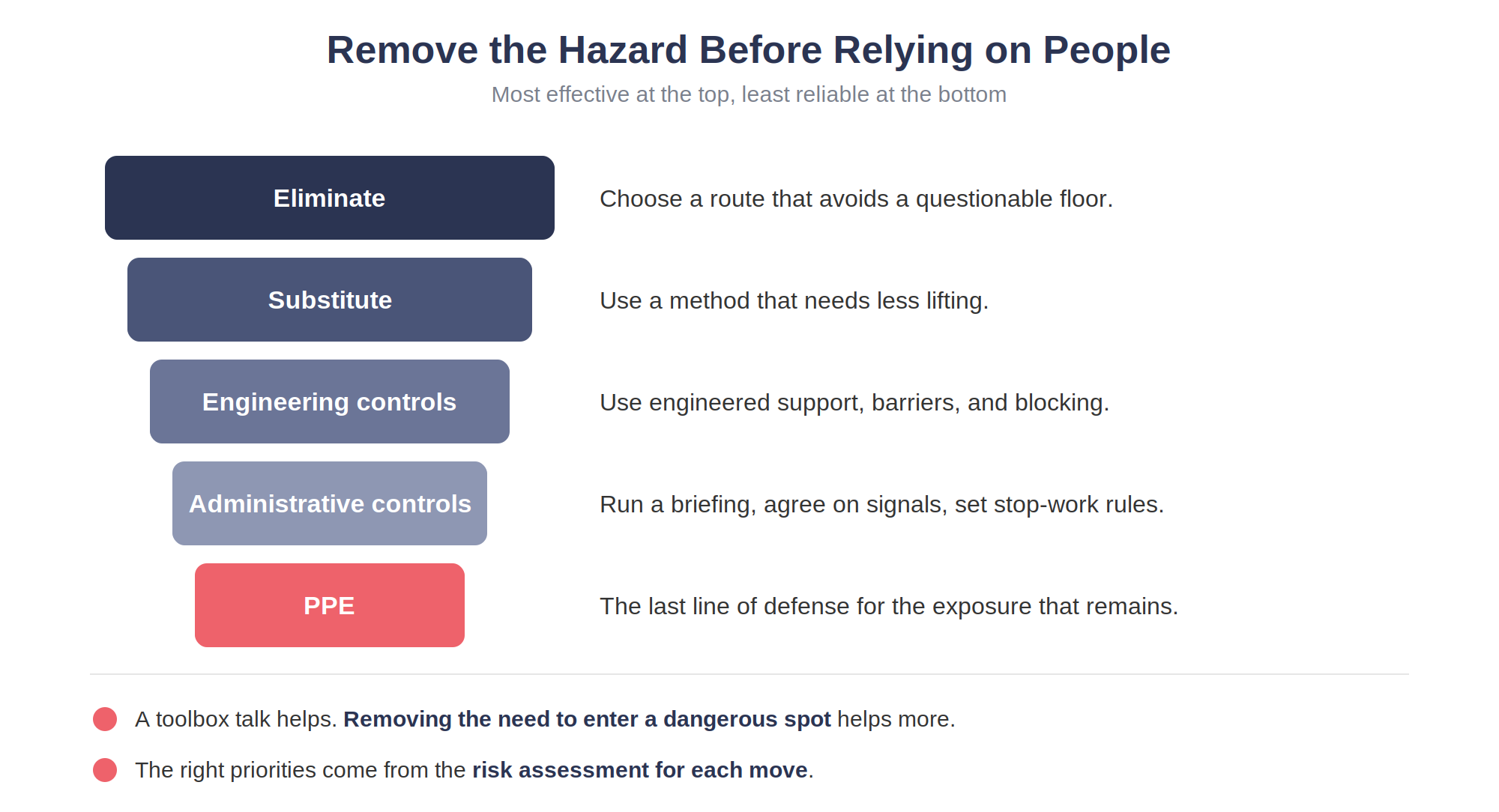
The five controls follow the Hierarchy of Controls: eliminate the hazard, substitute a less hazardous method, use engineering controls, apply administrative controls such as procedures and communication, and use PPE for what remains. For a move, that can mean a route that avoids a questionable floor or an arrangement where nobody stands in a pinch point. The priorities come from the risk assessment for that move.
Equipment Choice Is Part of Machinery Moving Safety
Machinery skates, dollies, Machinery Sliders, air casters, forklifts, and cranes each have appropriate uses, and no single method is safest for every move. Machinery Sliders are nonmetallic and slide instead of rolling, and their low profile can reduce lifting height where clearance is limited. But sliding brings its own friction and pulling-force requirements, and the floor, load distribution, and means of control still have to be evaluated. See how they compare with dollies and skates and how they reduce risk.
Questions to Ask Before a Move
These are discussion prompts for a pre-move talk. They are not an approval, and they do not replace a site-specific plan.
- The machine: are its weight, center of gravity, and support points known, and has load redistribution been considered?
- The route: has the whole route, floor included, been inspected, and is the lowering and removal planned?
- Movement: can the load be controlled and restrained if resistance changes, and do the attachments and anchors suit the load?
- People: where could the machine go if control were lost, and is anyone in that path?
- The crew: does everyone share one plan, know the stop signal, and have the authority to use it?
When Engineering or Manufacturer Guidance May Be Needed
Qualified engineering or manufacturer guidance may be needed when a machine’s structure or center of gravity cannot be established, floor or foundation capacity is questionable, pulling or reaction forces cannot be confidently evaluated, the machine has unusual geometry, damage, or modifications, or a support failure would be catastrophic.
Learn More: Frequently Asked Questions
No single hazard ranks first in every move. Loss of stability, uncontrolled movement, crush exposure, support or floor failure, and failure of the pulling arrangement all matter, and which one dominates depends on the machine, the route, and the method.
A lower center of gravity can improve stability, but stability also depends on the support footprint, slopes, acceleration, turning forces, and load transfer. Low-profile equipment does not make a move automatically safe.
Yes. Total weight does not establish the load each support carries. Uneven loading, floor irregularities, and changing support reactions can push one support past its rating.
Not necessarily. A forklift’s lifting rating does not establish its pushing or towing capability. The manufacturer-approved application, traction, stability, attachments, and stopping capability all matter.
Stop and investigate. Unexpected resistance can mean an obstruction, changed load distribution, binding equipment, or floor distress, and adding force before the cause is known can make the problem worse.
Final takeaway: machinery moving safety starts long before the forklift starts, the jack rises, or the line comes tight. It starts when someone asks where the weight is going, what is supporting it, what happens when it starts and stops, and who could be hurt if something changes. If the conditions do not support the plan, the sound decision is to change the plan.