

Direct answer On a wheeled machine skate, the roller material decides four things: load rating, floor marking, noise and debris tolerance. Steel carries the most and rolls on sound concrete but marks floors and is loud. Polyurethane is gentlest on floors and quietest but carries less. Nylon sits in between. If floor protection and low profile matter more than raw rolling capacity, a wheelless pad like Machinery Sliders removes the wheel question entirely. It slides at 3/8 inch above grade instead of rolling.
A machine skate is a steel frame carrying a row of rollers, and those rollers come in three materials: steel, nylon and polyurethane. The frame is often the same. The wheel is what changes how the skate behaves on your floor. Get the material wrong and you either mark a finished floor or run out of capacity. This guide compares all three on the four things that actually matter, then covers the case where the right answer is no wheel at all. If you are earlier than that and still working out what these things are, start with what are machine skates.
The four things a wheel material decides
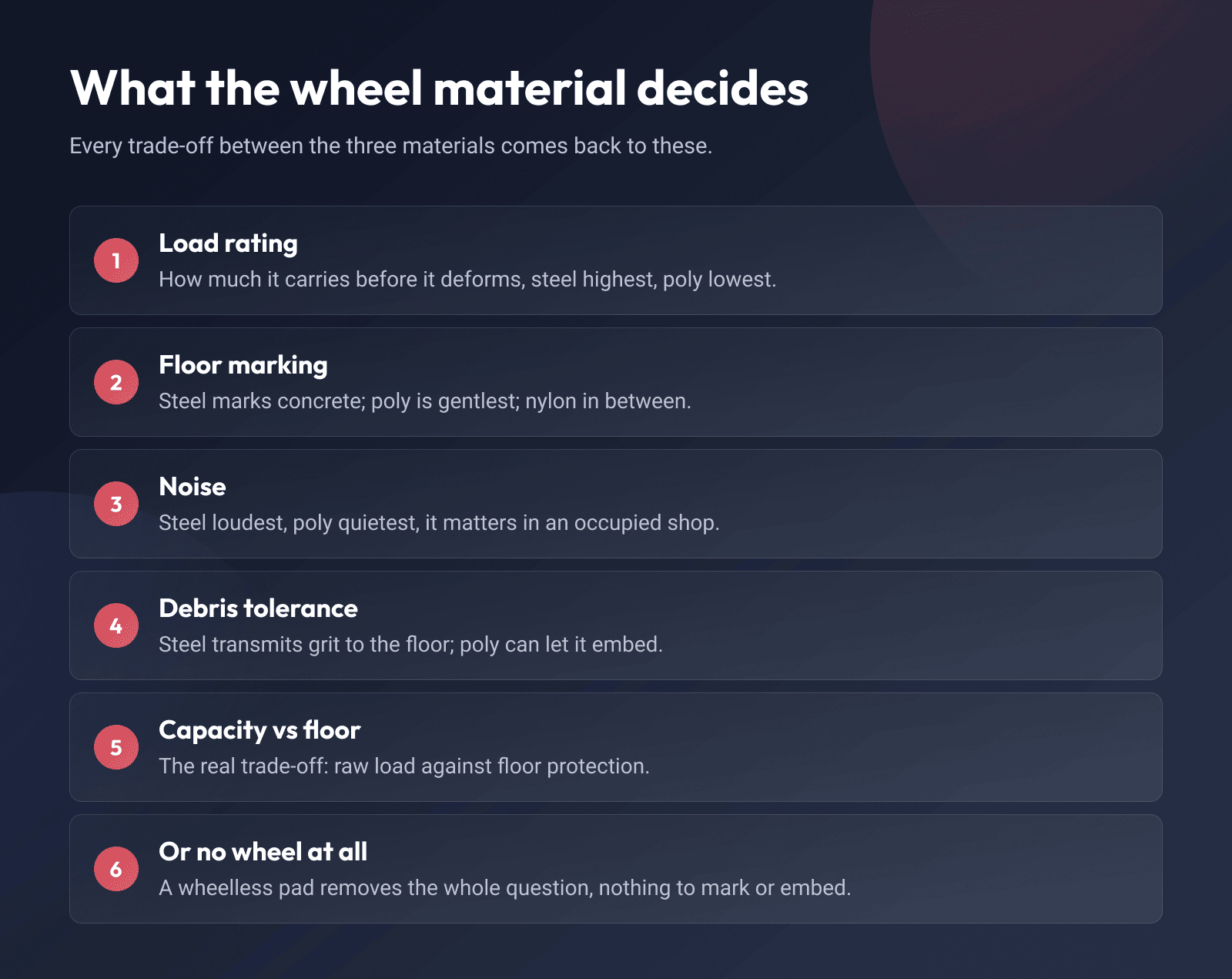
Every trade-off between the three materials comes back to four properties. Rank these for your own shop before you choose:
- Load rating. How much weight the roller carries before it deforms. Wheeled skates span roughly half a tonne to 100 tons per skate depending on model and material.
- Floor marking. Whether the roller marks or damages the surface it runs on. This is the deciding factor on any finished floor.
- Noise. How loud the move is, which matters in an occupied shop or a shared building.
- Debris tolerance. How the roller handles chips, grit and weld spatter on the floor. Some materials pick debris up, others transmit it straight into the surface.
Steel rollers
Steel is the highest-capacity choice and the traditional one for heavy, repeated, straight-line moves on sound concrete. Hevi-Haul, manufacturing in the USA since 1938, builds straight-line skates from 2.5 to 100 tons on steel rollers. The trade-offs are the floor and the noise: steel marks concrete, is unforgiving on anything more delicate, and is the loudest of the three. Choose steel when the load is very heavy, the floor can take it, and you will reuse the skates for years.
Nylon rollers
Nylon is the middle ground. It carries a high load, less than steel but more than most polyurethane, and is gentler on floors than steel while still being firm enough to roll well on concrete. It runs quieter than steel. The catch is debris: a nylon roller can pick up and hold grit, which then travels with the skate. Nylon is the sensible all-rounder when you want more floor friendliness than steel without giving up much capacity.
Polyurethane rollers
Polyurethane is the floor-friendly, quiet choice. It is the gentlest of the three on finished surfaces and the quietest to run, which makes it the pick for occupied shops and cleaner environments. Its softness is also its limit: it carries less than steel, and debris can embed in the material rather than being pushed aside. Choose polyurethane when protecting the floor and keeping the noise down outrank raw capacity.
Side by side
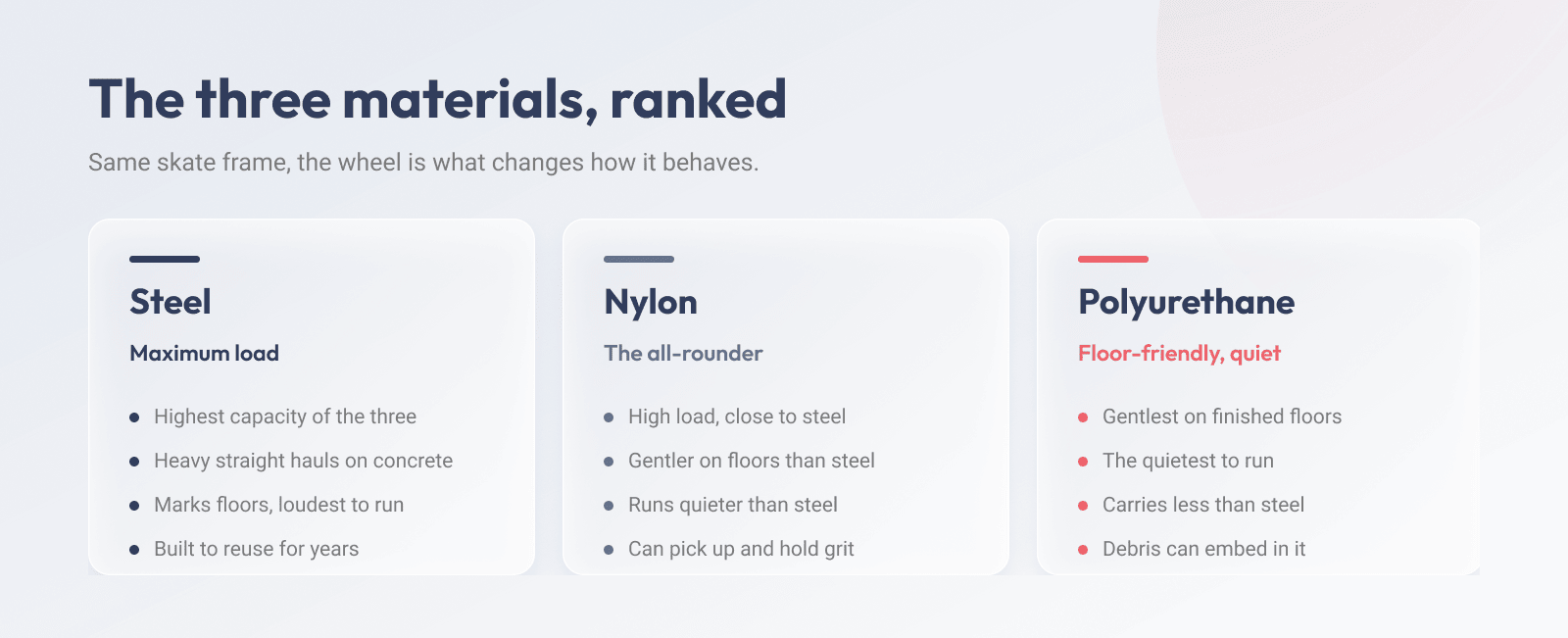
The same four properties, across all three materials:
| Steel | Nylon | Polyurethane | |
|---|---|---|---|
| Load rating | Highest, for heavy straight-line moves | High | Moderate to high |
| Floor marking | Marks concrete; hard on floors | Gentler than steel | Gentlest of the three |
| Noise | Loudest | Moderate | Quietest |
| Debris tolerance | Rolls over some debris, but transmits it | Can pick up debris | Softer, so debris can embed |
| Best for | Sound concrete, maximum load | A middle-ground all-rounder | Delicate floors, quieter shops |
When the right answer is no wheel at all
Every wheel material shares two limits that come from being a wheel: it concentrates the load onto a narrow contact line, and it lifts the machine up onto a deck. Wheeled skates raise a load 3 1/2 to 5.35 inches off the floor, and even the lowest-profile wheeled options at a usable capacity sit around 3 1/2 inches. That point-loading is what marks floors, and that deck height is what raises a machine’s center of gravity.
A wheelless pad removes both. Machinery Sliders are solid engineered-plastic pads made of Crate-Grade PE with no wheels, axles or bearings. They slide the load instead of rolling it, spreading the weight across a broad face rather than a wheel line, and they lift the machine just 3/8 inch for the single-direction pad or 1 inch for the multi-directional one. There is no roller material to choose because there is no roller: nothing to mark the floor, nothing to embed debris in, and nothing to raise the load. Each pad carries roughly 10 tons, and they stay under the load for the whole move.
Wheeled skates still win the long straight haul across sound concrete, where rolling is less effort than sliding. But when floor protection, low profile or a top-heavy load is the real constraint, the wheel material question is the wrong question. A wheelless slider is the answer. The full comparison is on the machine skates versus dollies versus Machinery Sliders page, and the method side of a skate move is in the complete guide to machine skates.
Frequently asked questions
What are machine skate rollers made of?
Usually one of three materials: steel, nylon or polyurethane. Steel carries the most load but marks floors and is loud. Polyurethane is gentlest and quietest but carries less. Nylon sits in between.
Which roller material is best for delicate floors?
Polyurethane is the gentlest of the three wheeled options. But for the most floor protection, a wheelless pad like Machinery Sliders spreads the load across a broad face instead of a wheel line, avoiding the point-loading that marks floors in the first place.
Are steel rollers better than polyurethane?
Better for raw load capacity and heavy straight-line moves on sound concrete, yes. Worse for floor marking and noise. The right choice depends on whether capacity or floor protection matters more for your move.
Do Machinery Sliders use rollers?
No. Machinery Sliders are solid engineered-plastic pads with no wheels, axles or bearings. They slide the load rather than rolling it, which removes the roller-material trade-off entirely and keeps the machine just 3/8 to 1 inch off the floor.
What is the lowest-profile machine skate?
Among wheeled skates, 3 1/2 inches at a capacity most people can use, on Vestil’s MDSKT-2 and Beacon’s BVHMS-2, rising to 5.35 inches on a swivel unit like Hilman’s Bull Dolly. The absolute lowest in any manufacturer catalogue is 3 7/16 inches, on Hilman’s N.5-SP at half a tonne. A wheelless single-direction Machinery Slider sits at 3/8 inch, roughly nine times lower, because there is no wheel or deck to lift the load.
Does polyurethane always carry less than steel?
Not always, but often enough to check the exact part number. Hevi-Haul rates the CS-25 at 12.5 tonnes on steel rollers and the CS-25-P at 10 tonnes on polyurethane, a 20 percent derate, and the poly version costs more. Their ST-5 keeps the same rating on both, so the derate is model specific.
Choosing the wheel, or skipping it
Rank load rating, floor marking, noise and debris tolerance for your own shop, and the material picks itself. If the answer keeps coming back to the floor, the honest recommendation is to stop choosing a wheel. Specifications are on the what are Machinery Sliders page and sets are in the store.