
Your Machine's Spec Sheet Weight
Is Probably Wrong
Home » Technical Library » Hidden Factors & Machine History » Your Machine’s Spec Sheet Weight Is Probably Wrong
By Machinery Sliders™ Technical Team|Drawing on industry background in machinery rigging and moving equipment|Last Updated: November 8, 2026
Direct Answer: The Machine Was Empty When You Weighed It. What Is Still Inside It?
The machine weight printed on a spec sheet often isn’t the weight you’re actually about to move. Retained coolant, hydraulic oil, tooling, fixtures, chips, and sludge can add thousands of pounds beyond a manufacturer’s “dry” or “net” weight figure — and because that added mass is rarely centered, it shifts the center of gravity at the same time it adds weight. The right question isn’t “what does the machine weigh?” It’s “what does the machine weigh right now, in the condition we’re actually moving it?”
There Are Several Different "Machine Weights" — and They Aren't Interchangeable
Manufacturer documentation might list net weight, shipping weight, operating weight, or dry weight — and these terms don’t automatically mean the same thing. A published “30,000 lb” figure may represent the machine with no coolant, no hydraulic oil, and no tooling installed. Once the coolant reservoir is filled, the hydraulic system charged, tooling loaded, and a chip conveyor or transformer added on, the number on the spec sheet is simply out of date.
Liquid Weight Adds Up Faster Than It Look
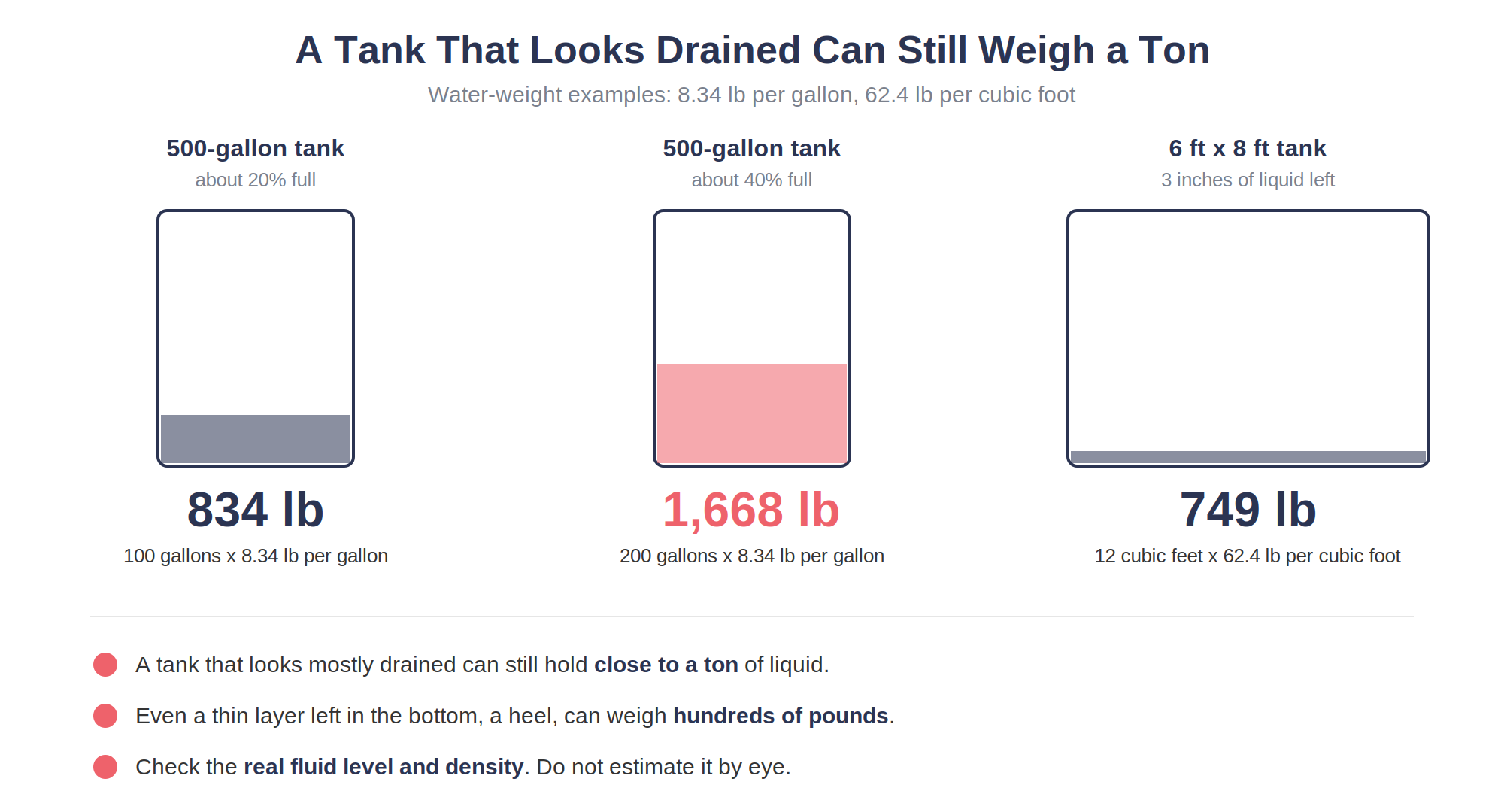
The basic relationship is weight = volume × density. For water, a useful field number is roughly 8.34 lbs per gallon — meaning 100 gallons weighs about 834 lbs, 500 gallons about 4,170 lbs, and 1,000 gallons over 4 tons. A tank that looks mostly empty can still be deceiving.
Worked example: a 500-gallon tank appears about 20% full. That’s 100 gallons — at 8.34 lbs/gal, roughly 834 lbs sitting in “the little bit at the bottom.” At 40% full, it’s closer to 1,668 lbs — nearly a ton, in a tank most people would describe as mostly drained.
Even a Thin Residual Layer ("Heel") Can Be Hundreds of Pounds
A pump or drain rarely removes everything — the remaining liquid is called a heel, and it can be heavier than intuition suggests because tank footprints are often large relative to the residual depth.
Worked example: a tank with a 6′ × 8′ footprint holds just 3 inches of residual liquid. Volume: 6 × 8 × 0.25 ft = 12 cubic feet. At roughly 62.4 lbs per cubic foot for water, that’s 12 × 62.4 ≈ 749 lbs — from a tank most people would call empty.
Weight Location Matters as Much as Weight Amount
Added mass rarely sits at the machine’s exact center — a coolant tank, tool magazine, or fixture is usually off to one side, which shifts the center of gravity even before you account for the extra weight itself. See our page on how a level machine can still have unequal loads for the underlying reaction math this feeds into.
Worked example: a 30,000 lb machine has its center of gravity 5 feet from a reference point. Adding 3,000 lbs of tooling located 9 feet from that same reference shifts the combined center of gravity to roughly 5.36 feet — a shift of about 4.3 inches, from 3,000 lbs the machine looks exactly the same size and shape from the outside. On a two-support span, that shift alone can move nearly 2,700 lbs of reaction onto one side — almost the entire added weight, concentrated on a single support.
Liquid Can Keep Moving After the Machine Stops
Solid tooling has a fixed location. Liquid in a partially filled tank doesn’t — it can slosh during acceleration or braking, meaning the center of gravity can shift temporarily even while total weight stays exactly the same. A 4,000 lb tank of liquid shifting its effective center by 2 feet can redistribute roughly 1,000 lbs of reaction from one support to another on an 8-foot span — with nothing having left the machine. “The machine stopped” doesn’t mean everything inside it stopped moving at the same instant.
Measuring Beats Guessing
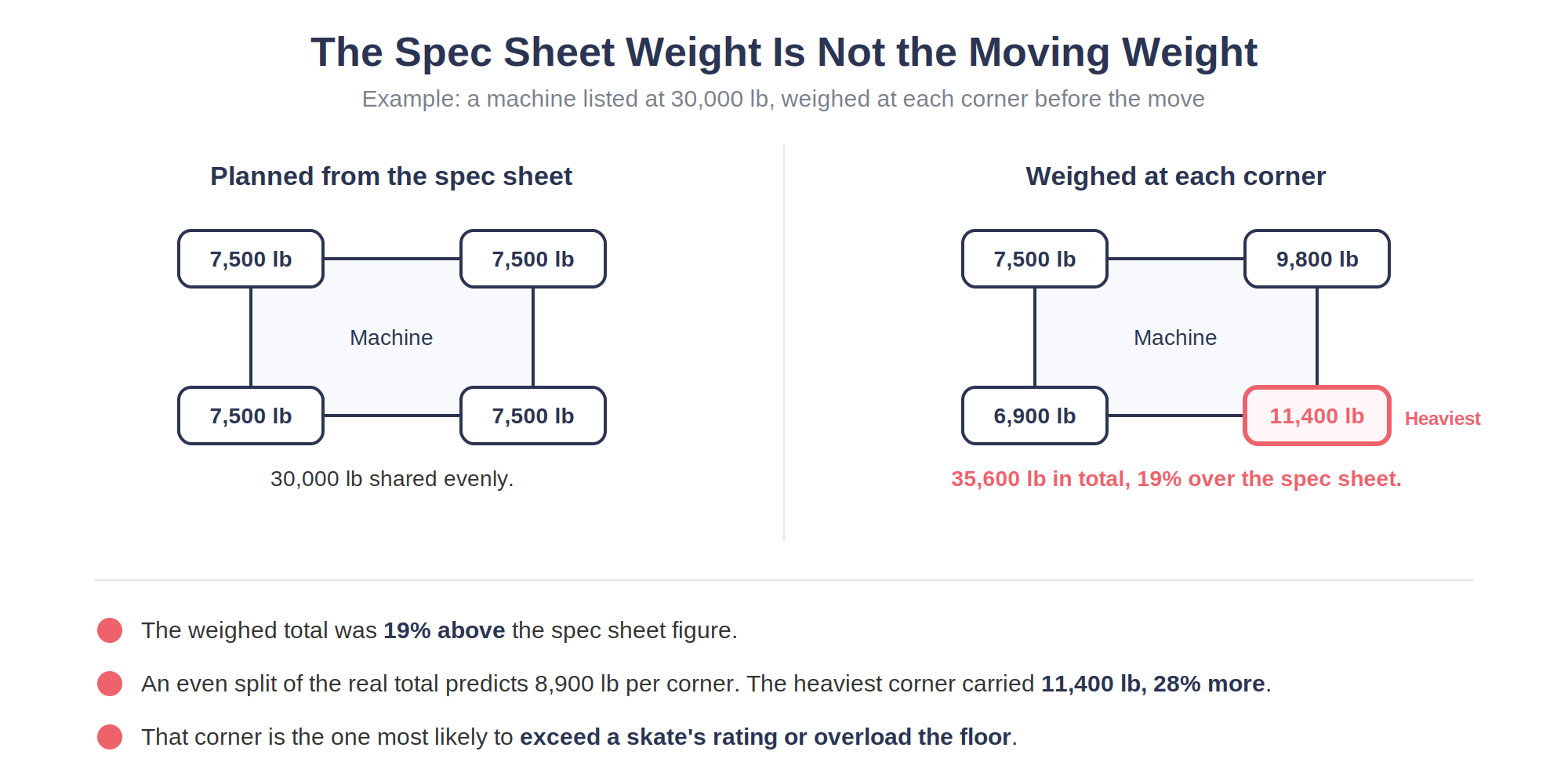
For a critical move, actual four-corner weighing reveals both the true total weight and how it’s really distributed — often catching errors that a simple “weight divided by four” assumption would miss entirely.
Worked example: four-point measurements come back at 7,500 / 9,800 / 6,900 / 11,400 lbs — a total of 35,600 lbs against a spec sheet figure of 30,000, nearly 19% higher than planned. Dividing the actual total evenly across four supports would predict 8,900 lbs each — but the heaviest corner is actually carrying 11,400 lbs, about 28% above that naive assumption. That’s the exact corner most likely to exceed a skate’s rating or overload the floor beneath it.
Hazardous Contents Add a Second Layer of Concern
Some retained fluids may be flammable, corrosive, or under pressure — a half-full chemical tank makes the machine both heavier and genuinely more dangerous to relocate. Hydraulic accumulators deserve particular caution: a system can show zero pressure on a gauge in one circuit while an accumulator elsewhere remains fully charged. Standard energy-control practice — isolating, relieving, and verifying every energy source before disconnection — applies directly here, and releasing stored pressure incorrectly can shift an internal mass (like a hydraulically supported head settling onto a mechanical stop) and change the center of gravity before the move even starts.
Machinery Sliders Don't Solve the Weight Question — They Depend on Getting It Right
A slider rated for a given capacity assumes an accurate load estimate feeding into that selection — if the machine is actually 20% heavier than the spec sheet suggests, individual slider capacity and support reaction margins need to reflect the real number, not the published one. Their low profile can genuinely help by reducing the lift height needed to install them, but that benefit only holds if the weight and center-of-gravity numbers behind the plan are accurate in the first place. See our page on why jacking one corner changes every support’s load — an inaccurate starting weight compounds every one of those calculations.
Build an Actual Moving-Weight Inventory
Rather than looking up a single number, build the machine you’re actually about to move: dry weight, plus coolant, hydraulic oil, tooling, fixtures, chips and sludge, plus any retrofit additions like a transformer or added cabinet. A machine that started at a published 30,000 lbs can easily total 36,000–37,000 lbs once every retained item is accounted for — over 20% heavier than the number everyone used to plan the move.
Before Selecting Equipment: A Machine Weight Checklist
- What condition does the published weight actually represent — dry, shipping, or operating?
- What’s the actual coolant and hydraulic oil level, and what’s the fluid’s real density?
- Is tooling, a fixture, a die, or a workpiece still installed on the machine?
- Are chip hoppers, sludge traps, or abrasive media reservoirs actually empty?
- Where is each significant mass located — left/right, front/rear, high/low?
- Has stored hydraulic, pneumatic, or gravity energy been verified controlled, not just assumed isolated?
Stop and reassess if: the machine reacts noticeably heavier than expected during jacking, one support reaction is unexpectedly high, fluid can be heard or seen shifting, or the actual configuration no longer matches the original moving plan. Don’t just upgrade one skate and move on — recalculate the whole system with the real weight and real center of gravity.
Learn More: Frequently Asked Questions
Not necessarily. Published weights often represent a dry or net condition that excludes fluids added during setup.
Approximately 4,170 lbs, using roughly 8.34 lbs per gallon.
Yes. A large tank footprint means even a shallow residual layer can represent several hundred pounds.
Yes. Off-center added mass shifts the center of gravity, which changes individual support reactions independently of the total weight increase.
Yes, temporarily. Liquid can continue shifting briefly after the machine stops moving, changing reactions without any change in total weight.
Yes. It reveals actual individual support reactions, which often differ significantly from an equal four-way split.
No. Their capacity selection depends on an accurate weight and center-of-gravity estimate — retained contents need to be identified and included first.
Final takeaway: the specification sheet may have been accurate the day the machine left the factory empty. That doesn’t mean it’s accurate today. Before selecting a jack, forklift, skate, or Machinery Slider, don’t just ask what the machine weighs — ask what it weighs right now, in its current condition, and where every one of those pounds actually is. Sometimes the most dangerous weight on a move isn’t visible from the outside at all.