
Anchors Removed, Machine Won't Move?
Here's What's Still Attached
Home » Technical Library » Hidden Factors & Machine History » Anchors Removed, Machine Won’t Move? Here’s What’s Still Attached
By Machinery Sliders™ Technical Team|Drawing on industry background in machinery rigging and moving equipment|Last Updated: November 8, 2026
Two Explanations That Look Identical From Across the Room
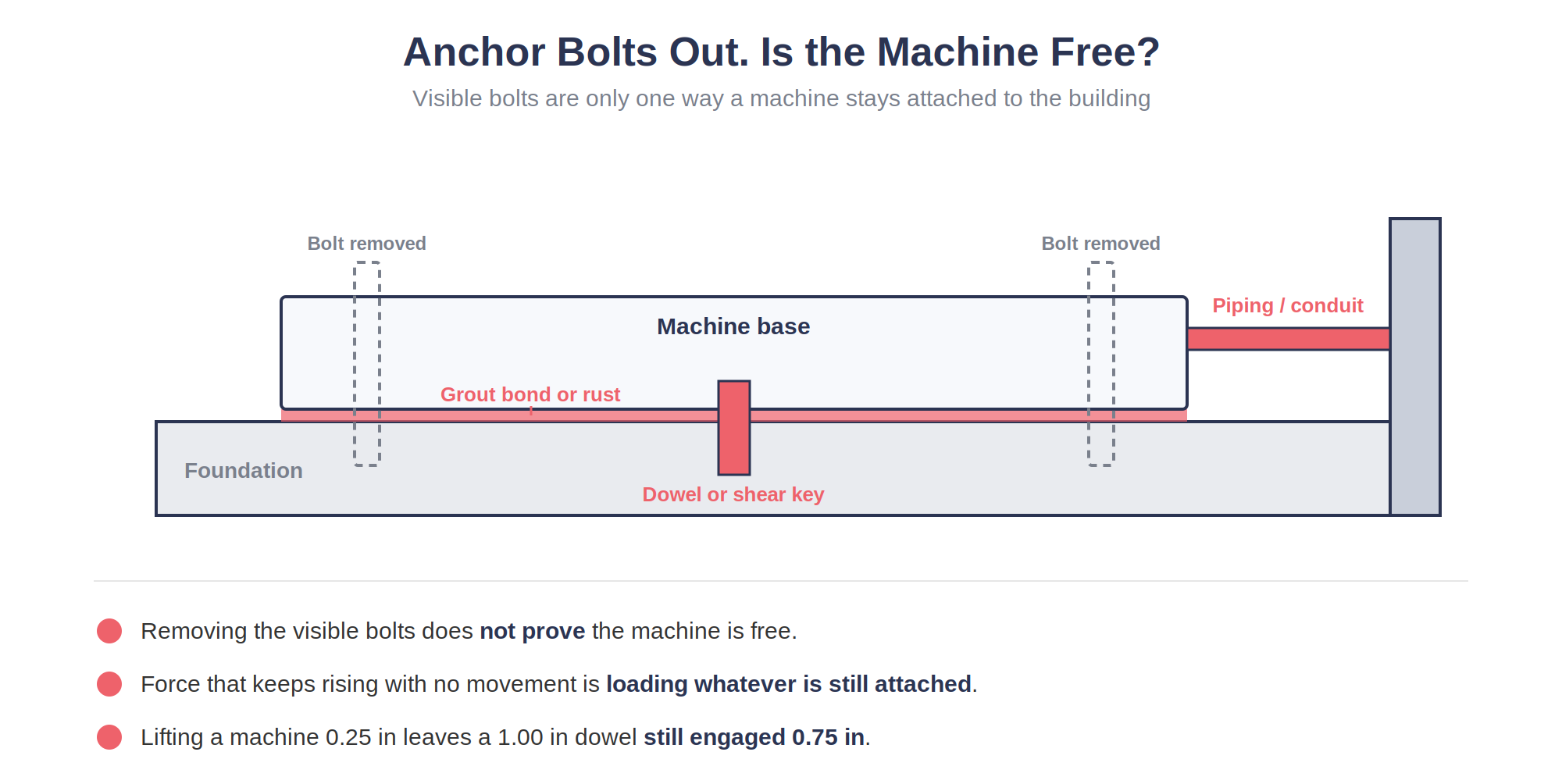
When a machine resists movement, there are two very different possibilities: it’s genuinely free and just has high breakaway resistance, or it’s still mechanically attached to something. These look the same — rising force, no motion — but they demand completely different responses. If the machine is still attached, more pulling force doesn’t overcome friction. It loads whatever connection remains, and eventually something has to give. The thing that gives first may not be the connection you knew about.
A Machine Can Be Free Vertically But Not Horizontally
Jacking a corner up an eighth of an inch proves the machine can move upward locally — it does not prove it can translate horizontally. A locating dowel or shear key can allow the machine to lift slightly while remaining fully engaged against horizontal movement, turning your test into a false confirmation.
Worked example: a locating dowel is engaged 1.00″ into the machine base. The crew jacks the machine up 0.25″. Remaining engagement: 1.00 − 0.25 = 0.75″. The dowel is still fully capable of resisting horizontal force — “we lifted it” doesn’t mean “it’s clear.”
Grout and Rust Can Act Like a Genuine Bond
Grout installed years ago to provide bearing and fill irregularities can, over time, become mechanically resistant to separation — the machine may not simply be resting on it, but bonded or partially keyed to it. Pulling horizontally turns grout from support material into an unintended restraint, and it rarely fails cleanly: it can crack progressively, with the machine suddenly releasing once enough of the bond gives way at once. That sudden release combines with whatever stored energy has already built up in the pulling system — see our page on stored energy in rigging systems — meaning what looks like “we finally got it moving” can actually mean something just broke.
Hidden Restraints Are More Common Than People Expect
Installation drawings might show eight anchors when the crew only located and removed six — the machine isn’t being stubborn, two bolts genuinely still exist. Used machinery adds another layer of uncertainty: a previous owner may have added extra anchors, welded tabs, or seismic restraints that never appear on the original manufacturer drawing. Process piping, electrical conduit, drains, and ductwork are all real, if less obvious, candidates — a 2-inch pipe deflecting under load can act like a spring, and flexible conduit or slack cable can hide the problem entirely at first, only becoming taut and suddenly resistant after the machine has already moved several feet.
One Remaining Restraint Can Be Worse Than Several
If three of four original anchors are removed and one hidden anchor remains, that single connection isn’t sharing load with anything anymore — it can become the entire restraint system, and pulling from a distant point creates a genuine turning moment around it.
Worked example: a single hidden anchor sits 10 feet from where a 4,000 lb pull is applied. The turning moment is 4,000 × 10 = 40,000 lb-ft — resisted entirely by one bolt, some machine-floor contact, and whatever else remains. What looks like unequal floor resistance (see our page on why a heavy machine can rotate during a straight pull) may actually be a hidden mechanical pivot, not a friction problem at all.
Force Comparison Is Your Best Diagnostic Tool
If a properly planned moving system normally requires around 1,500 lbs to break away a comparable load, and you’ve already reached 5,000 lbs with zero movement, that’s not “we need more force” — that’s a roughly 3.3x deviation from expectation, and it deserves investigation before another pound is applied. The exact numbers matter less than the pattern: known weight, known moving system, clean route, and force dramatically higher than expected is the system telling you something is still connected.
Watch Beyond the Machine Itself
If the machine has piping, conduit, or cable leaving it, watch where those connections go — the actual restraint may be crocheted into a wall twenty feet away, invisible to anyone only watching the machine. Fresh paint cracking, a grout line separating, a pipe bending, or unusual sound near a distant connection are all real evidence worth stopping for immediately. Treat the machine like an aircraft before departure: make an actual list of every expected connection — mechanical anchors, electrical feeds, pneumatic, drains, data cable, locating dowels — and confirm the status of each one individually rather than relying on “looks disconnected.”
Verify Hazardous Energy Control Before Touching the Machine
Disconnected control power doesn’t necessarily mean the machine is fully isolated — hydraulic accumulators can remain charged, air lines pressurized, and internal masses like counterweights still capable of releasing stored energy the moment the machine shifts. Standard lockout/tagout practice — identifying, isolating, and verifying every hazardous energy source before servicing or disconnection work — applies directly here, and “off” is not the same as “isolated.”
Machinery Sliders Don't Solve a Hidden Restraint — But They Can Reveal One
This needs to be said plainly: Machinery Sliders reduce movement resistance once a machine is genuinely released. They cannot make an attached machine free, and low-friction moving equipment should never be used to try to tear a hidden connection loose.
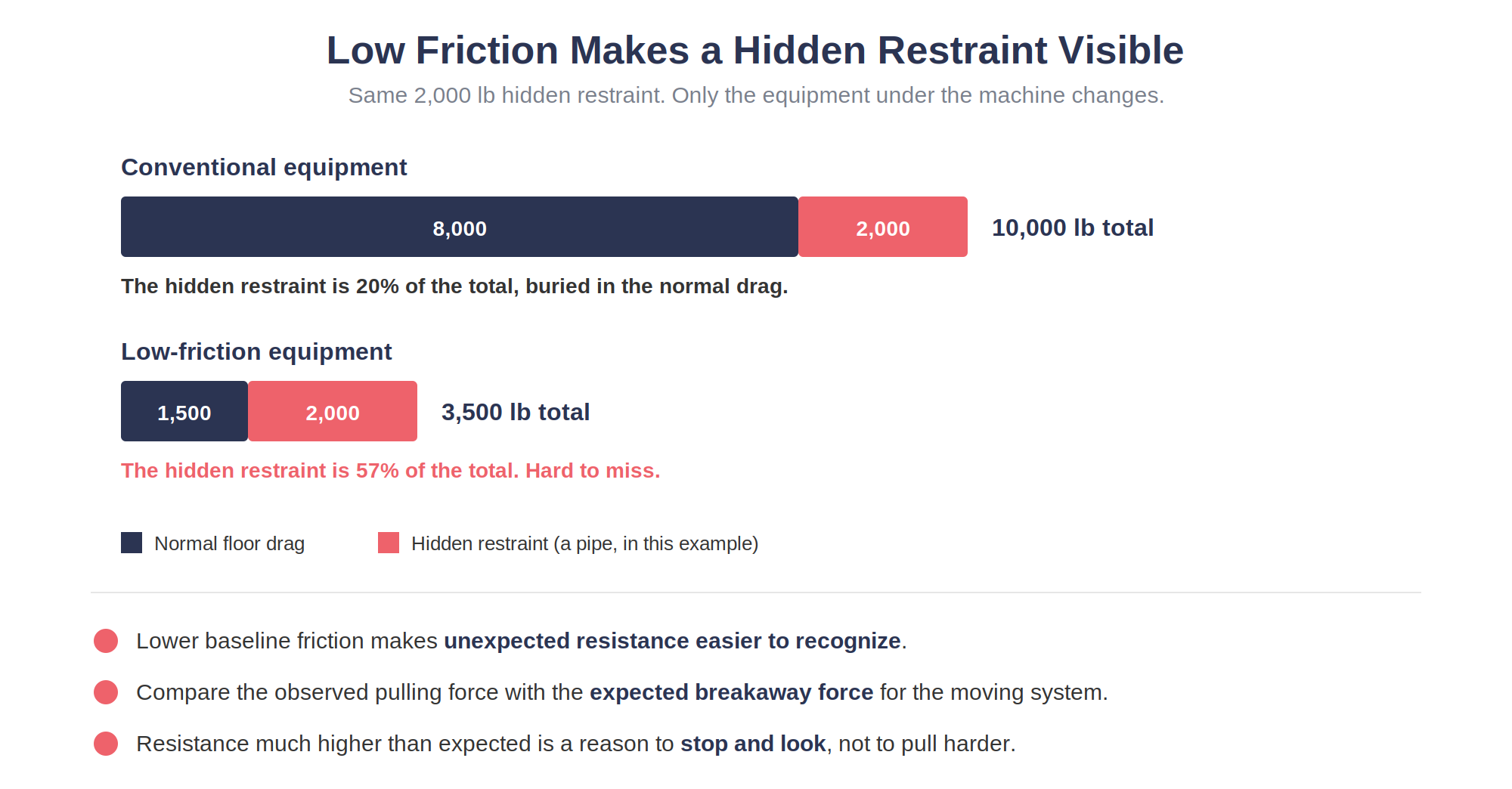
Worked example: raw floor drag on conventional equipment might be 8,000 lbs, masking a 2,000 lb hidden pipe restraint within a combined 10,000 lb total — hard to distinguish. Switch to low-friction moving equipment and total resistance drops to roughly 1,500 lbs of normal drag; the same 2,000 lb hidden restraint now dominates a 3,500 lb total, making the abnormal resistance proportionally obvious instead of buried in noise. Lower baseline friction makes unexpected resistance easier to recognize — a genuine diagnostic advantage, not just a convenience.
Before Attempting Horizontal Movement: A Hidden Restraint Checklist
- Does the anchor count actually removed match the count shown on installation or foundation drawings?
- Have locating dowels, shear keys, or foundation pockets been specifically checked, not just anchor bolts?
- Have all utility and process connections — piping, conduit, drains, ductwork, cables — been traced and confirmed disconnected?
- Has hazardous energy (electrical, hydraulic, pneumatic, gravity) been verified controlled, not just assumed off?
- What is the expected breakaway force for this specific moving system, and how does observed force compare?
- Is someone watching connections beyond the machine itself — pipe, conduit, cable runs — not just the machine’s four corners?
Stop and reassess if: pulling force rises well beyond the expected breakaway force with no movement, one corner moves while another stays fixed, the machine frame appears to twist, grout or concrete cracks, or any distant connection shows movement or tension. Don’t add more forklift force — find the restraint first.
Learn More: Frequently Asked Questions
Not necessarily. Grout, dowels, shear keys, piping, conduit, drains, and hidden bolts can all still restrain it.
Yes. A dowel or shear key can remain partially or fully engaged even after a small vertical lift.
Yes. Grout can bond to both surfaces over time and behave as a genuine mechanical restraint, not just support material.
Yes. Once other restraints are removed, one remaining anchor can become the entire restraint system and a pivot point for rotation.
Yes. The pipe or conduit only needs to resist the pulling force being applied, not the machine’s total weight.
No. Rising force with no movement means something is absorbing that force — investigate before continuing.
Indirectly, yes. Their lower baseline friction can make an abnormal remaining resistance proportionally easier to notice — though they cannot release a genuinely attached machine.
Final takeaway: “it’s just stuck” is not a diagnosis. If a forklift applies 6,000 lbs and the machine moves zero inches, that force didn’t disappear — something is carrying it. When that unknown connection finally fails, the machine may not gently start moving. It may break free, and those are not the same event. Before asking how hard to pull, ask what is still attached.