
Machinery Bearing Pressure:
Rated Skate, Rated Spot?
Home » Technical Library » Load Distribution & Final Positioning » A Rated Skate Doesn’t Mean a Rated Spot on Your Machine
By Machinery Sliders™ Technical Team|Drawing on industry background in machinery rigging and moving equipment|Last Updated: November 8, 2026
Direct Answer: The Skate Is Rated for 10 Tons. Is the Machine Base Above It?
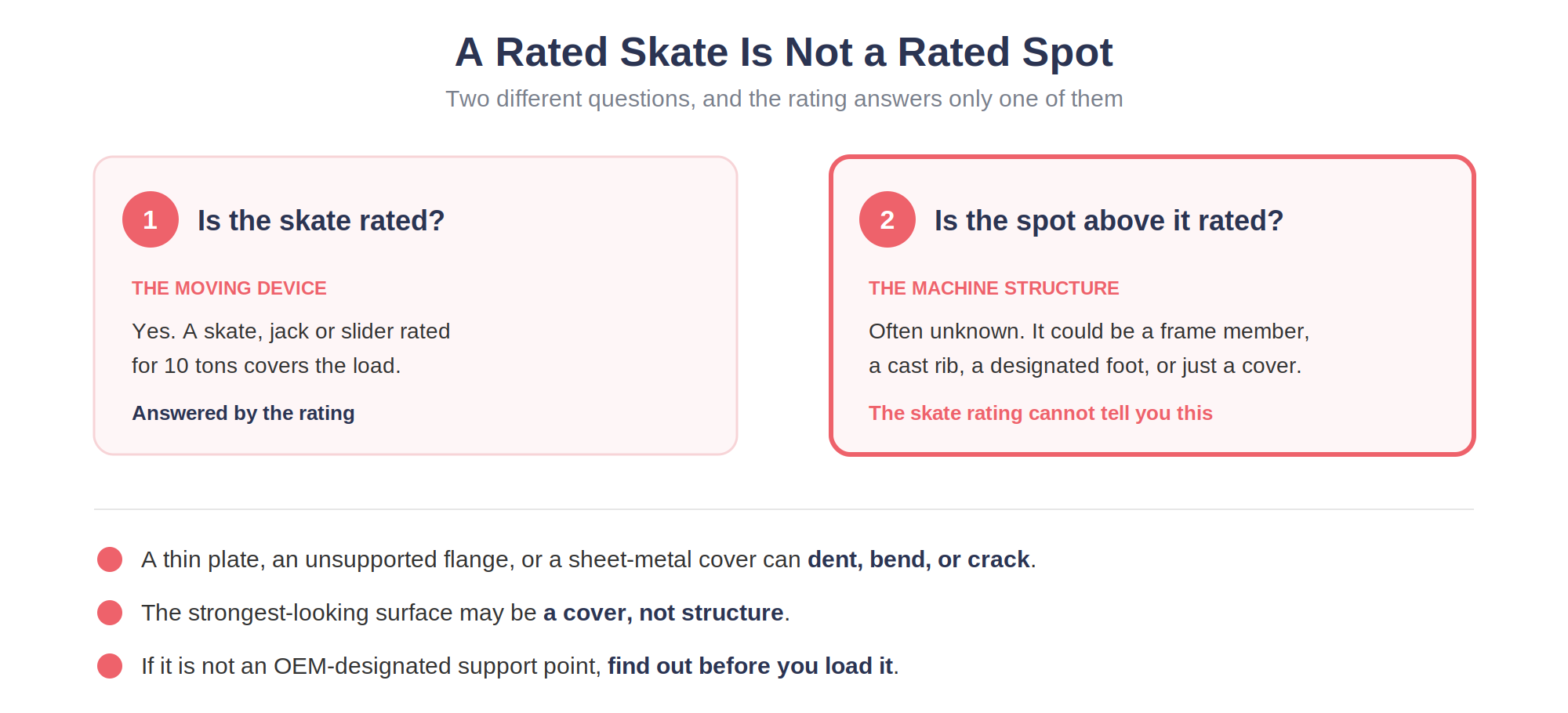
A machinery skate, jack, or slider being properly rated for the load only answers half the question. The other half is bearing pressure: whether the specific spot on the machine resting on it can actually carry that same reaction. A perfectly rated moving device can sit beneath a thin plate, an unsupported flange, or a sheet-metal cover and cause that part of the machine to dent, bend, or crack — while the skate itself never comes close to its limit. A rated moving device does not create a rated support point on the machine above it.
Two Different Questions: Rating and Bearing Pressure
“Can the skate hold the machine?” and “can the machine safely carry the skate’s reaction at this exact spot?” are separate questions with separate answers. The basic relationship is pressure = force ÷ area — the same total load spread over a smaller contact area creates dramatically higher local pressure.
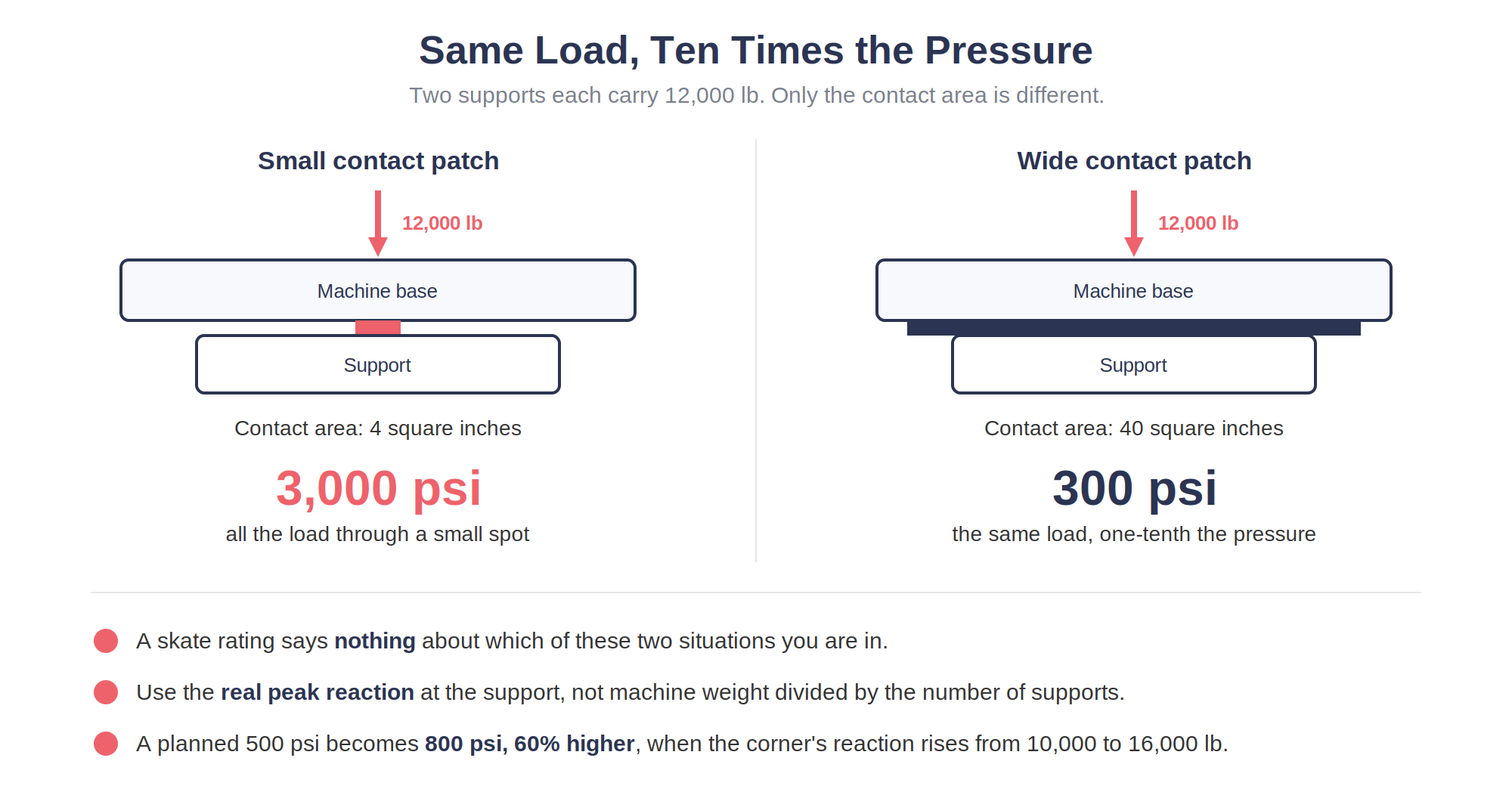
Worked example: two supports each carry 12,000 lbs. One contacts the machine over 4 square inches, producing 12,000 ÷ 4 = 3,000 psi. The other contacts over 40 square inches, producing 12,000 ÷ 40 = 300 psi — the same load, ten times the contact area, one-tenth the pressure. The skate rating tells you nothing about which of these two situations you’re actually in.
A Bigger Plate Isn't Automatically the Fix
Spreading a load over a wider plate lowers the *average* pressure on paper — but only if the plate actually stays flat and fully seated. If the plate bends under load, it can dish in the middle and lift at the edges, meaning your calculated 144 square inches of bearing area might function more like a small fraction of that. Bending moment in a simply supported span works out to roughly force times span divided by four, so doubling the unsupported distance between structural supports doubles the bending demand on the exact same load — and deflection is even more sensitive, since it scales with the *cube* of the span. Doubling the span in a simple beam model can mean roughly eight times the deflection. A wide, thin plate is not the same thing as a properly sized thick one; in the standard stiffness relationship, doubling a plate’s thickness increases its bending stiffness roughly eightfold, while doubling its width only roughly doubles it. Width and thickness are not interchangeable.
The Strongest-Looking Surface May Be a Cover, Not Structure
Cast machine bases can contain ribs, pockets, and hollow sections invisible from outside — the exterior surface doesn’t tell you local wall thickness, and OEM jacking points exist precisely because not every location on a casting is meant to carry concentrated load. Fabricated bases have their own hidden weak points: a load applied against the thin web of a structural channel can crush that local section even though the channel is globally strong. A sheet-metal belly pan or electrical cabinet floor can look like structure from below when the real frame sits inches above it — meaning a jack can bend the cover before it ever engages the actual load path, all while the machine itself never visibly moves.
Unexplained Jack Travel Without Machine Movement Is a Warning
If the jack extends a half inch but the machine only rises an eighth, ask where the other movement went — the honest possibilities are machine deformation, base settlement, or blocking compression, none of which are good news. This connects directly to our page on why a jack can walk or tilt while the machine looks still: sometimes the machine isn’t lifting because the jack is quietly crushing the surface underneath it instead.
Load Migration Makes This Worse, Not Just Differen
Worked example: a support was planned for 10,000 lbs over 20 square inches, expecting 500 psi. If that corner’s actual reaction rises to 16,000 lbs during the move (see our page on how a level machine can still redistribute load), the real pressure is 16,000 ÷ 20 = 800 psi — 60% higher than planned, on the exact same contact point. Local bearing calculations should use the actual expected peak reaction at that support, not machine weight divided by the number of supports.
Contact Geometry Matters as Much as Contact Area
A curved casting resting on a flat skate top can create line contact instead of full-surface contact, and a single weld bead, bolt head, or burr can end up carrying the entire initial load before it crushes flat — ten thousand pounds concentrated on one square inch is 10,000 psi, and on a quarter square inch it’s 40,000 psi. Inspect and clean the intended bearing surface before transferring load, not after — hydraulic cylinder manufacturers commonly warn against off-center or edge loading on their saddles specifically because partial contact concentrates force and introduces unwanted side load, and machinery skate manufacturers commonly offer different top configurations (padded, diamond-steel, or others) precisely because the machine-to-skate interface is a real engineering consideration, not an afterthought.
Overhang Turns the Machine Base Into a Cantilever
If a support reaction acts 6 inches out from the nearest structural connection instead of directly under it, the resulting bending moment doubles if that distance simply doubles to 12 inches — a difference of a few inches in support placement can matter far more than it looks like it should. Often the better fix for a weak support location isn’t a bigger spreader plate — it’s moving the support to a genuinely stronger point on the machine, even if that takes more setup time.
Machinery Sliders Face the Exact Same Requirement
A slider rated for a substantial load answers whether the slider can carry it — it says nothing about whether the specific piece of machine resting on the slider can carry that same reaction. A low-profile slider can often sit near existing feet or structural bearing points without a tall stack, which is genuinely useful, but placing it under a weak panel doesn’t make that panel any stronger. A broad contact area can reduce pressure — but only if the surface actually engages that full area and the structure beneath can distribute the load, not just because the slider’s spec sheet says it’s rated for more than enough.
Damage Can Be Invisible and Still Change Everything Downstream
A precision machine bed can deform by just a few thousandths of an inch — invisible to the eye, but potentially significant to machining accuracy once the machine is reinstalled. That deformation may be fully elastic and disappear once the load is removed, or it may take a permanent set, quietly becoming the root cause of an alignment problem discovered weeks later during an unrelated troubleshooting session. Local structural damage rarely stays contained to one category either: a crushed support point can unload that corner, load a different one heavier (see our page on why jacking one corner changes every support’s load), and set the machine yawing — a bearing-pressure problem becoming a load-sharing problem becoming a steering problem, all from one wrong contact point.
Before Placing Any Support: A Bearing Pressure Checklist
- What is the expected maximum reaction at this specific support, not just total machine weight divided by the number of supports?
- What structure is actually directly above the contact point — a frame member, a cast rib, a designated foot, or just a cover?
- Is this an OEM-designated jacking or support point? If unknown, has the OEM or a qualified machinery mover been consulted?
- Will the intended contact area actually engage fully, or could the surface rock, bend, or make only partial contact?
- If a spreader plate is used, what is its own unsupported span, and is it stiff enough not to bend under this load?
- Has the bearing surface been inspected and cleaned of burrs, bolt heads, or debris before load transfer?
Stop and reassess if: machine metal begins denting, a plate bows unexpectedly, paint cracks near the support, a weld appears to open, jack travel occurs without proportional machine movement, or the actual reaction turns out higher than what the bearing arrangement was selected for. Don’t respond to local deformation by pumping harder — find out what’s actually carrying the load.
Learn More: Frequently Asked Questions
No. The machine structure resting on the skate must also be capable of carrying that reaction at that exact location.
Yes. The jacking force can deform a weak local support point before it ever lifts the whole machine.
Not automatically. The plate itself can bend, rock, or fail to fully engage its full geometric area, which can concentrate load more than expected.
Yes. If a support’s actual reaction rises during the move, the local bearing pressure at that same contact point rises with it.
Often relevant since it’s designed to carry machine weight, but suitability for the specific moving method and load direction still needs verification.
No. Their low profile and broad contact can help, but the machine structure directly above the slider still has to support the applied reaction.
Assuming that because the moving device is rated for the load, the spot on the machine underneath it must be safe too.
Final takeaway: the skate can be perfectly rated, the jack well within capacity, and the slider carrying far less than its limit — and the machine above any of them can still dent, bend, or crack. A ten-ton-rated moving device does not create a ten-ton-rated spot on the bottom of a machine. Before asking how much the skate can carry, ask the harder question: what is actually carrying the skate?