
Why a "Dry" Floor
Can Suddenly Make Machinery Accelerate
Home » Technical Library » Hidden Factors & Machine History » Why a “Dry” Floor Can Suddenly Make Machinery Accelerate
By Machinery Sliders™ Technical Team|Drawing on industry background in machinery rigging and moving equipment|Last Updated: November 8, 2026
Direct Answer: The Floor Looks Dry. Why Did the Machine Suddenly Take Off?
A floor doesn’t have to look slippery to change how a heavy machine moves. Thin, nearly invisible films from hydraulic oil, coolant residue, floor sealer, condensation, polishing compound, or fine dust can meaningfully reduce floor friction long before the floor looks wet or contaminated. If only one side of a machine crosses into that lower-friction area first, the machine can accelerate, crab sideways, or rotate almost instantly — not because anyone changed the pull, but because the floor itself just changed the resistance pattern underneath it.
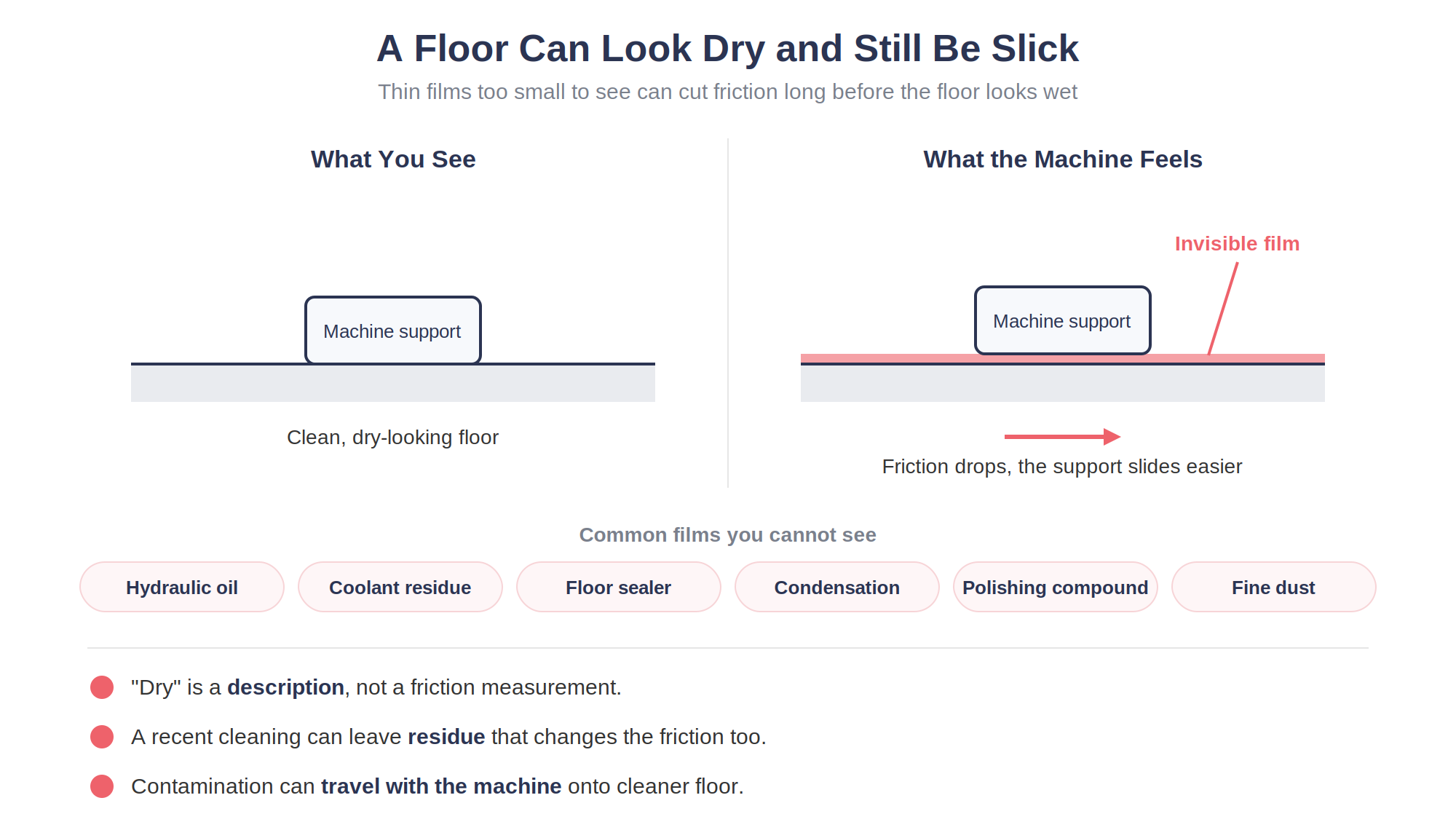
"Dry" Is a Description, Not a Floor Friction Measurement
A floor can look clean, polished, and completely dry while behaving very differently from the section immediately before it. Hydraulic oil doesn’t need to form a puddle to matter — a very thin residue spread over a wide area can meaningfully change resistance under heavy contact pressure. Coolant is a common trap here: a leak gets cleaned up, the floor looks dry hours later, but oils or additives can remain behind even after the visible moisture is gone. Ironically, cleaning the route can sometimes create the exact problem it was meant to prevent — if cleaning solution isn’t fully removed, the cleaned section may temporarily have different friction than the surrounding floor.
One Support Hitting the Change First Is What Makes It Dangerous
If a front-left support reaches a lower-friction area while the front-right doesn’t, resistance on that side drops while the other side stays the same — and the machine begins rotating, exactly the mechanism described on our page about why a heavy machine can rotate during a straight pull. Nobody touched the steering handle or the pulling line; the floor itself just created an asymmetric resistance condition. With multidirectional moving equipment, the same asymmetry can show up as crabbing (sideways drift while staying roughly square) instead of rotation — either way, the floor has effectively taken over part of the steering.
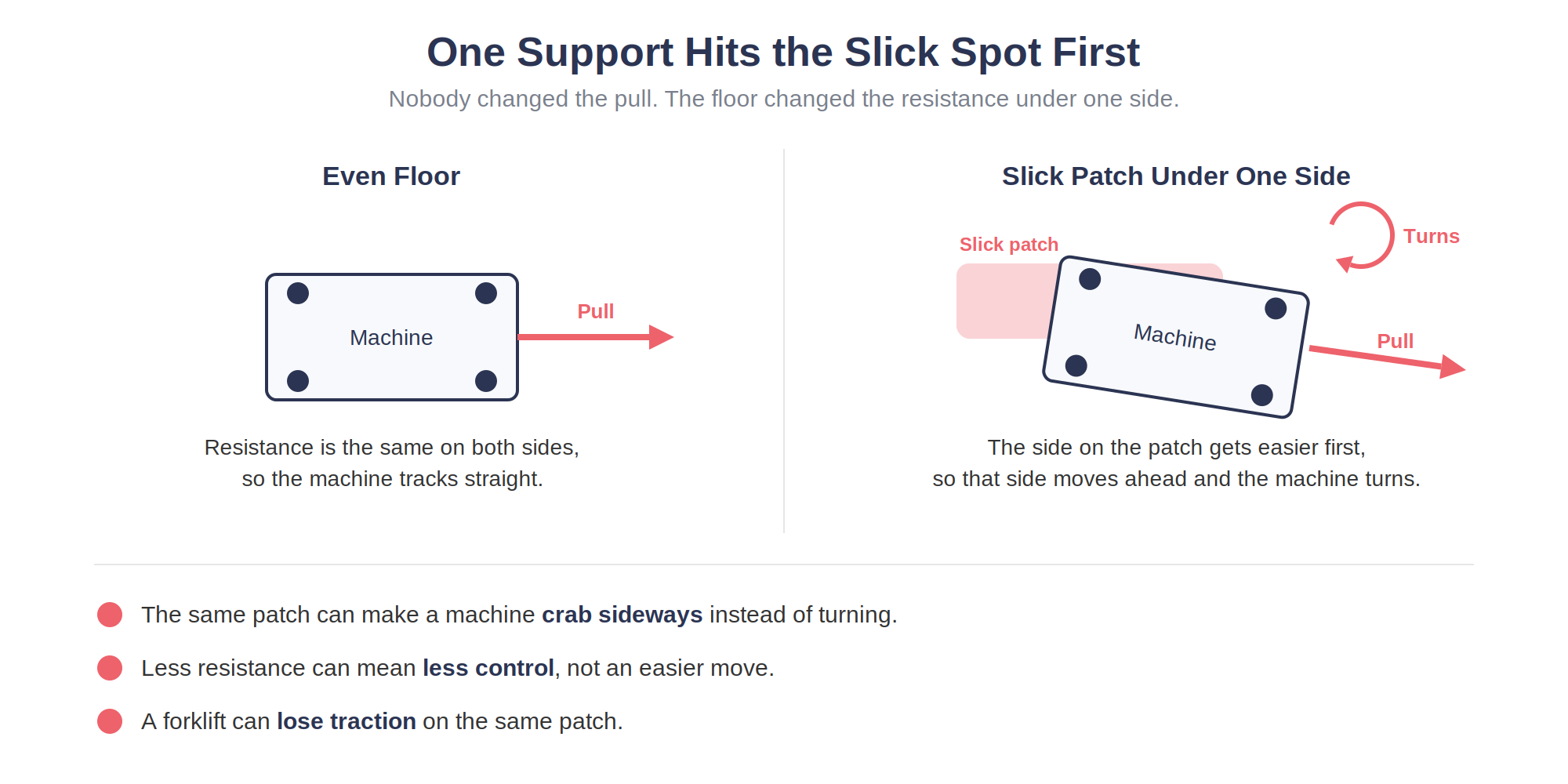
Getting Easier to Move Can Make a Machine Harder to Control
High resistance at least tells you something is pushing back. Low resistance can tell you nothing — the machine simply travels farther than expected. This connects directly to our page on why a sudden drop in pulling force can be a warning: if the operator doesn’t immediately reduce input once resistance drops, the same force that was appropriate a moment ago becomes acceleration instead. A large machine gaining even a small amount of speed carries real momentum, and lower floor friction also means less natural help slowing it back down — which matters even more if there’s any cross-slope, since friction that was previously masking a slight slope can stop doing that job the moment it drops.
The Forklift Faces the Same Problem the Machine Does
Whatever’s supplying push, pull, steering, or restraint for the move also depends on floor traction — reduced speed and extra care on wet or slippery surfaces is standard safe forklift practice for exactly this reason. The genuinely dangerous combination is when the machine gains mobility at the same moment the controlling forklift loses grip: oil under just one tire can cause the truck itself to steer, yaw, or slide, changing the force direction it’s putting into the machine without the operator intending it.
Steel Plates, Floor Tape, and "Protective" Plastic Can All Be Traps
Crossing from concrete onto a temporary steel plate (see our page on bridge plates over pits and trenches) can change resistance abruptly on its own, and adding oil or moisture on top of steel makes that transition even sharper. Plastic sheeting placed to protect a floor from dirt or scratches deserves particular caution — it can wrinkle, bunch, or slide under a moving system, meaning the interface briefly goes from very low friction to suddenly binding on a wrinkle within just a few inches, which is a dangerous easy-then-stop sequence. Even painted aisle stripes or floor tape can behave differently than the surrounding concrete; a support only needs a brief moment of different resistance to introduce a steering input nobody planned for.
Contamination Can Travel With the Machine
A slider or skate crossing an oily patch can pick up that contamination and carry it onto the next several feet of otherwise clean floor — meaning resistance doesn’t necessarily return to normal the instant the machine leaves the original problem area. The same thing happens with forklift tires. This also means the four supports on one machine may not experience identical floor conditions even on a single straight path, since the first support to cross a contaminated area can spread or transfer that condition onto what the trailing supports encounter.
Machinery Sliders Interact Directly With Whatever Is on the Floor
Because a slider’s whole design relies on direct contact with the floor surface, its behavior is inherently sensitive to contamination, coatings, and debris — that’s not a flaw, it’s basic interface mechanics. A broad sliding contact patch can be less sensitive to small cracks or debris than a small hard roller would be, but that doesn’t make it immune to a genuine friction change from oil, sealer, or moisture. A low profile keeps the machine close to the floor, which is a real advantage in tight clearance — but it does nothing to prevent acceleration or drift if the floor itself becomes unpredictably slick.
Predictable Floor Friction Beats Low Friction
A machine that consistently requires 3,000 lbs of pull is often easier to manage safely than one that swings between 500, then 3,500, then 800 lbs across the same move — because operators are constantly reacting to whatever just happened, and unpredictable variation is what actually erodes control, not the specific friction number itself. Never improvise a lubricant to make a stuck machine “slide better” — introducing oil, soap, or grease to reduce resistance creates uncontrolled movement and a genuine cleanup and safety hazard on top of whatever problem you were trying to solve.
Before Crossing a Suspected Transition: A Checklist
- Does the floor have different coatings, sealers, or an old machine footprint anywhere along the route?
- Has this area been recently cleaned, and could residue or moisture remain?
- Are steel plates, floor tape, or protective sheeting present anywhere on the path?
- Could only one support enter a changed-friction zone before the others?
- Could condensation form on this surface given the temperature and humidity?
- What actually stops the machine if resistance suddenly drops by half?
Stop and reassess if: the machine suddenly accelerates, pulling force drops without explanation, one side moves ahead of the other, the machine begins crabbing or yawing, or a forklift’s tires lose traction. Don’t respond by steering harder — find out what changed in the friction underneath the machine.
Learn More: Frequently Asked Questions
Yes. Thin films of oil, coolant residue, sealer, or condensation can be too thin to see while still meaningfully reducing friction.
Yes, because the resistance under that side changes before the resistance under the other supports does.
Yes. If resistance drops while the applied force stays the same, the excess force becomes acceleration.
Not automatically. It can slide, wrinkle, or bunch and become an unpredictable part of the moving interface.
Yes, and it can then affect the floor condition even after the machine has left the original contaminated area.
No. Improvised lubrication creates uncontrolled movement and its own safety and cleanup hazards.
Not necessarily. It can reduce the force required, but it can also reduce control — predictable friction matters more than minimal friction.
Final takeaway: machinery doesn’t respond to what a floor looks like — it responds to what the interface actually does. A film too thin to see, a strip of sealer, a painted line, or a patch of condensation can all change the move without any visible warning. When a machine suddenly becomes easier to move, don’t assume that’s good news. Ask what just lost resistance — because sometimes the machine didn’t get easier to move. It got harder to control.