
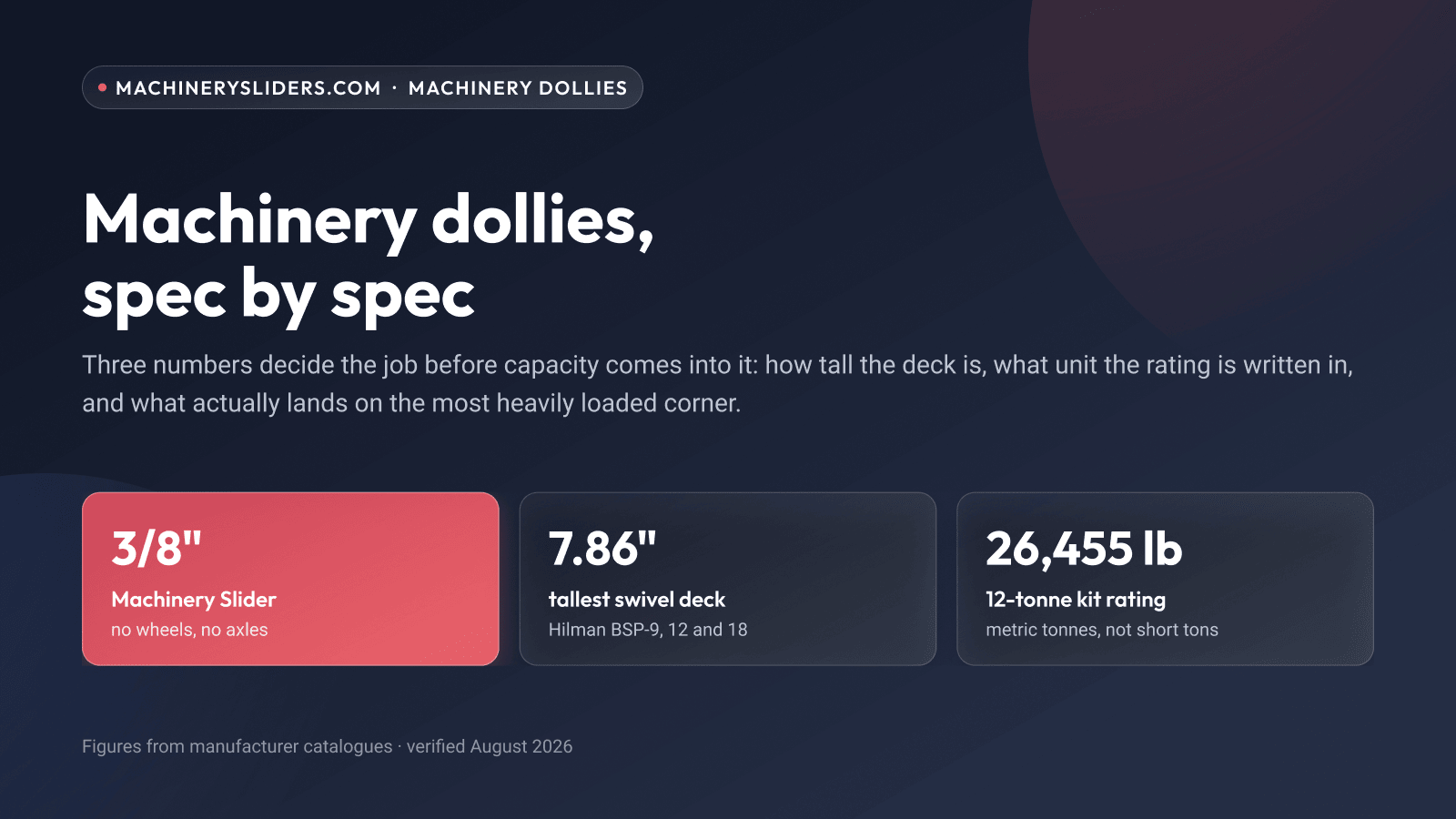
Direct answer A machinery dolly is a low steel platform on four wheels, usually with a swivel top, that carries part of a machine’s weight while you steer it with a handle. They are sold in kits of four. Per-dolly ratings run from 1 tonne to 18 tonnes, and deck heights run from about 4 inches to 7.86 inches, which is both how far you have to jack the machine and how much higher its center of gravity ends up sitting. A 12-tonne Hilman Bull Dolly kit sells for $1,065 to $1,795 depending on the dealer. Wheelless Machinery Sliders™ carry roughly 10 tons per pad at 3/8 inch of height.
What a machinery dolly actually is
Strip away the catalogue language and a machinery dolly is three things bolted together: a steel frame, a set of wheels underneath it, and a top plate the machine sits on. On most models that top plate swivels, which is the whole reason the tool exists. You get a handle in the front unit, and you steer the load.
The trade uses the words loosely. A rigger might say dolly when he means a straight-line skate, and a catalogue might say skate when the product has a swivel top. Hilman, whose Bull Dolly is the reference product in this category, calls the same item a dolly on one page and a skate in its warranty text. If you are buying, ignore the noun and read two specs: does the top swivel, and how tall is the deck.
Worth clearing up early, because it wastes people’s time in search results: machine slides are a different product entirely. Those are the hardened ways a milling machine table travels on, a component inside a machine tool. They have nothing to do with moving equipment. Skid plates are also different, they protect the underside of a truck. If you are looking for the tool that gets a lathe across a shop floor, dolly, skate and machinery roller are the words that will find it.
Capacity: read the unit, not just the number
This is the single most expensive misunderstanding in the category, and almost every distributor gets it wrong.
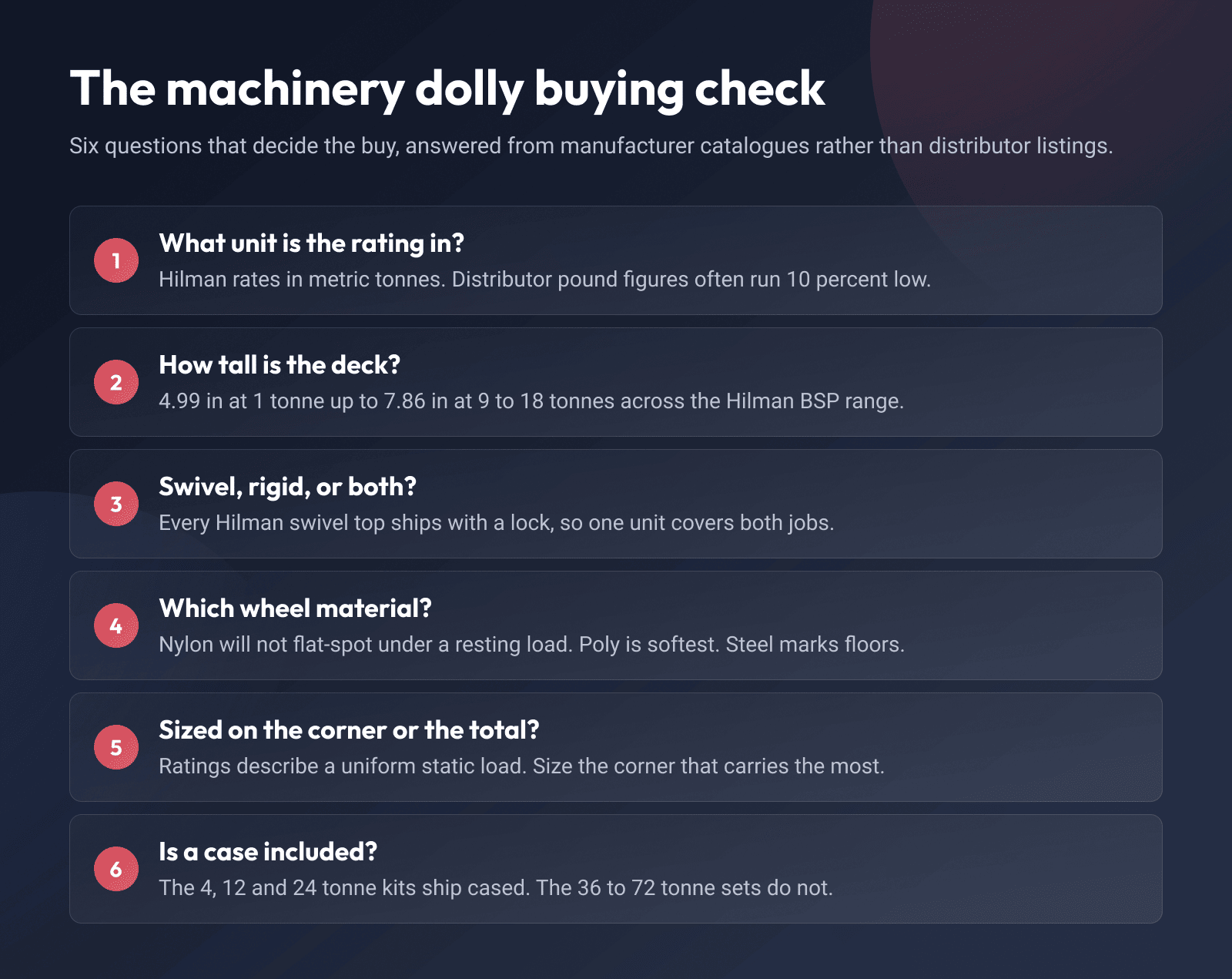
Hilman rates its dollies in metric tonnes, not US short tons. Their own storefront lists a kit as “24 Metric Tons (52910 lbs)”. That works out at 2,204 lb per ton. So a 12-tonne Hilman kit is rated 26,455 lb, not 24,000 lb. Grainger lists that same 24-tonne kit as 48,000 lb and Zoro lists the 12-tonne kit as 24,000 lb. Both are roughly 10 percent low. Southern Tool, an authorised Hilman dealer, prints the correction on its own page: all Hilman rollers are rated in metric tons.
If you sized a set from a distributor’s pound figure, you were conservative by accident, which is the harmless direction. If you sized it from the tonne figure and assumed short tons, you were optimistic, which is not.
Other brands are not consistent with each other either. Pake rates at 2,200 lb per ton and says so. Vestil and Wesco publish pounds only and avoid the problem. Beacon prints the word TON on its specification tables with no definition and no pound conversion anywhere on the page, so for Beacon products the unit is genuinely unknown and you should ask before you buy.
The range available is wide. At the small end, Hilman’s N.5-SP is rated half a tonne. At the top of the standard Bull Dolly range, the BSP-18 is rated 18 tonnes per dolly, which is 39,683 lb under one corner of a machine.
Deck height: the spec that decides most jobs
Deck height is the number people check last and regret first. It does two things. It sets how far you have to jack the machine to get the mover underneath, and it sets how much you have raised the machine’s center of gravity before you start pushing.
Here is the honest ladder, all from manufacturer catalogues:
- Machinery Sliders, single-directional: 3/8 inch (9.5 mm)
- Machinery Sliders, multi-directional: 1 inch (25 mm)
- Vestil MCD-10 flat machine dolly: 1 3/4 inches, rated 10,000 lb uniform static
- Wesco 480020 steel deck machine dolly: 2 1/2 inches overall, rated 10,000 lb
- Pake rotating machine dolly, 2,200 lb: 3 1/2 inches
- Hilman BSP-1, 1 tonne swivel padded: 4.99 inches (127 mm)
- Hevi-Haul CS-3 and CS-5 compact swivel: 4 1/2 inches
- Pake rotating machine dolly, 8,800 lb: 4 3/8 inches
- Hilman BSP-3, 3 tonnes: 5.35 inches (136 mm)
- Hilman BSP-6, 6 tonnes: 5.6 inches (142 mm)
- Hilman BSP-9, BSP-12 and BSP-18: 7.86 inches (199 mm)
Two notes on that list, because published data in this category is messier than it looks.
First, a figure of 6.75 inches circulates widely for the Hilman 9, 12 and 18 tonne dollies. It is wrong. Hilman’s own brochure gives 7.86 inches, Grainger lists the 36-tonne kit at 7 55/64 inches, and Zoro’s specification block says 7 7/8 inches. The 6.75 inch number is the top plate width of those frames, and it reached the internet because one large retailer put it in a field labelled deck length. If you are planning clearance around 6.75 inches on a Hilman 12-tonne kit, you are more than an inch short.
Second, Hilman’s brochure prints 6.6 inches for the BSP-6 in the inch column and 142 mm in the millimetre column of the same row. Those disagree. 142 mm is 5.6 inches, and both Grainger and Light Tool Supply independently list 5.6 inches. The inch figure is a typo in the source document.
What the ladder shows is that the swivel top is not free. Inside Hilman’s own range, at 3 tonnes, the rigid diamond top model sits at 4.36 inches and the swivel padded model sits at 5.35 inches. That is roughly an inch of extra height for the ability to steer. At 9 to 18 tonnes the gap widens to 2.23 inches, 5.63 against 7.86. You are trading center of gravity for steering, and at the heavy end you are trading a lot of it.
This is the reason wheelless pads exist. A wheel needs a diameter, an axle and a frame around it, and those three things have a floor below which they will not go. Remove the wheel and 3/8 inch becomes possible. If clearance under the machine, under a door header or inside a trailer is what governs your job, the low clearance approach is a different conversation from picking a shorter dolly.
Swivel or rigid, and what swivel really buys you
Hilman’s guidance is one line: choose rigid for straight, or swivel for easy turning. What most buyers miss is the next line in the same catalogue. Every swivel Bull Dolly ships with a lock, and the lock “enables the units to be used as swivel or rigid top dollies”. You are not committing to one behaviour. You can lock the tops for the long straight run and release them for the placement.
Hevi-Haul publishes the most useful engineering note anyone in this category has written down. Their swivel skates carry a friction plate between the top frame and the swivel plate, and the stated purpose is to “reduce swimming under load”. Swimming is their word for a swivel top wandering off your intended line because the load, not the operator, is deciding where it wants to go. It is the failure mode nobody warns you about until it happens, and it is why the friction plate is there.
The other thing Hevi-Haul is clear about is that rigid units are not the cheap option, they are a designed companion. Their rigid tops “were designed to be combined with their swivel top counterparts as rear following dollies”. Beacon says the same in different words: fixed units are designed primarily to be moved in straight lines. Enerpac puts the conclusion plainly, that using the right combination of fixed and steerable skates under the load is the key to a trouble free move.
So the real answer to swivel or rigid is usually both. One steerable unit at the front deciding direction, rigid units behind following the line.
Wheel material changes more than you would expect
Three materials are actually sold. Hilman’s catalogue describes each in one sentence and the sentences are worth reading literally.
Steel wheels “provide the best wear characteristics and are great for durable floors”. Hevi-Haul adds that steel can handle extended resting loads, even permanent installation, and that it excels on rough or uneven floors. Steel is the choice when the floor is sound and you do not care about marking it.
Nylon is for “good floor protection and favorable wear”, and Hilman notes something specific: nylon wheels “will not set if left under load for a period of time”. Setting is flat-spotting, where a wheel deforms because a machine has parked on it for a month. Hilman also recommends nylon for delicate surfaces, naming new concrete, epoxy coated surfaces, and painted or sealed floors.
Polyurethane is “a softer wheel that provide excellent floor protection on tile floors”. The trade-off is stated by Hevi-Haul, not Hilman: poly rollers are not recommended for extended resting loads or on rough and debris riddled rolling surfaces.
Two things that get repeated and should not be. Phenolic wheels are a caster material and are not offered on machinery dollies by any of the eight brands worth naming, so ignore any guide that lists them as an option. And polyurethane does not always carry the same load as steel. On Hevi-Haul’s CS-25 the steel version is rated 12.5 tonnes and the poly version is rated 10 tonnes, a 20 percent derate, and the poly version costs more, $690 against $575. That derate is model specific, their ST-5 keeps its 2.5 tonne rating on both, so check the individual model rather than assuming either way.
If floor damage is the reason you are reading this, the mechanism matters. Every wheel concentrates the load onto a narrow contact line. Material changes how much that line marks. It does not change the fact that it is a line. That is a different problem from spreading the load across a pad, which is covered on the page about moving over floors and truck surfaces.
What is actually in a kit
Hilman’s brochure lists kit contents plainly, and the list is shorter than most buyers assume.
A KBSP-12 kit is four BSP-3 dollies and two handles. That is it. Kit weight 100 lb. A KBSP-24 kit is four BSP-6 dollies and two handles, 216 lb. The larger sets, RS-BSP-36P, 48P and 72P, are four BSP-9P, 12P or 18P dollies and two handles, and they weigh 409 lb, 443 lb and 517 lb respectively.
The case is where the confusion sits. Hilman’s brochure does not list a case in any kit. Distributors do, and they do not agree. The clearest published statement comes from Rigging.com: the 4, 12 and 24 tonne kits ship in a steel case, and the 36, 48 and 72 tonne sets do not come with a case. If a case matters to you, confirm it against the specific part number before ordering.
Note also what the two handles are for. They are for turning the swivel tops, not for pulling the load. Nothing in a Bull Dolly kit supplies the force that moves the machine. You still need something to push or pull with, and how much force that takes is worked out on the page about force to move a machine.
What machinery dollies cost
Prices below are current published figures. Individual Bull Dollies, from an authorised dealer:
- 1 tonne, poly, BSP-1P: $169.39
- 3 tonnes, poly, BSP-3P: $223.47
- 6 tonnes, poly, BSP-6P: $389.79
- 12 tonnes, poly, BSP-12P: $1,662.40
Steel and nylon cost more than poly at every tier. A 6 tonne steel BSP-6S is $714.28 against $389.79 for the poly version of the same dolly.
Complete kits, showing the spread across dealers rather than one convenient number:
- 4 tonne kit, KBSP-4P: $890.81 to $966.40
- 12 tonne kit, KBSP-12P: $1,065.30 to $1,795.00
- 24 tonne kit, KBSP-24P: $1,922.43 to $2,592.99
- 36 tonne set, RS-BSP-36P: $5,374.40 to $5,666.99
- 72 tonne set, RS-BSP-72P: $7,232.80
That spread is real. The same 12 tonne kit is $1,065 at one authorised dealer and $1,795 at another. If you are buying, the part number is the thing to shop, not the description.
Outside the Hilman range the market widens sharply. A Wesco 480020, rated 10,000 lb, is $149.95. A Pake rotating dolly rated 8,800 lb is $569. Beacon’s 24 ton BASKT-24 is $1,463.49. And at the bottom, rebadged import kits advertised at 44,000 lb sell for around $210 with a 90 day warranty, against a five year warranty on the US-made equivalent. Those two products are not competing on the same axis, and averaging them produces a number that describes nothing.
For contrast on the same job: as of this writing, four Machinery Sliders rated 10 tons each are $142.97, which is $35.74 per pad, and the price per pad barely moves at volume, dropping to $35.11 in a 64 pack. All five sets are listed in the store.
Sizing a set, and why dividing by four is wrong
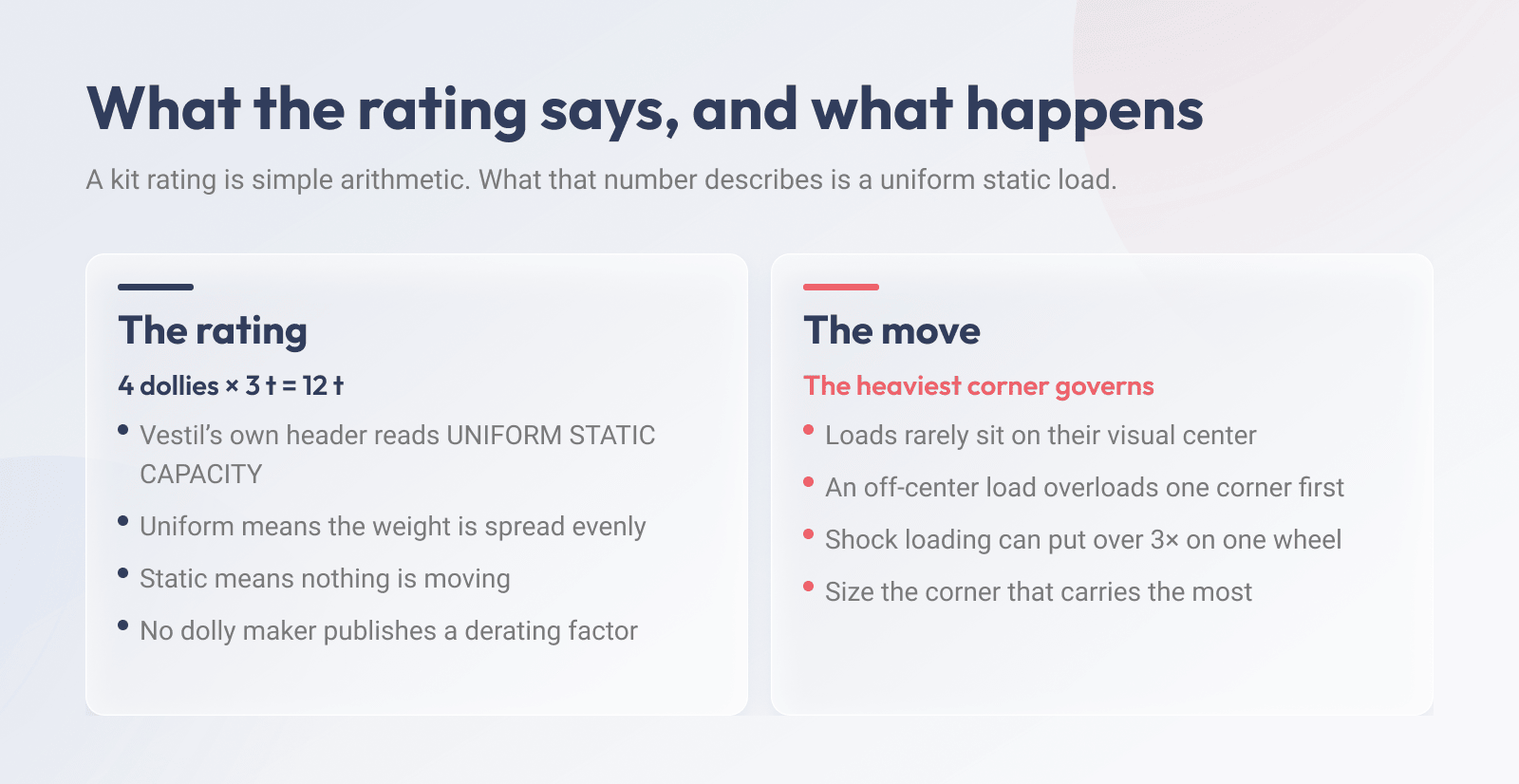
Every manufacturer rates a kit by simple arithmetic. Four 3 tonne dollies make a 12 tonne kit. Pake writes the rule out: when combining multiple machine dollies on a single load, the total load capacity is the combined capacity of each dolly.
The arithmetic is correct and the conclusion people draw from it is not.
Look at what the capacity figure actually describes. Vestil’s own column header on its dolly tables is UNIFORM STATIC CAPACITY. Uniform means the weight is spread evenly. Static means nothing is moving. A machine being pushed across a shop floor is neither of those things.
No dolly manufacturer publishes a derating factor for uneven loads. I looked across Hilman, Vestil, Wesco, Beacon, Pake and Hevi-Haul, and it is not there. The clearest engineering statement on the problem comes from the caster industry instead. Hamilton Caster, a manufacturer, writes that it may seem obvious to divide the maximum load weight by four, but this can lead to heavy miscalculations, because most loads do not maintain an even weight across the length and width of the vehicle, and an off-center load could overload even the most durable casters.
The same source is worth reading on uneven ground. Hamilton notes that slopes, ramps and uneven floors can cause shock loading when one or more wheels lose contact with the floor, that the remaining wheels then carry the entire load, and that this can force a wheel to bear more than three times the weight of the load. That is caster guidance rather than dolly guidance, and it should be read as an analogy, but the physics does not change when the wheel gets bigger.
So the defensible way to size a set is to work from the most heavily loaded corner, not from the total. Find where the machine’s weight actually sits, which is rarely its visual center, and make sure the dolly under that corner is rated for what lands on it.
One manufacturer does publish a quantitative table, and it is the only one I found. Beacon’s guide gives 4 skates rated 5,000 lb each for a 5,000 lb load, 6 skates rated 5,000 lb each for a 10,000 lb load, and 8 skates rated 10,000 lb each for a 30,000 lb load. Useful as a starting point, but notice the implied margin drifts from 4.0 times down to 2.67 times across those three rows, so treat it as one manufacturer’s rule of thumb rather than an engineering method.
Enerpac states the front and rear split cleanly: on a 70 ton load using a set, the weight shares between front and rear, so you need front and rear skates each rated for a minimum of 35 tons.
For Machinery Sliders the rule is simpler because every pad is the same. Each is rated roughly 10 tons, so divide the machine weight by 20,000 lb, round up, and spread the pads around the true center of gravity. The manufacturer’s own worked example puts sixteen single-directional sliders under a 100 ton press on a 6 inch by 6 inch timber, which is 6.25 tons per pad in practice.
Floors, and what manufacturers will and will not tell you
Beacon states the requirement in one sentence: a machine on skates must be moved on a smooth floor capable of taking on the point load of each skate. Their suitable list is concrete floors, epoxy warehouse floors and steel plates. Their not-recommended list is soft surfaces, dirt or gravel, and heavily damaged floors.
The most practical published guidance comes from TPX’s operational manual. Cracks wider than a standard concrete expansion joint are a problem, and the remedies given are crossing at an angle, filling, or laying thin metal plating. Abrupt ledges need plating or fillers, and transitions should be as gentle and subtle as possible. The same manual makes a point that experienced crews already know and new buyers do not: the closer the weight of the load is to the maximum carrying capacity of the skates being used, the harder it will be to turn, rotate and maneuver them.
It also says the thing that should be printed on the box. Entering any kind of machine moving project without having a really close idea of the weight of the load can be dangerous.
Now the honest part. There are four numbers buyers ask for constantly, and none of them exists as a published manufacturer figure anywhere in this category:
- A floor flatness tolerance. No FF number, no millimetres over a given length. All flatness guidance is qualitative.
- A maximum gradient. Hilman footnotes one product’s capacity as based on a flat level riding surface and stops there.
- A tip-over angle or maximum center of gravity height. Nobody publishes one.
- A floor contact pressure in psi. Manufacturers make qualitative claims about spreading load and no numeric ones.
If you see those figures quoted confidently, they were invented somewhere upstream. The category has no ASME, ANSI or OSHA standard behind it. ASME B30 covers below-the-hook lifting devices and skates are not below-the-hook equipment, so capacity ratings here are manufacturer-declared with no common test basis. That is not a scandal, it is just worth knowing when you are comparing two numbers from two brands.
Where a dolly is the right tool, and where it is not
A machinery dolly earns its place when you need to steer a load under load, repeatedly, on sound concrete. The swivel top with a handle is a genuinely good mechanism for that and nothing wheelless replicates it. If your work is moving equipment around a plant on good floors, week after week, a set of dollies is capital equipment that will outlast several crews.
It is the wrong tool in four situations, and all four come back to the same two specs.
Clearance. If you cannot jack the machine 4 to 8 inches, or the route passes under something you cannot raise the load past, deck height rules the dolly out before capacity ever comes into it.
Top-heavy machines. Raising the center of gravity of a tall, narrow machine by 5 to 8 inches narrows the tip-over margin at exactly the moment you start applying horizontal force. Keeping the load low is the whole safety argument, and it is set out on the page covering how Machinery Sliders reduce risk.
Poor or delicate floors. Wheels concentrate load on a line. Tile, wood, epoxy, dock plates and cracked concrete are where that becomes a repair bill.
Leave-in-place jobs. A dolly is too expensive to abandon under a machine inside a loaded shipping container. A $35.74 pad is not, which is why crews use them for loading machinery into shipping containers.
Most working crews carry both and stop trying to make one tool cover everything. The full side by side, on height, capacity, cost and floor marking, is on the Machinery Sliders versus dollies and skates page, and the broader method guide is the complete guide to machine skates.
Frequently asked questions
What is a machinery dolly?
A low steel platform on four wheels, usually with a swivel top, that carries part of a machine’s weight while you steer it with a handle. They are sold in kits of four, with per-dolly ratings from 1 tonne to 18 tonnes and deck heights from about 4 inches to 7.86 inches.
How many machinery dollies do I need?
Four is the standard kit, but size on the most heavily loaded corner rather than dividing the machine weight by four. Capacity ratings describe a uniform static load, and Hamilton Caster warns that dividing by four can lead to heavy miscalculations because loads rarely sit evenly. Find the true center of gravity and rate the corner that carries the most.
How tall is a machinery dolly?
From about 4 inches to 7.86 inches for swivel models. Hilman’s BSP range runs 4.99 inches at 1 tonne, 5.35 inches at 3 tonnes, 5.6 inches at 6 tonnes and 7.86 inches at 9, 12 and 18 tonnes. Flat non-swivel machine dollies go lower, down to 1 3/4 inches on a Vestil MCD-10.
What is the difference between a machinery dolly and a machine skate?
In practice the words overlap and manufacturers use both for the same products. The specs that matter are whether the top swivels and how tall the deck is. Swivel tops let you steer under load and cost you roughly 1 to 2.23 inches of extra height compared with a rigid top in the same range.
What do machinery dollies cost?
Individual Hilman Bull Dollies run $169.39 at 1 tonne to $1,662.40 at 12 tonnes in polyurethane. Complete kits run $890 to $966 for 4 tonnes, $1,065 to $1,795 for 12 tonnes, and $5,374 to $7,233 for the 36 to 72 tonne sets. Rebadged import kits sell for around $210 with a 90 day warranty.
Do machinery dollies damage floors?
They can, because every wheel concentrates the load onto a narrow contact line. Steel marks the most and suits durable floors. Nylon is recommended for new concrete, epoxy, painted and sealed floors, and unlike polyurethane it will not flat-spot under a resting load. Polyurethane is the softest and is not recommended for long static parking or rough floors.
Are Hilman dollies rated in metric or US tons?
Metric tonnes. Hilman’s own storefront lists a 24 tonne kit as 52,910 lb, which is 2,204 lb per ton. Several large distributors convert at 2,000 lb and understate capacity by roughly 10 percent, so read the pound figure rather than the ton figure.
Can you steer a machine on dollies while it is loaded?
Yes, that is the reason to own them. One steerable unit at the front sets direction and rigid units follow behind. Hevi-Haul notes that swivel tops carry a friction plate specifically to reduce swimming, their term for the top wandering off your line under load.