
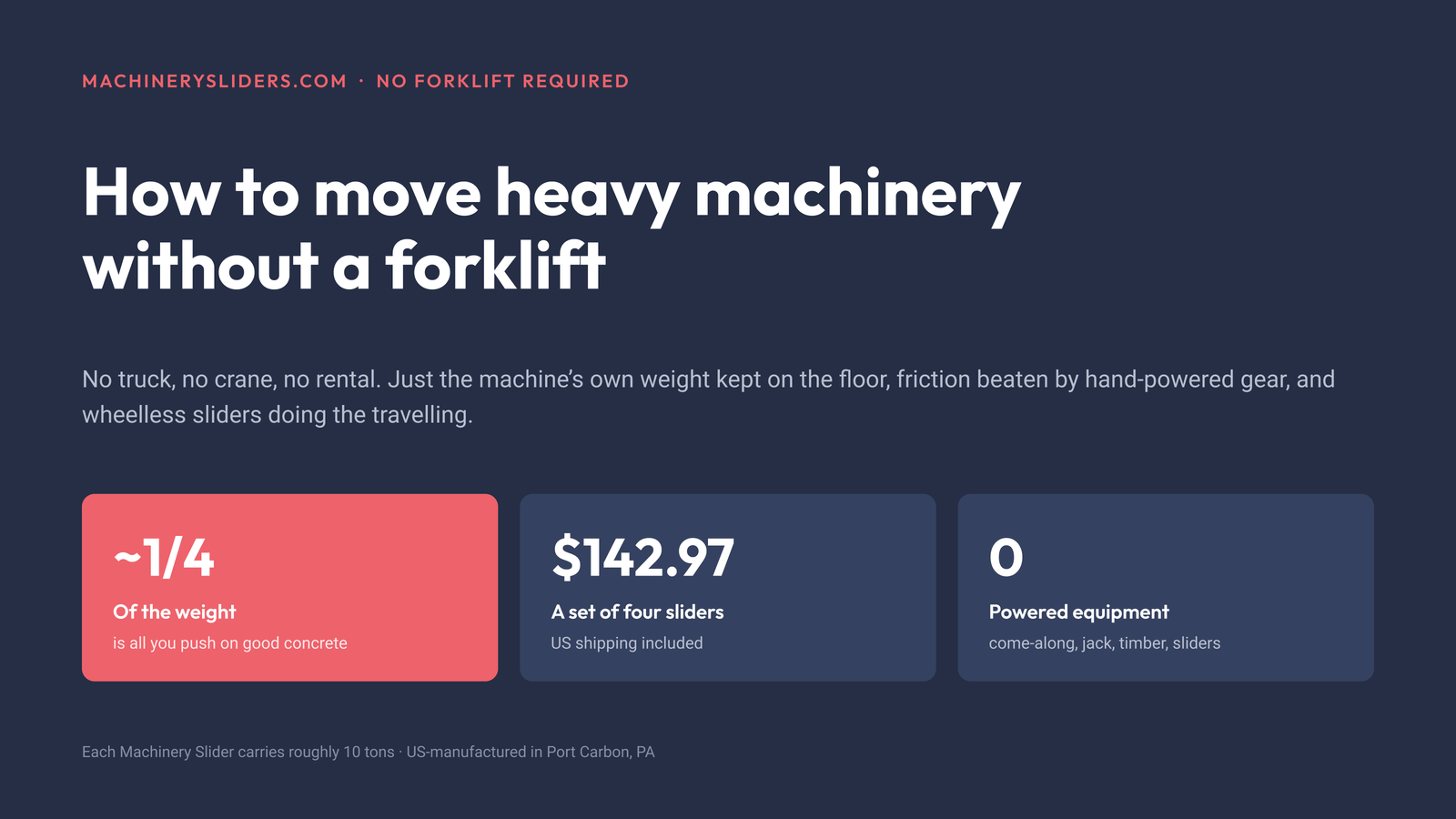
Direct answer You do not need to lift a machine to move it — on a level floor you only have to overcome friction, roughly a quarter to a third of the machine’s weight. Keep the weight on wheelless Machinery Sliders™ and supply the horizontal pull by hand: a come-along, chain hoist or lever hoist anchored to rated structure moves a 20,000 lb machine on about 5,000 lb of pull. Each slider carries roughly 10 tons and the load never leaves the floor.
Push, don’t lift — the physics that makes it possible
To lift a 20,000 lb machine you need 20,000 lb of lifting force. To slide the same machine on a level floor, you only need to overcome friction — roughly a quarter of its weight on smooth clean concrete, up to a third on a rough or dirty floor. That is about 5,000 to 7,000 lb of push for a 20,000 lb machine, and crucially the machine’s weight never leaves the ground. Each Machinery Slider carries roughly 10 tons, so the load rides on the sliders while you supply nothing but the horizontal shove.
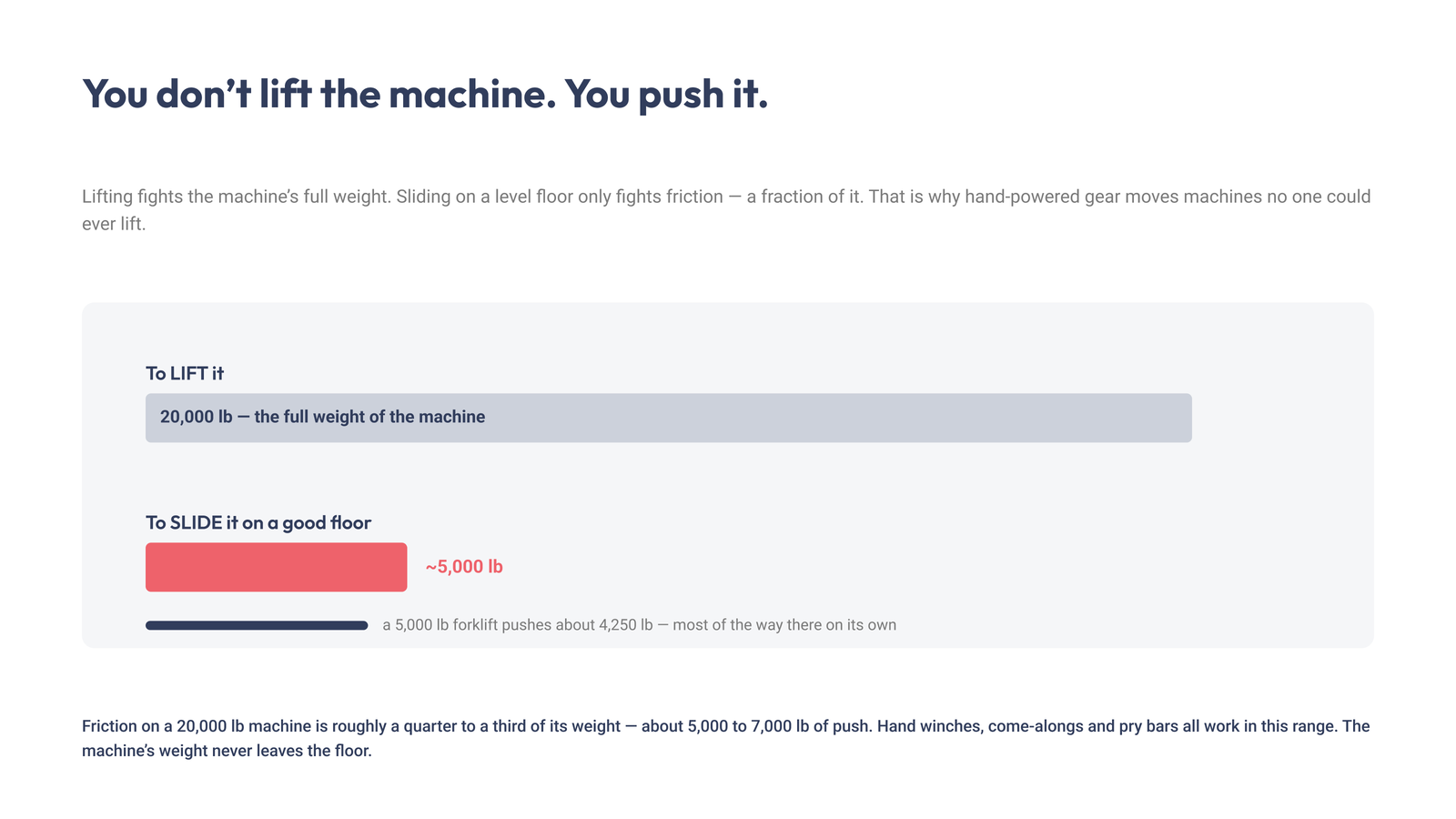
This is why moving without a forklift is realistic rather than heroic. Five thousand pounds of steady pull is well within the range of a hand winch anchored to solid structure. You are not fighting the machine’s weight — only the friction between the sliders and the floor.
Also see How Much Force Does It Take to Move a Machine
What you need
- Machinery Sliders — single-directional pads if the machine travels one line to its spot, multi-directional if the placement needs more than one direction. Whichever you choose, they stay under the load the whole way.
- A toe jack or bottle jack with timber, to lift the machine just enough to place the sliders — usually barely more than the thickness of the pad.
- A come-along, chain hoist or lever hoist, and rated chain or strap, to supply the pull.
- Solid timber and wood blocking, to push against and to spread the load.
- A rated anchor point — a structural column, wall tie or another heavy machine — to pull from.
Pick your pulling power
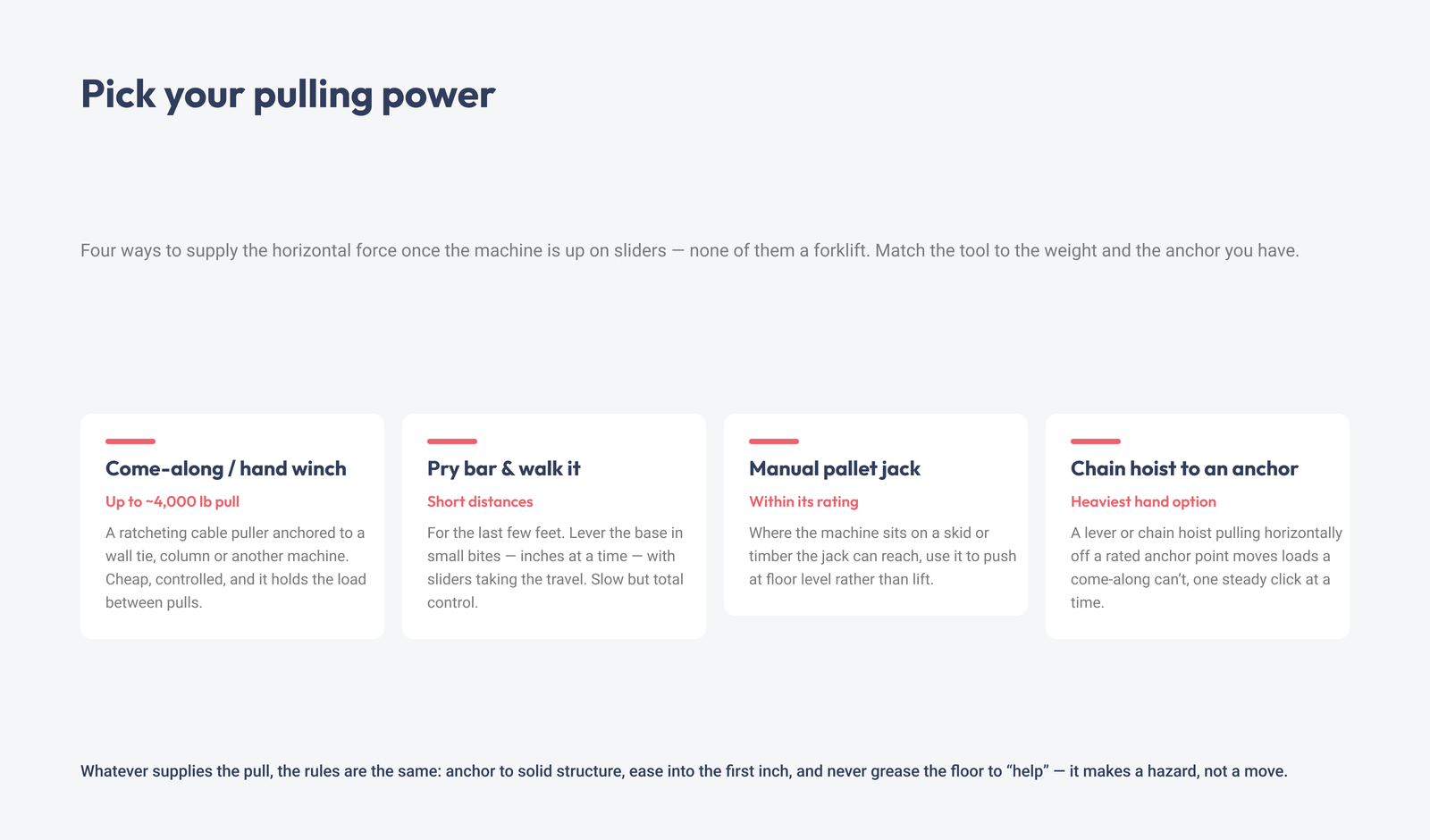
A come-along or hand winch is the workhorse — a ratcheting cable puller anchored to solid structure, good for a few thousand pounds of controlled pull, and it holds the load between pulls. A pry bar walks the machine the last few feet, levering the base in small bites while the sliders take the travel. A manual pallet jack can push at floor level where the machine sits on a skid it can reach. And a lever or chain hoist pulling horizontally off a rated anchor moves loads a come-along cannot, one steady click at a time. Whichever you use, the sliders do the travelling; the tool only supplies the pull.
The method, step by step
Walk the route first — clearances, floor condition, slopes and thresholds. Every 1 percent of grade adds about 1 percent of the machine’s weight to the pull, and the same holding force coming back down, so find the slopes before you start.
Jack the machine just enough to slide the pads underneath, arranged around its true center of gravity, single-directional pads pointing the way you are going. Anchor your come-along or hoist to something rated, take up the slack, and ease into the pull — the first inch takes the most force, and a sharp yank is how loads jump and people get hurt. Keep the pull steady and reset the anchor as you go. The sliders stay under the machine the whole way — you do not swap them out partway — and they come out only once it is on its marks or loaded. When the pull stops, the machine stops: there is no coasting on sliders, which is a control advantage wheels cannot offer.
The rules that keep it safe
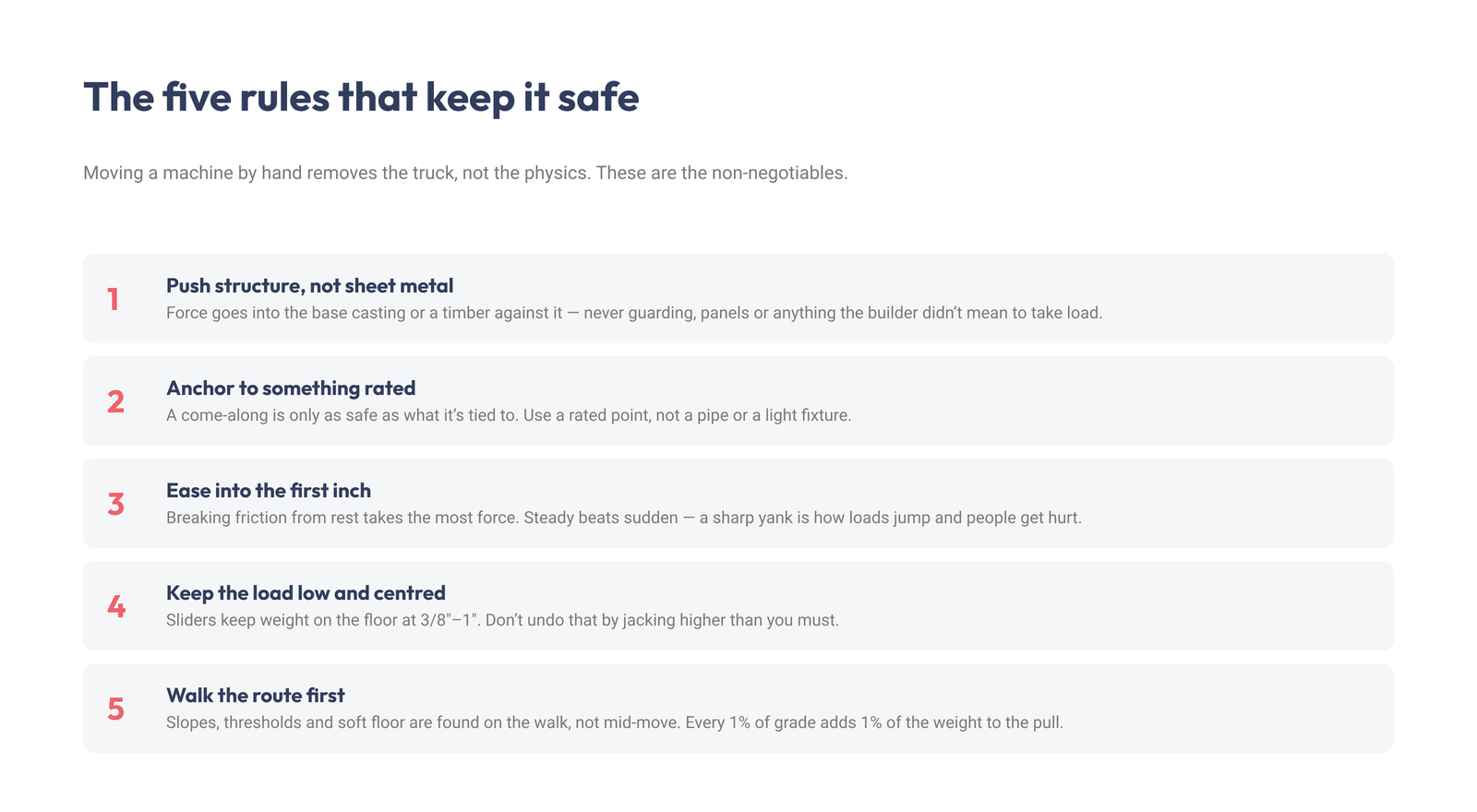
None of these is optional. Push against the base casting or timber, never against guarding or sheet metal the machine builder never meant to take load. Anchor to something actually rated for the pull. Ease into the first inch. Keep the load low and centered — sliders keep the weight on the floor at 3/8 to 1 inch, so do not undo that by jacking higher than you must. And walk the route before you move, not during.
A word on limits: some machines are too heavy, too tall, or too awkward to move safely by hand, and some jobs need a professional rigger. If the machine has an unpredictable center of gravity, or the route has real slopes, get a qualified assessment rather than guessing. Moving without a forklift is about method, not bravado.
When you do have a forklift
If a forklift is available, it changes the math in your favour — a 5,000 lb-capacity forklift can push roughly 4,000 to 4,500 lb on sliders, enough to move a machine several times its lift rating without ever picking it up. That method, with the full force calculations, is covered on the moving machinery with a forklift page.
Frequently asked questions
Can you really move heavy machinery without a forklift?
Yes. On a level floor you only overcome friction, which is about a quarter to a third of the machine’s weight, so hand-powered gear like a come-along or chain hoist can move machines far heavier than anyone could lift. The weight stays on the sliders the whole time.
How much force does it take to move a machine by hand?
Roughly a quarter to a third of its weight on decent concrete — about 5,000 to 7,000 lb of pull for a 20,000 lb machine. A hand winch anchored to solid structure covers much of that range.
What tools move a machine without a forklift?
Wheelless sliders to carry the load, a toe jack to place them, and a come-along, chain hoist or lever hoist anchored to rated structure to supply the pull. A pry bar handles the final few feet.
Is it safe to move a machine without a forklift?
It can be, with method. Push structure not sheet metal, anchor to a rated point, ease into the first inch, keep the load low, and walk the route first. Machines with an unpredictable center of gravity or routes with real slopes warrant a professional rigger.
How many sliders do I need to move a machine by hand?
The same rule as any move: each slider carries about 10 tons, so divide the machine weight by 20,000 lb, round up, and spread the pads around the true center of gravity.