
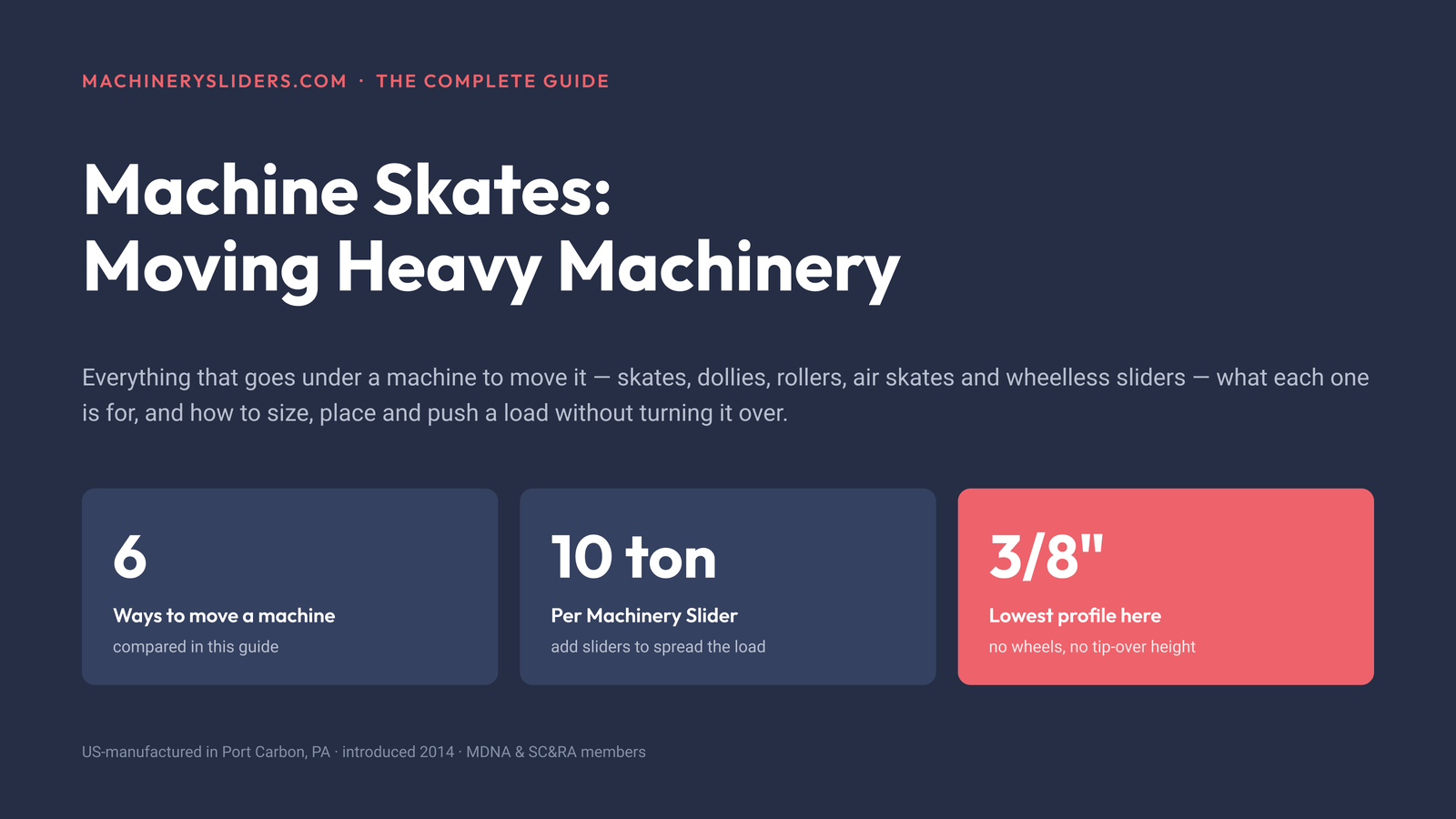
Direct answer The safest, lowest way to move a heavy machine is to keep its weight on the floor and slide it, not lift it. Machine skates, dollies and rollers ride 1.7– 5.35 inches up on wheels; wheelless Machinery Sliders™ sit just 3/8 inch off the floor and slide, cutting the lift, the tip-over height and the floor marking. Each slider carries roughly 10 tons, so you divide the machine weight by 20,000 lb, round up, and spread the pads around the true center of gravity.
What “machine skates” actually means
The phrase is used loosely. Strictly, a machine skate is a low steel frame carrying a row of rollers that a heavy load rides on. In practice people use “machine skates” as a catch-all for the whole family of low movers — skates, dollies, rollers, and the wheelless pads that do the same job by sliding. This guide uses the strict meaning when it matters and flags the difference wherever it does.
The six ways to move a heavy machine
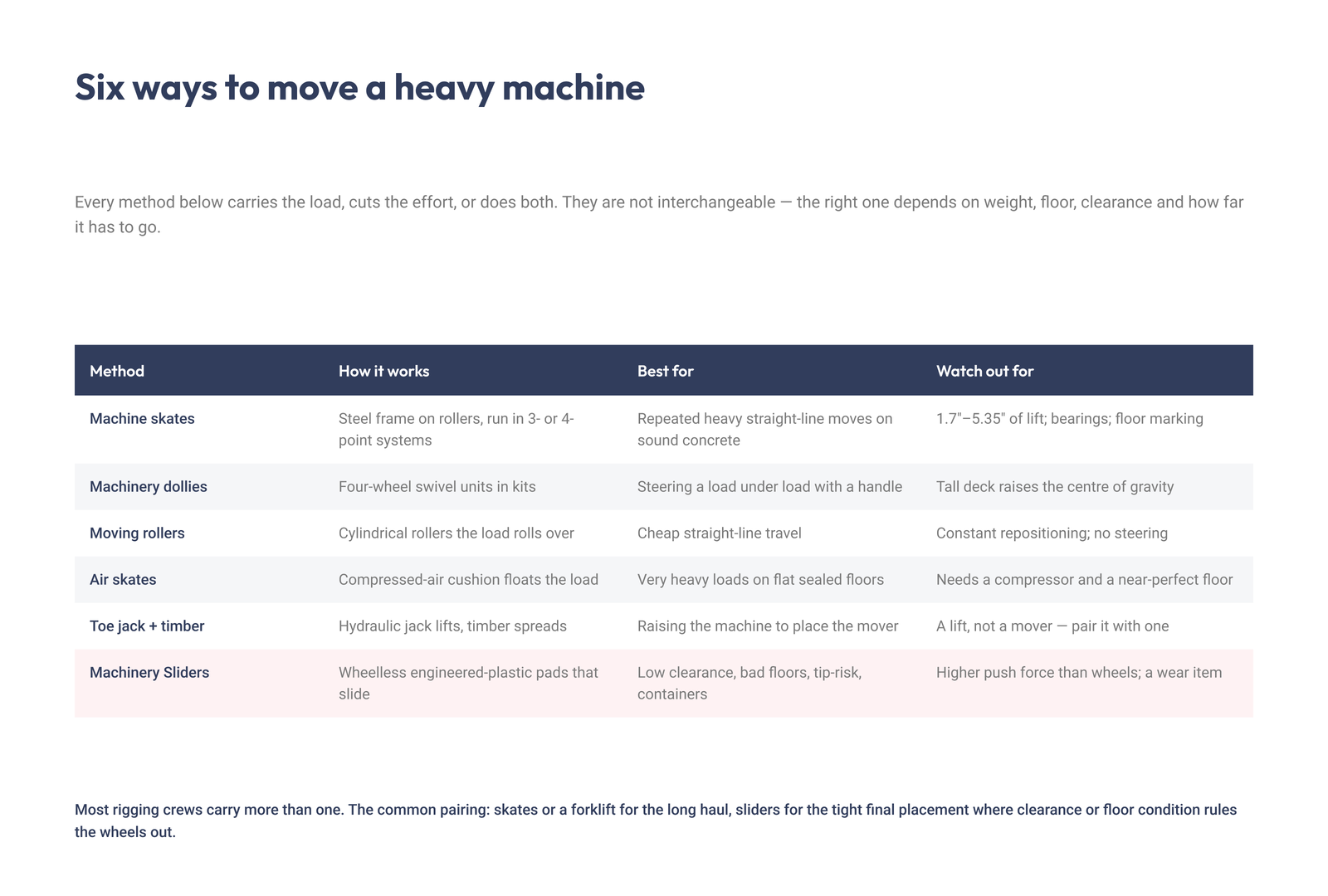
Every method below either carries the load, cuts the effort of moving it, or does both. They are not interchangeable. The right choice depends on four things: how heavy the machine is, what the floor is like, how much clearance you have, and how far it has to travel.
Machine skates
A welded steel frame on rollers — steel, nylon or polyurethane — run in three-point or four-point systems with one steerable unit at the front. Capacities span roughly 1.5 to 100 tons per skate depending on the model; Hevi-Haul, manufacturing in the USA since 1938, builds straight-line skates from 2.5 to 100 tons. Skates are the right tool for repeated, heavy, straight-line moves on sound concrete, and they last for decades if the bearings are maintained. Their limits are deck height (1.7 to 5.35 inches of lift), bearing wear, and floor marking from the rollers.
Machinery dollies
Four-wheel swivel units sold in kits — Hilman’s Bull Dolly is the archetype, four three-ton dollies plus handles and a case, rated twelve tons for the kit. The swivel top is the reason to own them: you can steer the load under load with a handle. The trade-off is deck height, which on a Bull Dolly is 5.35 inches, raising the machine’s center of gravity by that much.
Moving rollers
Cylindrical rollers laid under a load so it rolls forward in a straight line. Cheap and simple, with no bearings to fail, but no steering and constant repositioning — as the load rolls off the back roller you carry it to the front. Fine for short straight moves, tedious for anything longer.
Air skates
A cushion of compressed air floats the load almost frictionlessly across a flat, sealed floor. Extremely powerful for very heavy loads, but they need a compressor and a near-perfect floor — any seam, crack or debris breaks the cushion. Specialist equipment for specialist conditions.
Toe jack and timber
A hydraulic toe jack lifts the machine just enough to place whatever is going to move it, and timber spreads the load and gives the mover something solid to sit under. Note that this is a lift, not a mover — it is always paired with one of the other methods, never used alone to travel.
Machinery Sliders
Wheelless pads of engineered plastic resin that the machine slides on rather than rolls. The single-directional pad is 3/8 inch high and follows whichever way you push or pull it, including around curves, though it will not track sideways. The multi-directional pad is 1 inch high and moves in any direction, sideways included, when a pin drops through the machine’s foot into its center hole. Each is rated at approximately 10 tons. They are the right tool when clearance is tight, the floor is poor, the load is top-heavy, or the machine is going into a shipping container — and the wrong tool for long straight hauls on good concrete, where a wheeled skate is less effort.
How to size a set
Sizing is where most mistakes happen, and the rule is the same across skates and sliders: the combined rated capacity has to exceed the machine’s actual weight, with margin, and it has to be arranged around the machine’s true center of gravity rather than its visual center.
For machine skates, a common rule of thumb is to choose a set whose combined rating exceeds the machine weight by 20 to 30 percent, because one skate can momentarily carry more than the others as the load shifts mid-move. For Machinery Sliders, each pad carries roughly 10 tons — 20,000 lb — so you divide the machine weight by 20,000, round up, and spread the pads to keep the floor loading down. The manufacturer’s own worked example moves a 100-ton press on sixteen single-directional sliders under a 6-inch by 6-inch timber laid across the lead edge — 6.25 tons per pad in practice, comfortably inside the rating.
Whatever you use, do not assume one mover at each corner is safe. A machine with an uneven center of gravity loads one area far more than another, and the arrangement has to account for weight, base configuration, mover count, individual capacity and floor condition together.
The move, step by step
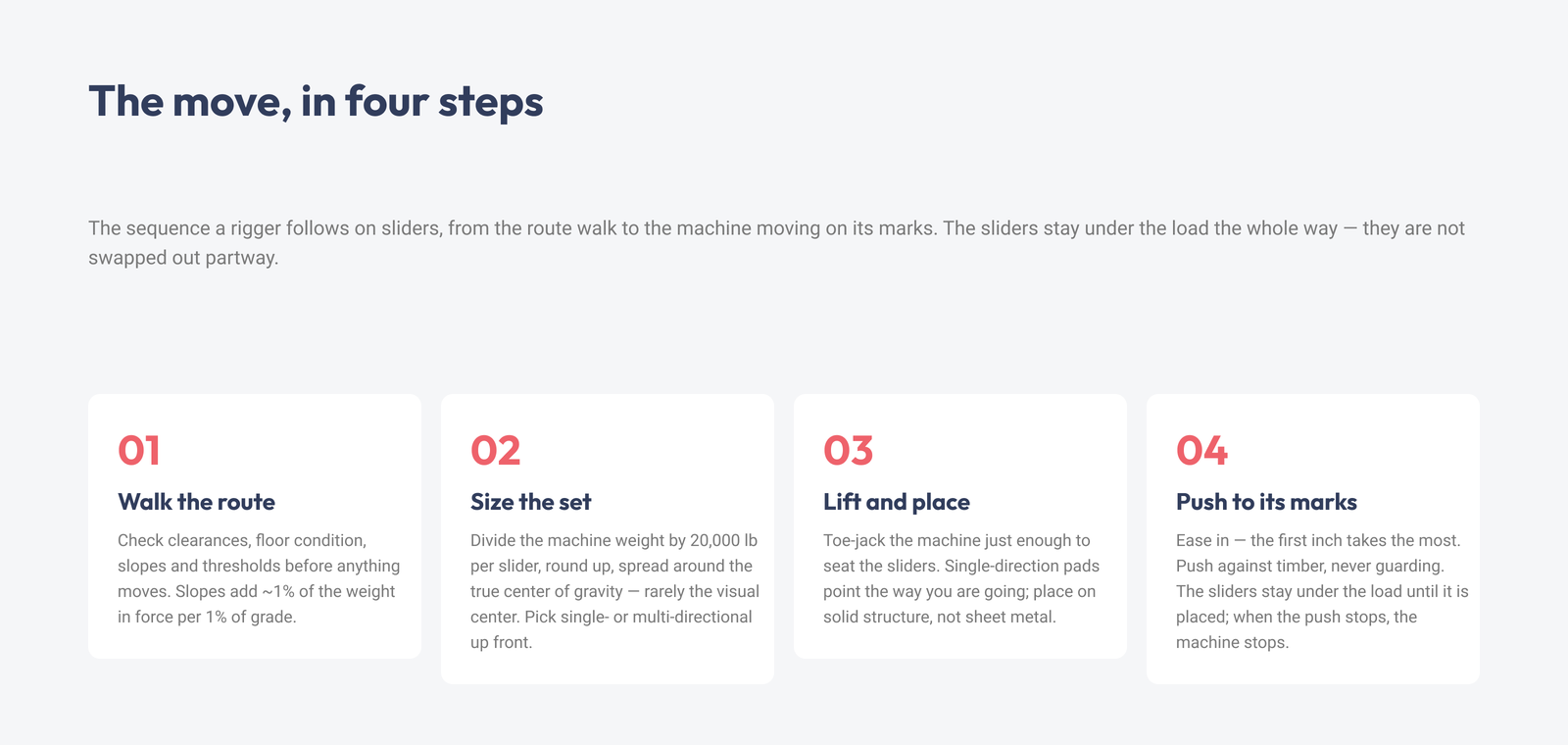
Walk the route first. Every experienced crew does this and every incident report explains why: clearances, floor condition, slopes, thresholds and soft spots are found on the walk, not mid-move. Remember that every 1 percent of grade adds roughly 1 percent of the machine’s weight to the force you need — and demands the same holding force coming back down.
Size the set to the weight and the center of gravity, and choose the pad up front: single-directional if the machine travels one line to its spot, multi-directional if the placement needs movement in more than one direction. Lift with a toe jack just enough to place the movers, and set them on solid structure — the base casting or timber against it, never sheet metal or guarding. Then push past friction: ease into the first inch, because breaking a load from rest takes more force than keeping it moving, and steady always beats sudden. The sliders stay under the machine the whole way — you do not swap them out partway. They come out once the machine is on its marks or loaded.
How much force does it actually take?
Less than people expect, because on a level floor you are not lifting the machine, only overcoming friction — and friction is a fraction of the weight. On smooth clean concrete, figure about a quarter of the machine’s weight; on an average shop floor, about a third. So a 20,000 lb machine needs roughly 5,000 to 7,000 lb of pull, which is well within reach of a forklift pushing on sliders, or even hand-powered gear. The full method, with the friction numbers, the forklift math and the ramp rule, is on the force-to-move-a-machine page.
Reading the floor before you commit
The floor decides more moves than the machine does. Before anything rolls or slides, the route gets inspected end to end for cracks and damaged concrete, uneven surfaces, floor joints, drain covers, thresholds, slopes, debris, wet or contaminated areas, narrow passages, doorways and low overhead clearance. A machine may weigh several tons, and floor capacity should never be assumed — where there is any doubt, the building owner, a structural engineer or the equipment manufacturer is the right person to ask.
Floor condition also chooses the mover. Steel-rollered skates want sound, smooth concrete and will mark it; nylon and polyurethane rollers are gentler but still concentrate load on a line. Wheelless sliders spread the load across a pad and tolerate tile, wood, carpet, dock plates and damaged concrete that would stop a wheeled skate — which is precisely why crews reach for them when the floor is the problem rather than the weight.
Tip-over: the failure that actually hurts people
Machines are rarely lost because a mover fails under load. They are lost because a load tips. Raising a machine’s center of gravity — even by the few inches of a tall dolly or skate — narrows the tip-over margin on tall, narrow equipment, and wheeled movers can roll unexpectedly on a ramp or sloped floor. Extracting a mover from beneath a positioned load, especially inside a tight shipping container, is one of the higher-risk moments in any move.
Two things reduce that risk directly: keeping the center of gravity low, and keeping the load on the floor. A lower mover means a lower center of gravity and a smaller drop if a corner ever comes off the mover. This is the safety argument for wheelless sliders in one sentence — at 3/8 inch to 1 inch they add almost no height, so there is less to tip and less distance to fall. The full treatment is on the how Machinery Sliders reduce risk page.
Which method for which job
A rough map, to turn all of the above into a decision:
- Long straight haul across sound concrete, moved often — machine skates, or a forklift pushing on sliders.
- Tight aisles that need steering under load — swivel dollies, or multi-directional sliders chosen for that job from the start.
- Low clearance under a header, in a trailer, or under the machine itself — wheelless sliders, nothing else gets that low.
- Damaged, tiled, wooden or carpeted floor — wheelless sliders, to spread the load off the wheel line.
- Very heavy load on a flat sealed floor with compressed air on hand — air skates.
- Top-heavy machine where tip-over is the real risk — the lowest-profile mover you can use, spread wide around the true center of gravity.
- Into a shipping container to stay there — wheelless sliders, cheap enough to leave under the load.
Choosing between them
Most rigging crews do not pick one method and stick to it. They carry more than one and use each where it is strongest. The common pairing is a wheeled skate or a forklift for the long haul across the shop, and sliders for the tight final placement where clearance or floor condition rules the wheels out. If you only take one decision rule from this guide, make it this: match the mover to the constraint that actually governs your job — weight, floor, clearance or distance — and stop trying to make one tool do everything.
Frequently asked questions
What is the difference between machine skates and machinery dollies?
A machine skate is a low steel frame of rollers run in a multi-point system, best for heavy straight-line moves. A dolly is a four-wheel swivel unit, usually sold in kits, whose advantage is that you can steer the load under load with a handle. Skates carry more and steer less; dollies steer better and sit taller.
How many machine skates do I need for my machine?
Enough combined rated capacity to exceed the machine’s weight with a 20 to 30 percent margin, arranged around the true center of gravity. For Machinery Sliders, divide the machine weight by 20,000 lb per pad and round up. Never assume one mover per corner is automatically safe.
Can you move a machine without a forklift or crane?
Yes. On a level floor you only have to overcome friction — about a quarter to a third of the weight — so hand-powered gear such as a come-along, a chain hoist or a pry bar can move machines no one could lift. The machine’s weight stays on the movers the whole time.
What is the lowest-profile way to move a machine?
Wheelless sliders. A single-directional Machinery Slider sits 3/8 inch off the floor, against 1.7 inches for the lowest wheeled skate on the market. Lower profile means less jacking and a lower center of gravity.
Do machine skates damage floors?
They can. Steel rollers mark concrete; nylon and polyurethane mark it less. All wheels concentrate load onto a narrow contact line, which is what damages tile, wood and dock plates. Wheelless sliders spread the load over a pad instead, which is why they are used on delicate floors.
What is the safest way to move a top-heavy machine?
Keep the center of gravity as low as possible and the load on the floor. That means the lowest-profile mover you can use, arranged wide around the true center of gravity, pushed steadily rather than jerked. Lifting a top-heavy machine onto tall movers or forks is where tip-overs happen.