
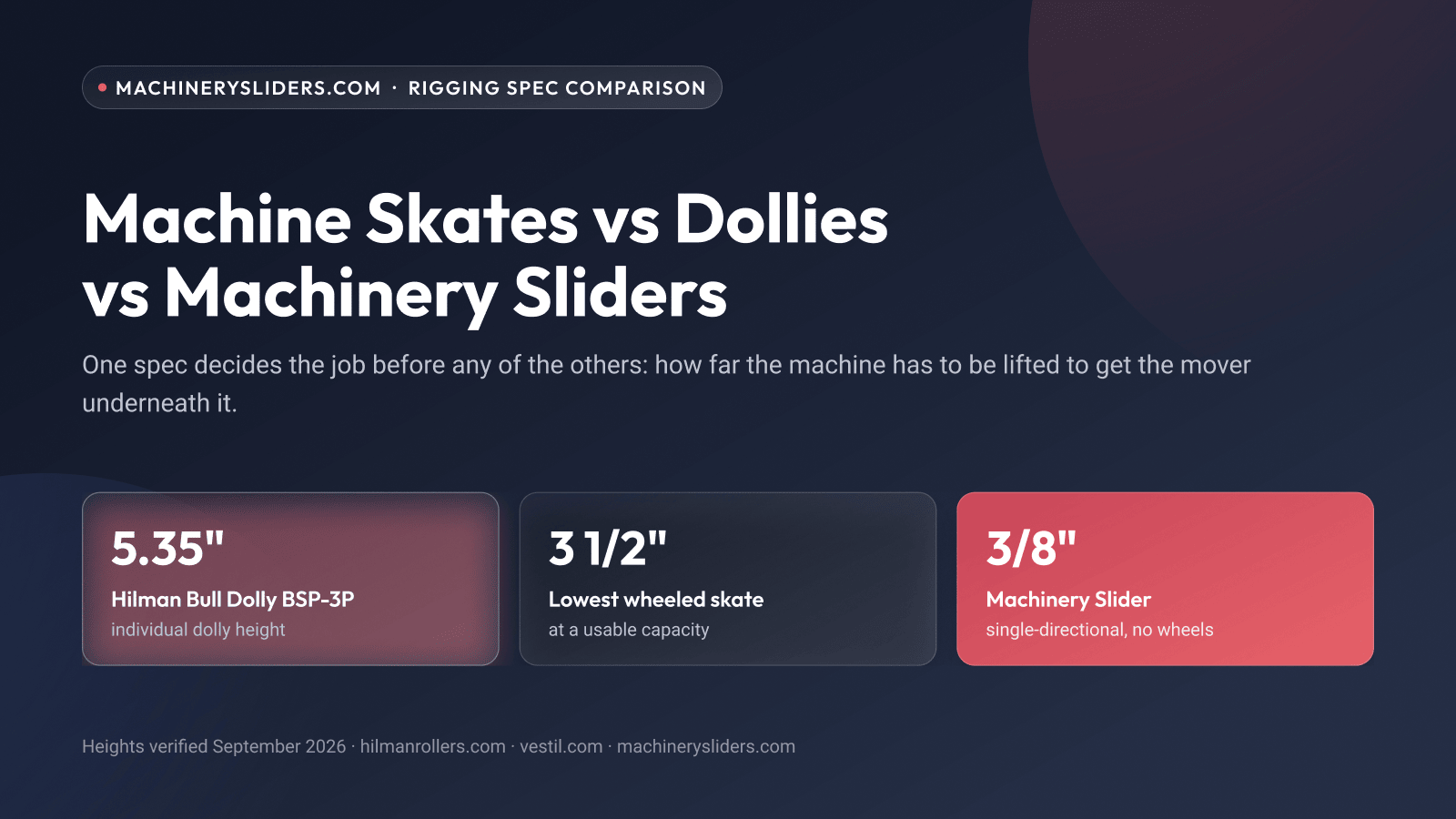
Direct answer Machine skates and machinery dollies are steel frames on wheels: they roll the load and lift it 3 1/2″ to 5.35″ off the floor. Machinery Sliders™ are solid engineered-plastic pads with no wheels, axles or bearings: they slide the load and lift it 3/8″. Skates win the long straight runs on sound concrete, and they let you steer under load with a handle. Sliders win when clearance, floor condition, tip-over risk, clean-room use or cost decides the job — $35.74 each against $237 to $590 for a single wheeled unit. Most working rigging crews carry both.
Machine skates and machinery dollies are steel frames on wheels. They roll a load across a floor, and to do it they lift that load somewhere between 3 1/2 and 5.35 inches off the ground. Machinery Sliders are solid engineered-plastic pads with no wheels at all. They lift the load three-eighths of an inch and slide instead of rolling. Skates win the long, smooth, straight runs. Sliders win when clearance, floor condition, tip-over risk or cost is the thing that decides the job.
The short answer
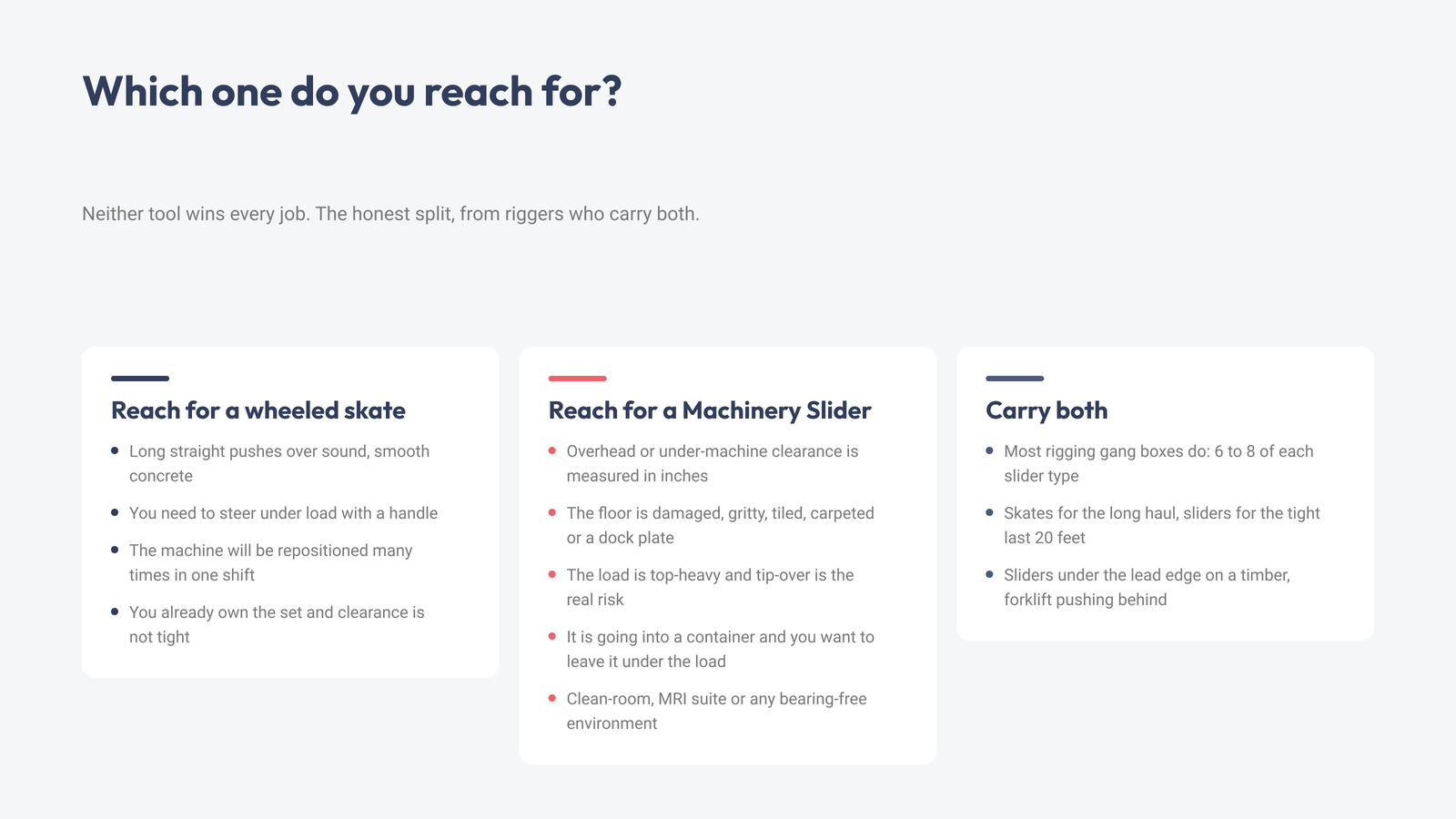
- Reach for a machine skate or dolly when you have clearance to spare, sound smooth concrete, a long straight run, and you need to steer under load.
- Reach for a Machinery Slider when the clearance is measured in inches, the floor is damaged, tiled, carpeted or a dock plate, the load is top-heavy, or the mover is going into a shipping container and staying there.
- Most working rigging crews carry both. The two tools solve different halves of the same job.
What each tool actually is
Machine skates and load skates
A machine skate is a welded steel frame carrying a row of rollers, usually steel, nylon or polyurethane. Capacities run from roughly 1.5 tons to 100 tons per skate depending on the model — Hevi-Haul’s straight-line skates, manufactured in the USA since 1938, span 2.5 to 100 tons. They are usually run in three-point or four-point systems, with one steerable unit at the front and fixed units behind. They are the correct tool for repeated, heavy, straight-line moving, and they last decades if the bearings are looked after.
Machinery dollies
A dolly is typically a four-wheel swivel or rigid unit sold in kits. Hilman’s Bull Dolly kit is representative: four three-ton dollies, two steering handles and a steel carrying case, rated at twelve tons for the kit. Each individual dolly measures 5.35 inches high, 5.23 inches wide and 8 inches long, and the kit weighs 100 lb. The swivel top is the reason to buy one — you can redirect the load under load with the handles.
Machinery Sliders
A Machinery Slider is a solid pad of high-performance engineered plastic resin with no wheels, no axles and no bearings. The single-directional slider is arrow-shaped, 3/8 inch high, 8-1/4 inches wide and 11-1/2 inches long, and travels in one direction only. The multi-directional slider is round, 1 inch high and 8 inches in diameter, with a 1-inch center hole so a bolt or pin can drop through the machine’s foot into the slider — that is what gives it 360-degree travel. A third version replaces the 1-inch hole with a 4-inch recess so a leveling pad seats inside it. Each is rated by the manufacturer at approximately 10 tons, and each weighs between 13 oz to 1.3 lb. There is a fuller explanation of what a Machinery Slider is.
Profile height: the spec that quietly decides everything
Every other specification is negotiable. Height is not. If the mover plus the machine is taller than the opening, the job stops, and no amount of capacity rating fixes it.
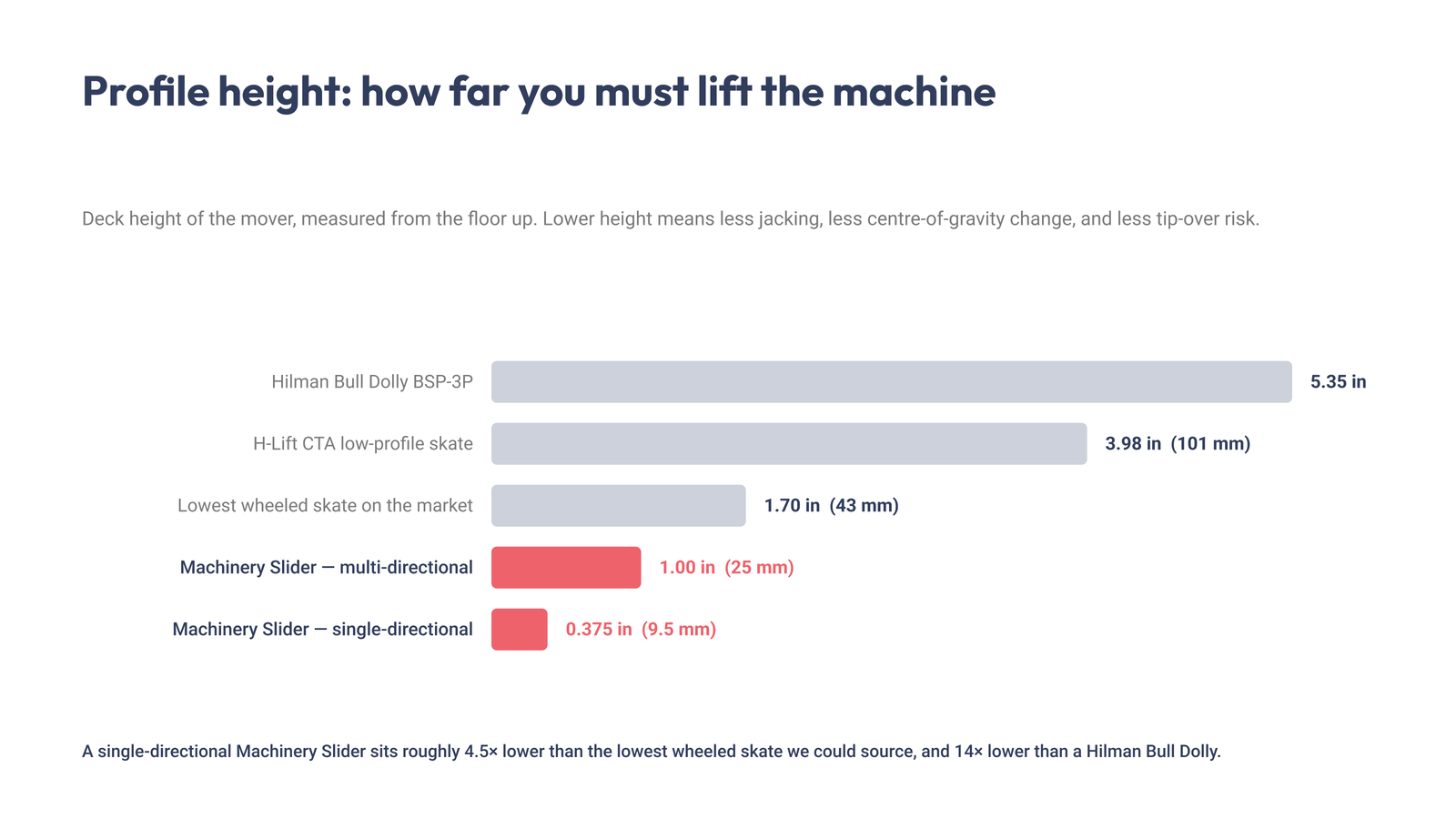
The lowest wheeled skates at a usable capacity sit at 3 1/2 inches, on Vestil’s MDSKT-2 and Beacon’s BVHMS-2, with 3 7/16 inches on Hilman’s N.5-SP at half a tonne the lowest in any catalogue. H-Lift’s low-profile CTA series advertises a deck height as low as 101 mm — just under four inches — and calls that a selling point, which it is, for a wheeled skate. A Hilman Bull Dolly is 5.35 inches. A single-directional Machinery Slider is 0.375 inches: roughly four and a half times lower than the lowest wheeled skate anyone sells, and fourteen times lower than the Bull Dolly.
Two consequences follow from that number, and they matter in opposite directions. The first is how far you have to jack the machine to get the mover under it. The second is how far the machine falls if the mover ever comes out. Both are covered in detail on low-clearance machinery moving.
The full comparison
Weight, and the injury nobody writes up
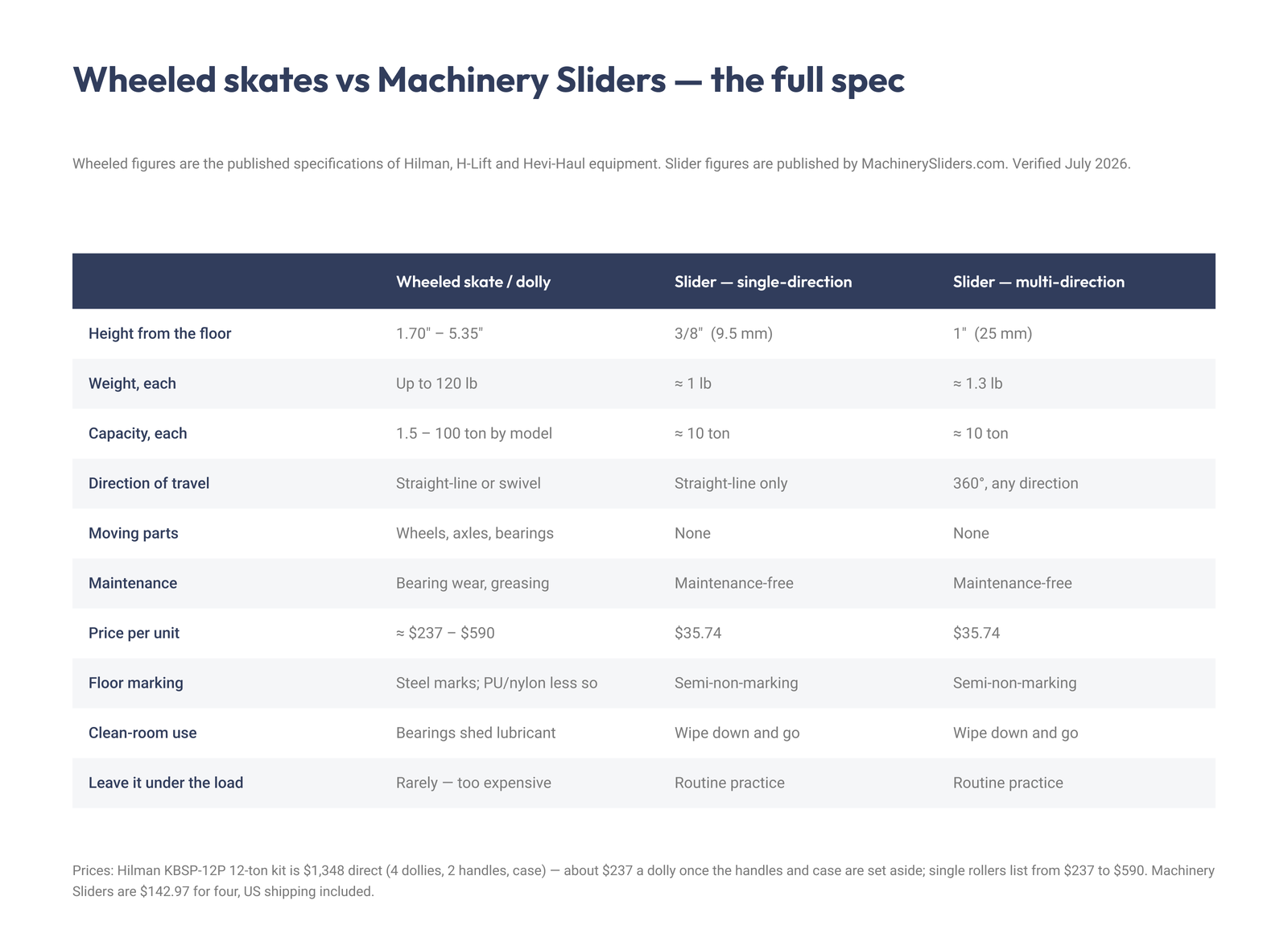
Traditional steel dollies and skates run up to 120 lb each. A Machinery Slider weighs about a pound. That difference does not show up in a capacity table, but it shows up in the crew: placing a set of four steel skates under a machine is four opportunities for a back strain, and it usually takes two people. A set of four sliders is carried in one hand.
It also changes what a crew keeps to hand. A rigger typically carries six to eight of each slider type in the gang box, and larger rigging companies order 200 to 300 at a time to kit out a whole crew. Nobody stocks 300 steel skates.
Capacity, and how sizing actually works
Machine skates are rated per skate and combined into a system: four ten-ton skates under a forty-ton machine, with the front unit steerable. Machinery Sliders are rated at approximately ten tons each and sized on the same logic, one under each leveling column, with more added to spread the pounds per square inch across a wider area of floor. The arithmetic behind the push itself is on how much force it takes to move a machine.
The manufacturer’s own worked example is the useful one. To move a 100-ton press in one direction, they put a 6-inch by 6-inch timber perpendicular across the lead edge of the machine, sixteen single-directional sliders under that timber, and a forklift pushing from behind. Sixteen sliders under 100 tons works out at 6.25 tons each — comfortably inside the ten-ton rating, which is how it should be. Ten tons is the rating; six is the working number once you have derated for floor condition and uneven load distribution.
What each one costs over a working year
As of this writing, a Hilman 12-ton Bull Dolly kit lists at $1,348 direct from the manufacturer and $1,795 through some distributors. Individual Hilman rollers run from around $237 for a two-ton unit to $590 for a fifteen-ton. Four Machinery Sliders cost $142.97 — $35.74 each, and the price per slider barely moves at volume, from $35.74 in a four-pack to $35.11 in a 64-pack.
The honest counterweight: steel skates are capital equipment and sliders are a wear item. Sliders wear according to the surface and the load. On carpet they last a very long time. On asphalt, the coarseness of the surface shortens their life considerably. A steel skate maintained properly outlives the crew that bought it.
Where the economics genuinely invert is container work. At thirty-five dollars, a slider is cheap enough to leave in place under a machine that has been loaded into a shipping container, rather than fighting a fully-packed container to retrieve it. No one leaves a $337 dolly behind. There is a dedicated page on loading machinery into shipping containers.
Floors, marking and point loading
Steel wheels mark concrete. Nylon and polyurethane wheels mark it much less, which is why every skate manufacturer sells all three. But every wheel concentrates the load onto a narrow contact line, and on tile, wood, dock plates, epoxy or damaged concrete that concentration is what does the damage.
A Machinery Slider is non-point-loading — the load spreads across an 8-inch pad rather than a roller line. On marking, the manufacturer’s own wording is worth repeating precisely: they are semi-non-marking, meaning they can leave marks on certain floor surfaces, and those marks can be removed. That is a more useful statement than a blanket “non-marking” claim, and it is the wording to trust. The surface-by-surface detail is on moving over floors and truck surfaces.
Bearings, clean rooms and magnetic environments
A wheeled skate has bearings, and bearings carry lubricant. That is what rules them out of clean rooms and makes them awkward around MR-controlled environments where the magnet is always on. A Machinery Slider has no bearings, no lubricant and no steel to attract: it is wiped down and used. If your work takes you into semiconductor fabs, pharmaceutical suites or hospital imaging, that is not a marginal advantage — it is the entire reason a slider gets specified. See clean-room machinery moving.
How crews actually run both
The common pattern is not one tool or the other. It is skates for the long haul across the shop and sliders for the last twenty feet where the aisle narrows, the floor changes, or the machine has to clear a header. It is sliders under the lead edge on a timber with a forklift pushing from behind, when the machine is heavier than anything you can lift. It is sliders under leveling pads for the final positioning, when a quarter-inch matters and a swivel dolly is too coarse an instrument.
Frequently asked questions
What is the difference between a machine skate and a Machinery Slider?
A machine skate is a steel frame on wheels that rolls the load and lifts it between roughly 3 1/2 and 5.35 inches. A Machinery Slider is a solid engineered-plastic pad with no wheels that slides the load and lifts it 3/8 inch for the single-directional model or 1 inch for the multi-directional. Skates roll; sliders slide.
Are Machinery Sliders as strong as machine skates?
Each Machinery Slider is rated at approximately 10 tons, which is in the same range as a mid-size machine skate. Heavier machines are handled by adding sliders rather than by upgrading to a larger unit — sixteen sliders under a 100-ton press is the manufacturer’s published example.
Can you steer a load on Machinery Sliders?
Not the way you steer a swivel dolly with a handle. The multi-directional slider travels 360 degrees when a bolt or pin drops through the machine’s foot into its 1-inch center hole, so the load can move in any direction, but there is no steering handle. If you need to steer under load, a swivel dolly is the better tool.
Do Machinery Sliders damage floors?
They are described by the manufacturer as semi-non-marking: they can leave marks on some floor surfaces, and those marks can be removed. Because they are non-point-loading, they spread weight over an 8-inch pad instead of concentrating it on a roller line, which is why they are used on tile, wood, carpet, dock plates and damaged concrete.
How many machine skates or sliders do I need?
For skates, a three-point or four-point system rated above the machine weight. For sliders, one under each leveling column as a starting point, then more to spread the pounds per square inch. A rigger’s gang box typically holds six to eight of each type.
Are Machinery Sliders cheaper than machine skates?
As of this writing, per unit, considerably. Four sliders are $142.97, against $1,348 for a 12-ton Hilman Bull Dolly kit. Sliders are a wear item and skates are capital equipment, so the comparison over ten years depends on your surfaces — but on the day of purchase the gap is roughly ten to one.
Where to go next
If the deciding factor on your job is clearance rather than capacity, the low-clearance page covers the door headers, trailer roofs and freight-elevator frames that stop a move. If you have a question this page did not answer, there is the full question and answer hub. If you already know what you need, the store lists all five sets.