
Two Forklifts, No Movement —
Where Did All That Force Go?
Home » Technical Library » Force & Rigging » Two Forklifts, No Movement — Where Did All That Force Go?
By Machinery Sliders™ Technical Team|Drawing on industry background in machinery rigging and moving equipment|Last Updated: November 8, 2026
Direct Answer: The Machine Isn’t Moving. But Two Forklifts Are Fighting Each Other.
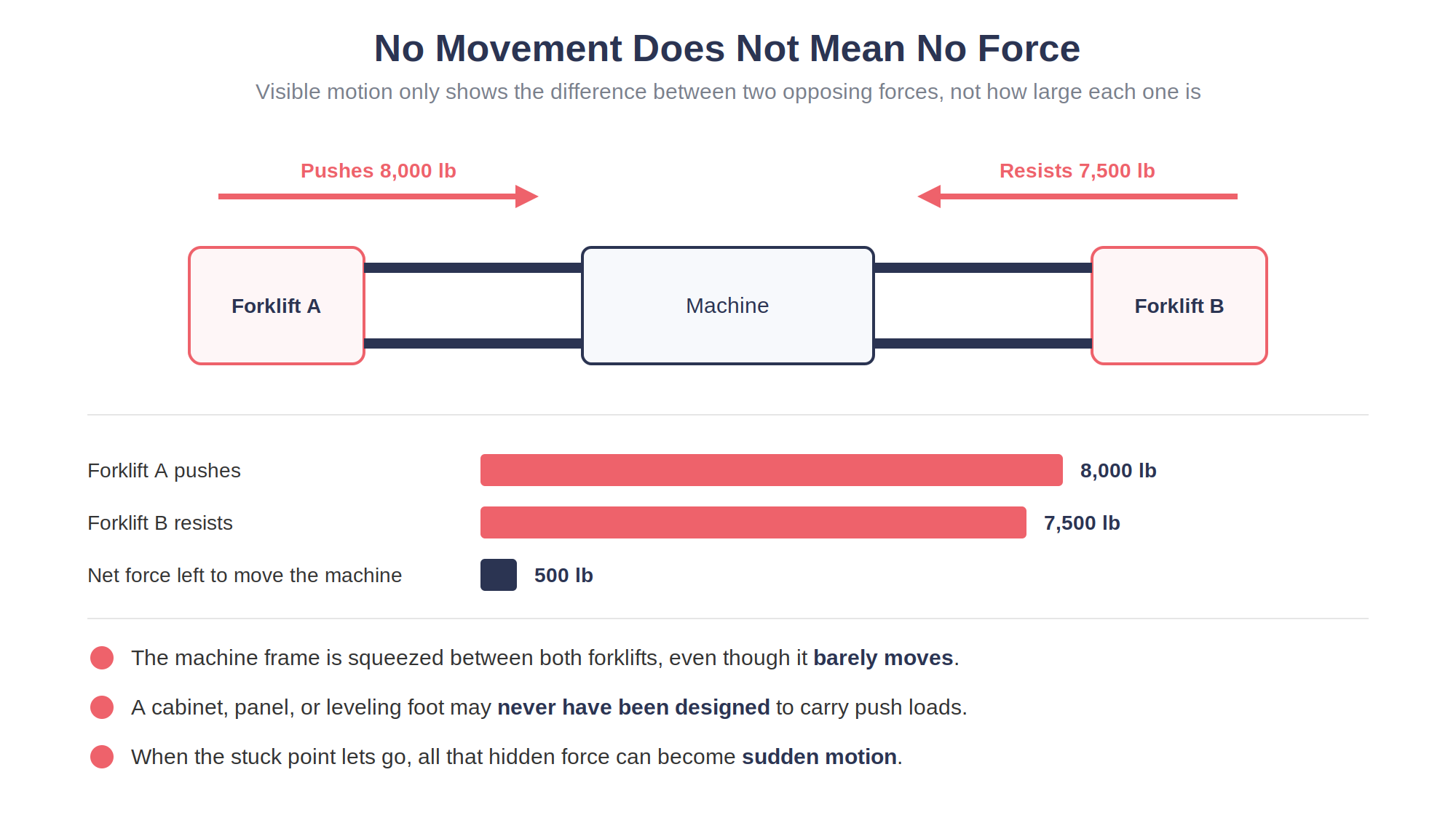
When one forklift pushes a machine forward while another restrains it from the opposite side, the machine can look almost perfectly still while both forklifts are actually applying enormous, nearly-canceling force. Visible movement only shows the difference between two opposing forces — it tells you nothing about how large those forces are individually. A machine that barely moves an eighth of an inch can still have thousands of pounds traveling through its frame, its contact points, its skates, and the floor. No movement does not mean no force. Sometimes it means two large forces are almost canceling each other out.
Think of a Bench Vise, Not a Tug-of-War
Two people pulling opposite ends of a rope with equal force don’t move the rope, but the rope is still fully tensioned — the same principle applies at machinery-moving scale, just with a 40,000-pound machine standing in for the rope. A better mental image is actually a bench vise: once the jaws contact the workpiece, further tightening produces almost no movement but dramatically increasing force. Lack of motion doesn’t indicate low load. Sometimes it indicates exactly the opposite.
The Machine Can Become the Workpiece Between Two Forklifts
If one forklift pushes with 8,000 lbs and the opposing forklift resists with 7,500 lbs, the net force actually available to move the machine might be only 500 lbs — but major parts of the system are still transmitting loads in the thousands of pounds. A machine base wasn’t necessarily designed to be a structural push beam between two arbitrary contact points, and force traveling through sheet metal, a cabinet frame, a welded crossmember, or a leveling foot never intended for horizontal loading can distort the machine without it ever visibly moving. Elastic distortion can spring back completely once the forklifts release, leaving no visible sign anything happened — or it can leave the machine permanently out of alignment, which is only discovered much later during a completely unrelated troubleshooting session.
Never Push Against a Convenient Surface — Find the Actual Structure
A cosmetic panel, cabinet door, electrical enclosure, or unsupported cover can collapse long before the machine itself moves, and even a machine foot may be designed primarily for vertical reaction, not horizontal push force. Before applying force, trace where it actually enters the machine and how it travels through to the opposing contact point — if you can’t trace that load path, you don’t yet understand the setup well enough to proceed.
Restraint Can Hide the Very Problem It's Meant to Control
If a machine is stuck on a floor joint or a caught skate, a holding forklift on the opposite side can make the situation look perfectly controlled — while force quietly builds on both sides of the obstruction. When that obstruction finally releases, the force balance changes almost instantly: the machine can jump, rotate, or suddenly transfer huge load onto the forklift that was previously just holding steady. See our page on stored energy in rigging systems — the same underlying mechanism applies here, just stored in tires, forks, and machine structure instead of wire rope. Two independent forklift operators are not synchronized hydraulic controls; both pedals looking similarly positioned tells you nothing about whether the actual forces are balanced, and traction differences between one forklift on rough concrete and another on smooth or oily flooring can shift the whole balance without warning.
Offset Force Lines Create Torque, Not Just Compression
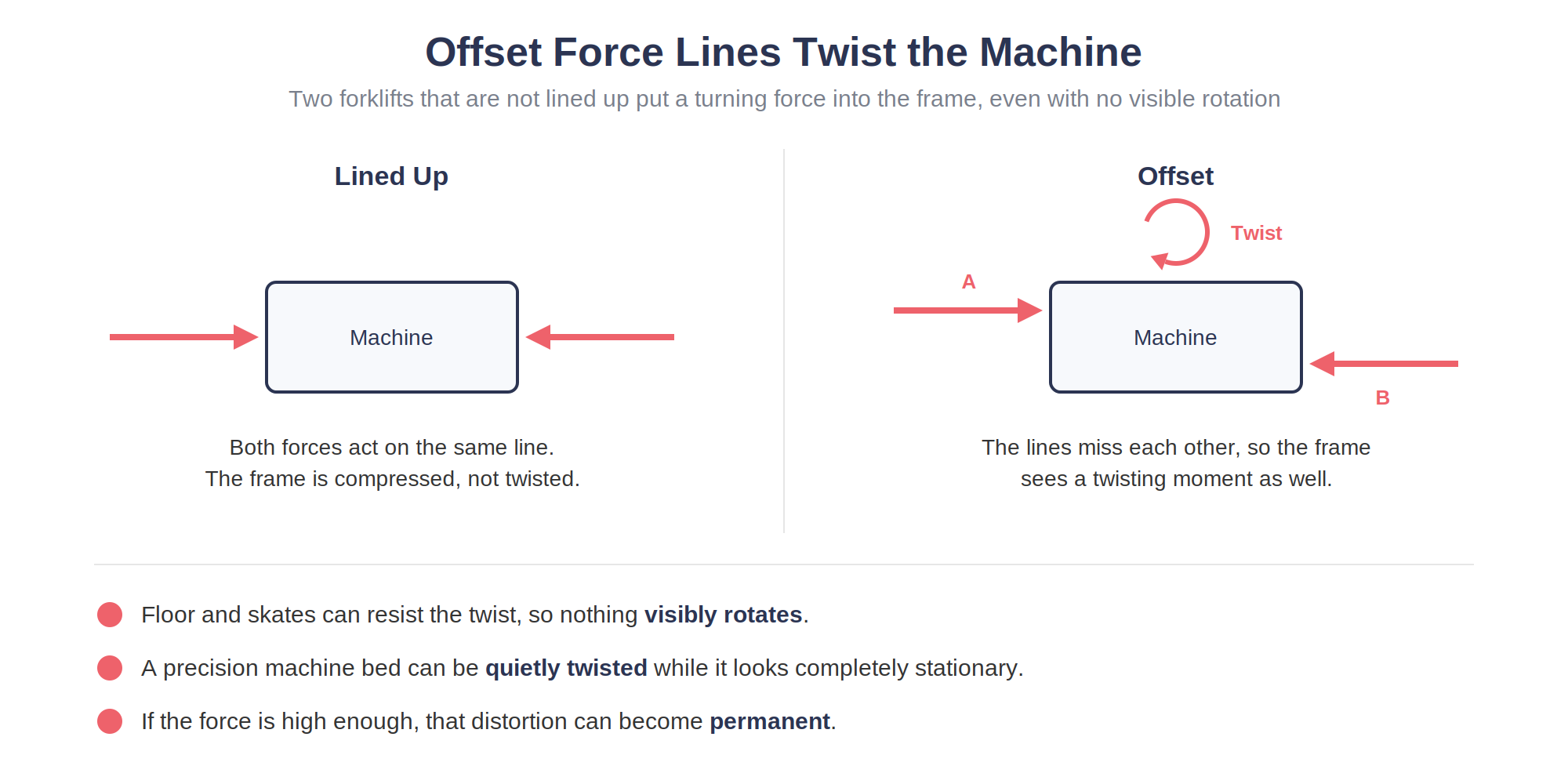
If the two forklifts’ force lines aren’t perfectly collinear, the mismatch creates a twisting moment across the machine — the same force-times-distance relationship covered on our page about why a heavy machine can rotate during a straight pull. The floor and skates can resist that twist enough to prevent any visible rotation, but lack of visible rotation doesn’t mean lack of torque — a precision machine bed can be quietly torsion-loaded while looking completely stationary, and if the force is high enough, that distortion can become permanent.
Forklift Ratings Don't Automatically Cover This Use
A forklift’s rated lifting capacity does not automatically establish its suitability for pushing, pulling, or serving as a restraint or anchor — those are different physics with different limits, and using forks to push a load (“bulldozing”) carries real, well-documented risks: compromised capacity, fork or floor damage, tipping, and reduced control. Rigging directly off the fork tips without an appropriate approved attachment, or assuming a rear tow pin can handle any pulling task, both raise the same concern — verify what the manufacturer actually permits for your specific truck and configuration rather than assuming. A parking brake being used as a holdback restraint is another example worth double-checking: it isn’t necessarily rated as a machinery-moving restraint, and if the “stationary” forklift starts creeping backward under load, that’s the system telling you the balance has changed. Watch both forklifts the same careful way our page on why a jack can walk while the machine looks still describes watching a jack — tire slip, mast deflection, or unusual creaking are all real warning signs.
Contact Geometry Can Turn a Push Into an Accidental Lift
If a forklift’s contact point isn’t square and level against the machine, horizontal push can pick up an unintended vertical component — riding upward can unload a support unexpectedly, while riding downward can overload one, either way changing resistance and steering behavior without anyone intending it. A wood block or spacer meant to protect paint can crush or shift under load, changing the contact geometry mid-operation, and an unsecured spacer can become a projectile if it’s ejected under load — use only a properly designed, planned contact arrangement, not an improvised buffer.
Machinery Sliders Don't Make Opposing Force Safe by Default
A low-profile sliding system can reduce the overall force needed to move a machine, which is a genuine benefit — but it doesn’t make excessive opposing forklift force harmless. If a move requires two machines fighting each other just to creep a few inches at a time, that’s worth questioning regardless of what’s underneath the machine — it may be a sign that a different moving method, better route preparation, or a single controlled force source would work better than two forklifts locked in an unmeasured standoff.
Establish Command and a Stop Point Before Applying Force
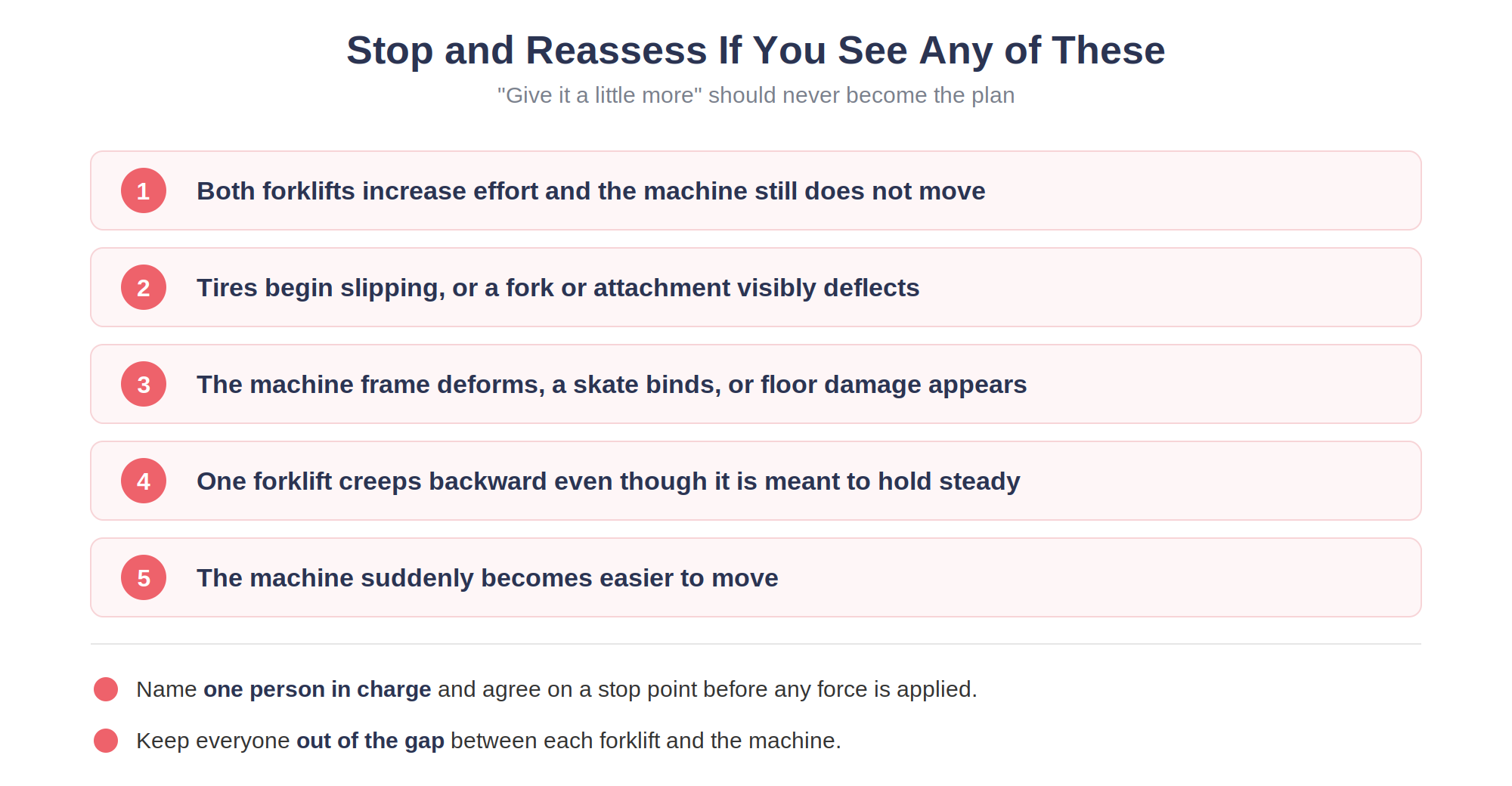
Two operators independently deciding to add “just a little more” can let combined force climb well past anyone’s actual intention — designate one person with overall authority over when force increases, and establish a genuine stop condition before starting, not “we’ll know it’s too much when something breaks.” No one should stand between a forklift and the machine, or between the machine and any fixed structure, to guide the movement by hand — that gap can close instantly if either forklift moves unexpectedly.
Before Using Opposing Forklifts: A Checklist
- Are both trucks and any attachments actually rated and approved for pushing, pulling, or restraining — not just heavy enough?
- What are the actual structural contact points on the machine, and where does force travel between them?
- Are the two force lines collinear, or will they create torque?
- What is providing the resisting force — brakes, traction, or an approved restraint — and is that appropriate for the load?
- Who has overall command, and what is the predetermined stop condition?
- Where do people stand — clear of every possible crush zone if either forklift or the machine moves suddenly?
Stop and reassess if: both forklifts increase effort with no machine movement, tires begin slipping, a fork or attachment visibly deflects, the machine frame deforms, a skate binds, floor damage appears, one forklift creeps despite being meant to hold steady, or the machine suddenly becomes easier to move. Don’t let “give it a little more” become the plan.
Learn More: Frequently Asked Questions
Yes. Opposing forces can nearly cancel in terms of net movement while remaining individually large.
Yes. Structural distortion doesn’t require visible movement, and it can be elastic (springs back) or permanent.
Yes, particularly if their force lines are offset rather than aligned, creating a twisting moment.
No. These involve different physics and different limits, and shouldn’t be assumed equivalent.
Yes. Traction differences between the two trucks can shift the force balance suddenly and without warning.
Not necessarily. Its actual holding capacity under horizontal load from another forklift shouldn’t be assumed without verification.
No. They can reduce the force needed to move a machine, but excessive opposing force from two pushing/restraining sources remains just as real a risk.
Final takeaway: don’t judge how much force is in a system by how little the machine is moving. Two forklifts fighting each other to hold a machine “under control” can be putting enormous force into everything around it — the frame, the contact points, the floor, the skates — right up until something releases and that hidden force becomes visible motion. Ask not how little the machine is moving, but how much force it’s taking to make it look that way.
More Resources: Force & Rigging
- Reversing a Heavy Machine: Why Skates Don’t Always Follow Instantly
- Stored Energy in Rigging: A Hidden Risk During Machinery Moves
- Why a Heavy Machine Can Rotate During a Perfectly Straight Pull
- Why a Machine Suddenly Pulling Easier Can Be a Warning Sign
- Why the First Inch of a Machinery Move Needs Its Own Plan