
Machinery Load Migration:
Level Does Not Mean Evenly Loaded
Home » Technical Library » Load Distribution & Final Positioning » A Level Machine Doesn’t Mean Equal Load on Every Support
By Machinery Sliders™ Technical Team|Drawing on industry background in machinery rigging and moving equipment|Last Updated: November 8, 2026
Direct Answer: The Machine Is Still Level. Why Is One Corner Getting Heavier?
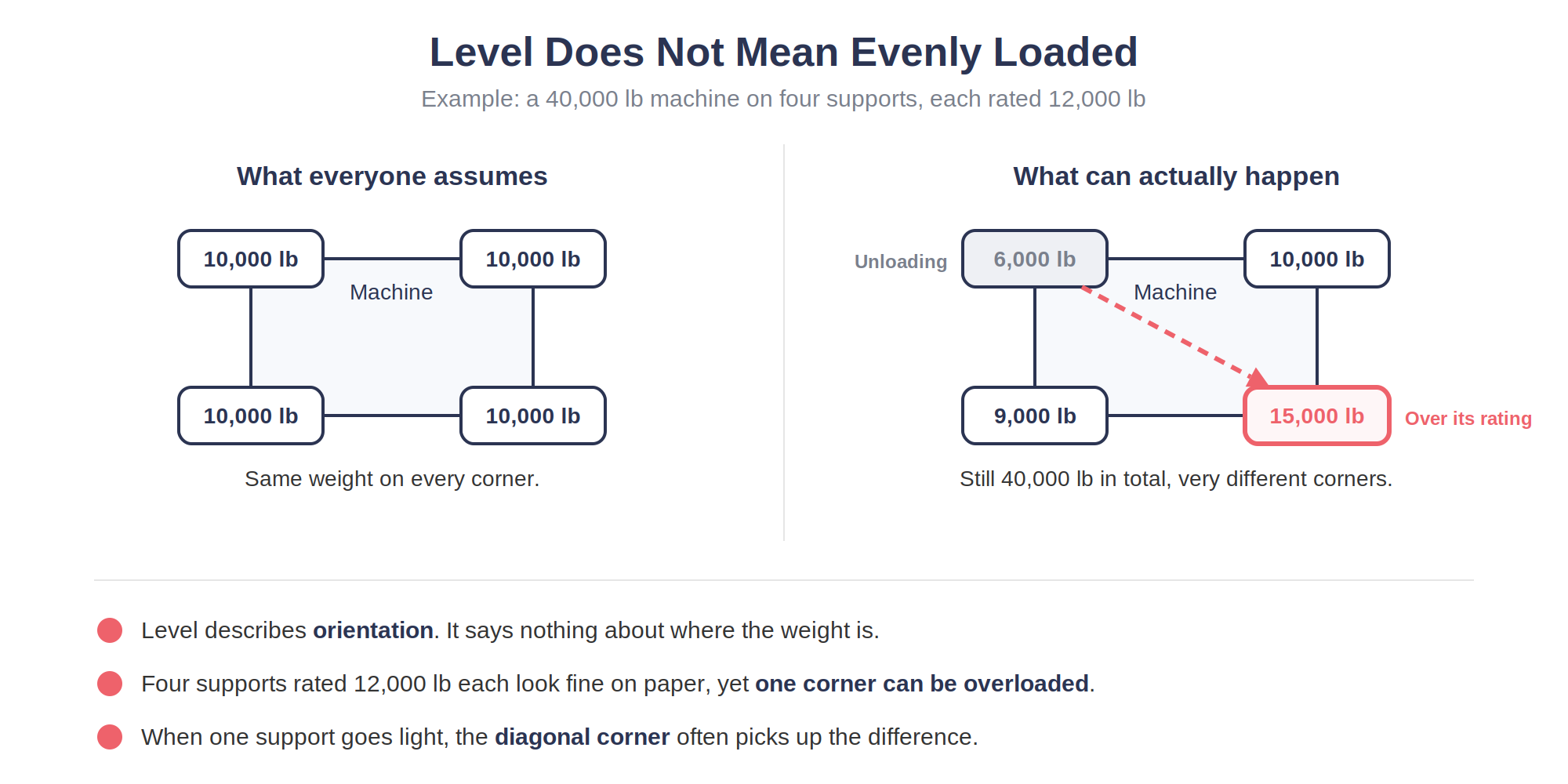
A machine can stay perfectly level while load migration shifts the actual weight underneath it between supports. A 40,000 lb machine on four skates doesn’t automatically carry 10,000 lbs on each one — center of gravity, floor elevation, machine stiffness, and applied forces all influence how much each support actually carries, and none of that shows up as visible tilt. One corner can quietly climb from an assumed 10,000 lbs to 17,000 lbs mid-move while the machine never appears to lean. Level describes orientation. It says nothing about where the weight actually is.
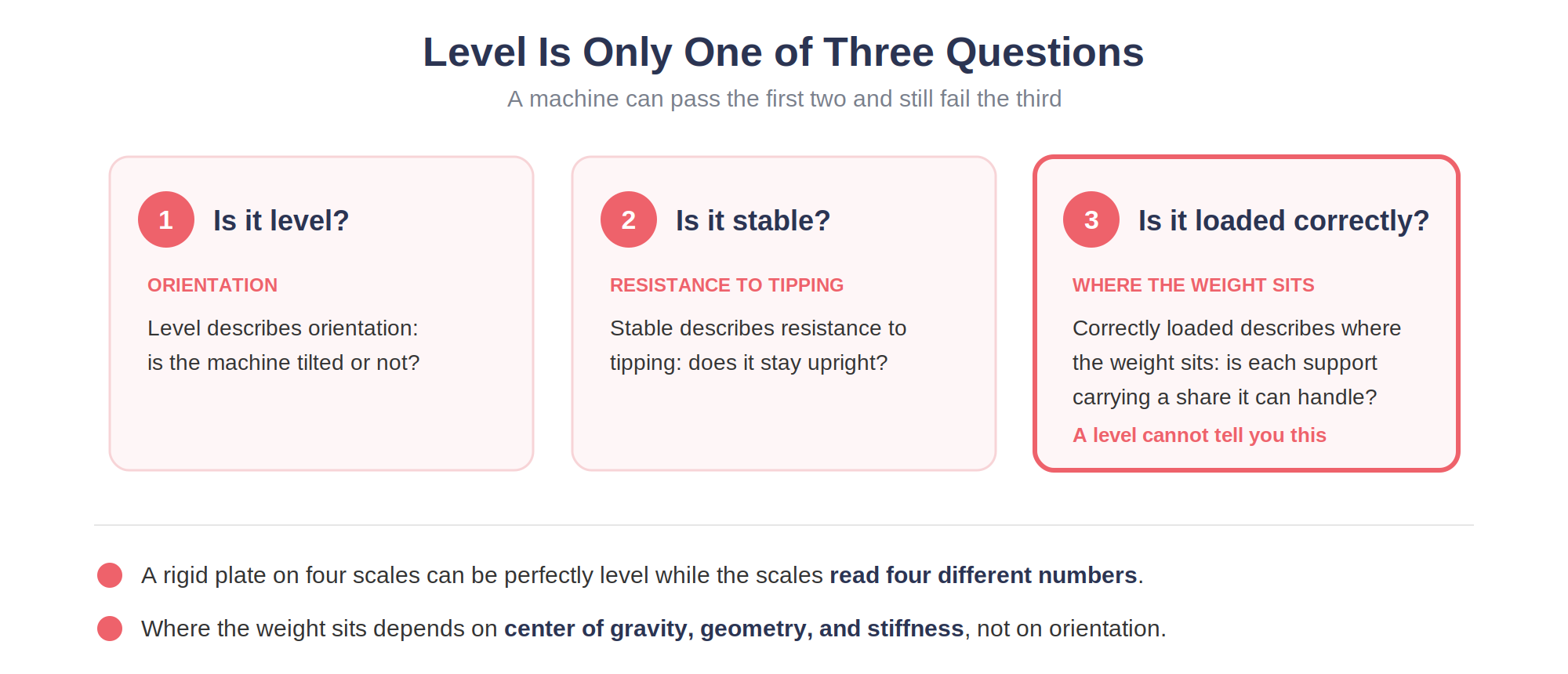
Level, Stable, and Correctly Loaded Are Three Different Questions
Is the machine level (orientation), is it stable (resistant to tipping), and are the support reactions acceptable (where the weight actually is) — these sound related but aren’t interchangeable. A rigid steel plate resting on four scales can be perfectly level while those scales read wildly different numbers, because reaction depends on center of gravity, geometry, and stiffness, not just orientation. Combined rated capacity can hide this: four supports each rated for 12,000 lbs sounds comfortable for a 40,000 lb machine, but if one corner actually carries 15,000 lbs, that individual support can be overloaded even while the math on paper looks fine — the same “don’t divide by four” lesson covered on our page about whether all your skates are actually carrying weight, just showing that the identity of the overloaded support can change as the machine travels.
Three Points Define a Plane — the Fourth Has to Match It
Each support travels along its own path, and those four paths are rarely perfectly coplanar — one might rise an eighth of an inch while another drops a sixteenth. Three supports always establish a stable plane; the fourth has to meet that plane or its reaction changes. None of this requires the machine to visibly tilt: a rigid frame can redistribute the mismatch internally, and even thousandths of an inch of structural deflection in a stiff, multi-support frame can shift thousands of pounds of reaction — which is exactly why visual inspection alone can’t tell you whether a support is carrying 6,000 lbs or 12,000.
A Light Support Means Something Else Just Got Heavier
Weight doesn’t disappear — if one support drops to nearly nothing, the other three have to carry the difference between them. The useful field habit is to immediately ask which support became heavy the moment you notice one going light, rather than focusing only on the unloaded corner. This can be counterintuitive: in a rigid rectangular frame, load migration can be diagonal, with the corner directly opposite an unloading support picking up more than an adjacent one would — the same structural principle as pressing down on one leg of a four-legged table and watching the diagonal leg’s behavior change.
Internal Mass and Pulling Height Both Shift Reactions Without Tilting the Machine
A shifting internal component — fluid sloshing, a table or head moving — changes the center of mass without necessarily changing the machine’s outward orientation at all, meaning reactions can move even while the machine looks completely unchanged from the outside. The height and angle of the applied pulling or pushing force matters too: force applied well above the support plane can create a moment that shifts weight between front and rear supports, similar to how a vehicle’s weight shifts under acceleration. See our page on why a heavy machine can rotate during a straight pull — the same three-dimensional force reasoning applies directly here, just affecting vertical reaction instead of yaw.
Machinery Sliders Don't Automatically Equalize Load Either
A broad sliding contact patch can distribute one support’s reaction more gently into the floor, but it doesn’t force all four sliders to share equally — a slider carrying twice the load still carries twice the reaction, regardless of how wide its contact area is. Single-direction and multidirectional sliders share this same underlying physics even though their movement characteristics differ; a heavily loaded slider can dominate the resistance pattern and drive yaw exactly the way an overloaded wheeled skate would. See our page on why a jack can walk while the machine looks still for the same “the visible component isn’t telling you the real story” theme applied to lifting instead of horizontal travel.
Final Positioning Can Produce the Highest Reaction of the Entire Move
This is genuinely counterintuitive: a long, uneventful move can go perfectly, and then one corner climbing a small foundation pad during final placement becomes the single most heavily loaded moment of the whole operation. Removing a support at the end is its own load-transfer event too — when a slider comes out, its share of the weight moves onto whatever’s left, and the last slider removed isn’t necessarily the lightest just because the others are already gone. See our page on why the last quarter inch is often the riskiest part of a move for the same principle from a different angle.
Before and During the Move: A Load-Migration Checklist
- Do you know the machine’s approximate center of gravity, not just its total weight?
- Are you assuming equal load sharing across supports, and if so, why?
- How much capacity margin exists between expected reaction and each support’s rating?
- Are all four support paths reasonably flat, or could one cross a hump, dip, or joint the others won’t?
- Is the pulling or pushing force applied above the support plane, and does it have a vertical component?
- How will an unexpectedly light or heavy support actually be detected during the move?
Stop and reassess if: one support clearly unloads, another appears to be approaching its rated capacity, floor damage develops beneath one corner, a skate begins steering abnormally, or actual behavior diverges from the plan. Don’t respond to unequal loading by adding more pulling force — find out where the weight actually is.
Learn More: Frequently Asked Questions
No. Level describes orientation, not load distribution — the two aren’t the same thing.
No. A rigid frame can redistribute reactions internally through very small structural deflection with no visible change in orientation.
Yes, depending on the machine’s stiffness and support geometry — load migration isn’t always to the nearest support.
Yes, depending on the height and angle of the applied force relative to the support plane.
No. More supports don’t guarantee more equal reactions without an actual equalizing mechanism.
No. A broad contact area can distribute one reaction more gently, but it doesn’t force multiple sliders to share load equally.
No. A support can be significantly overloaded while the machine continues moving smoothly and appears completely level.
Final takeaway: the machine’s total weight never changes during a move. Almost everything else can. A support climbs an eighth of an inch, another drops into a shallow depression, the frame flexes a few thousandths — and one corner that was assumed to carry 10,000 lbs may now be carrying 17,000, with nothing visible from the top of the machine to suggest it. Level is not a load measurement, and four supports do not mean four equal loads. The question that matters isn’t whether the machine looks fine — it’s where the weight actually is right now.