
Why a Heavy Machine Can Rotate During a Perfectly Straight Pull
Home » Technical Library » Force & Rigging » Why a Heavy Machine Can Rotate During a Perfectly Straight Pull
By Machinery Sliders™ Technical Team|Drawing on industry background in machinery rigging and moving equipment|Last Updated: September 27, 2026
Direct Answer: Every Pulling Line Is Straight. Why Is the Machine Rotating?
A heavy machine can rotate during a perfectly straight, perfectly centered pull because the machine responds to two things, not one: where you’re pulling it, and where it resists being moved. If the floor resistance underneath the machine isn’t balanced about the same centerline as the pull, the mismatch creates a turning moment — even though every visible piece of rigging looks dead straight. A centered pull doesn’t guarantee straight travel. It only guarantees the pull itself is centered.
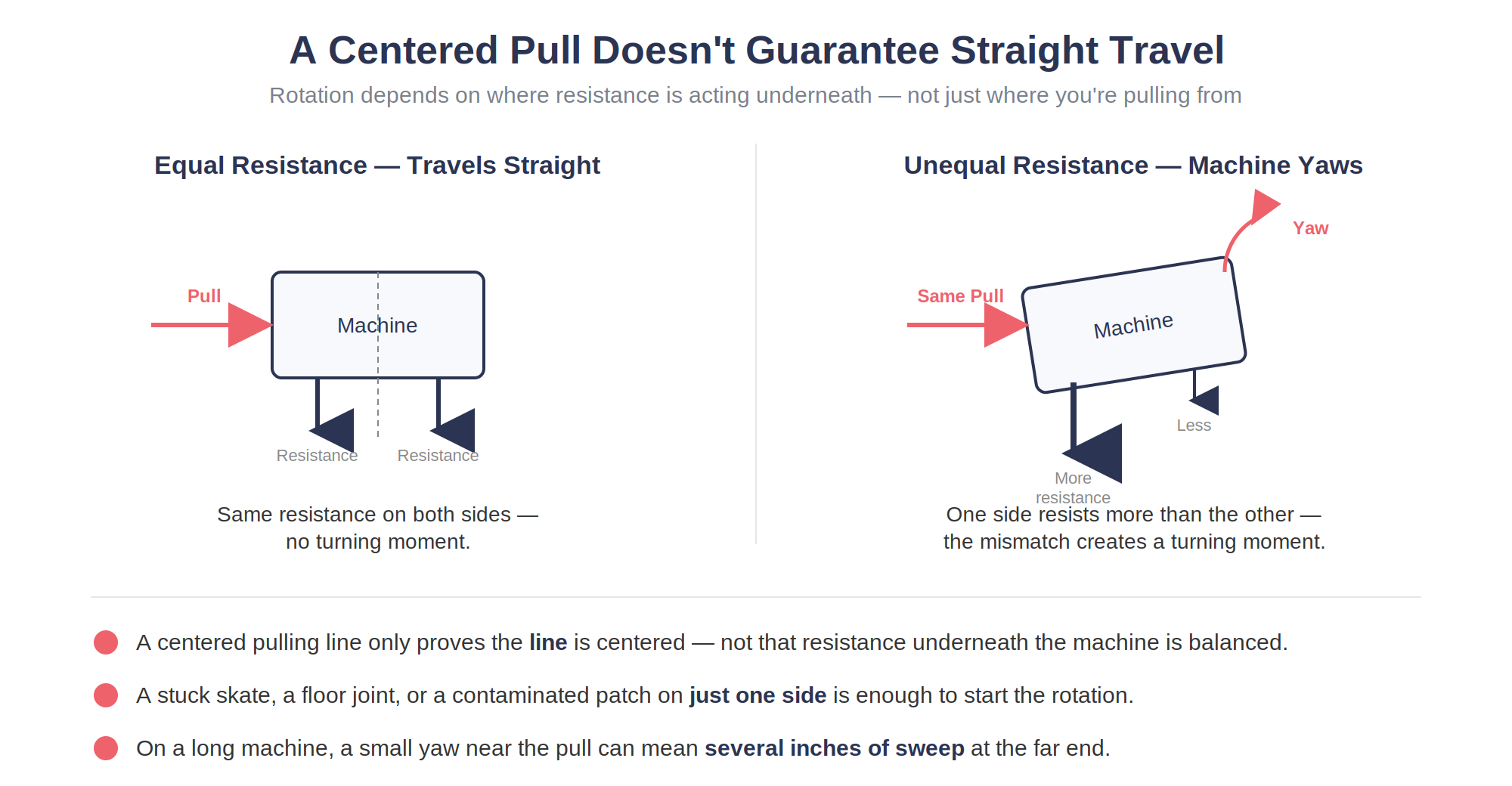
Translation and Rotation Can Happen at Once
The Machine's Weight Isn't Always Where It Looks Like It Is
One Support Can Become an Accidental Pivot
If one support becomes more heavily loaded than the others (see our page on how load distribution shifts across skates), it can generate meaningfully more resistance than the rest — and if one support hits a floor joint, contamination, or a surface transition before the others do, it can hesitate while the rest of the machine keeps moving, temporarily turning that support into a hinge the whole machine rotates around. On a long machine, this effect compounds dramatically: a quarter-inch obstruction at one support can translate into a rear corner sweeping several inches sideways, and on a machine roughly 20 feet long, just one degree of rotation can move the far end enough to strike a column, close a doorway gap, or reach a worker who had no reason to expect the machine to move toward them.
Rotation Can Feed Itself
Once yaw begins, it can change the very geometry that’s producing it: pulling angle shifts, support paths change, load redistributes across the remaining supports, and that redistribution can create even more rotational tendency than the original cause — a small, easily correctable yaw can escalate into a much larger one if it isn’t addressed early. This is exactly why steering against the symptom rather than investigating the cause tends to make things worse: adding more pulling force increases both the forward force and the rotational moment together, and if the underlying resistance imbalance is the real problem, a bigger forklift doesn’t fix physics — it can accelerate the rotation instead.
Two Pulling Lines Can Help, or Quietly Make It Worse
Two lines that both look equally tight aren’t necessarily carrying equal force — one chain might be carrying far more tension than the other while both appear identically taut, since visual tension isn’t a force measurement. Hydraulic skidding systems are often specifically designed with synchronized flow so both sides move together, precisely because letting one side lead the other can create skew and unequal loading — worth remembering if your move uses two independent pulling points without any real synchronization between them.
The Floor Can Steer the Machine as Much as the Operator Does
A cross-slope creates a lateral gravity component the machine has to fight, and depending on the support system, that drift can show up as rotation or as the machine crabbing sideways while keeping its orientation. Multidirectional skates and sliders make crabbing easier — genuinely useful in the right situation — but that same freedom of movement means small lateral forces produce lateral motion instead of being resisted the way a fixed-direction support would resist it. A long machine can also have four supports crossing four completely different floor conditions at the same moment — there may be no single “floor condition” under a large machine at all, which is why route planning should trace every support’s actual path, not just the centerline painted down the aisle.
Machinery Sliders Aren't Immune to This Either
A sliding system has no caster that needs to swivel, but frictional resistance can still vary meaningfully between individual sliders — one may be more heavily loaded, on rougher concrete, contaminated, or partway across a surface transition. A slider carrying unusually high localized resistance can become the dominant rotational point, just like a stuck skate can. See our pages on why a sudden drop in pulling force can be a warning and stored energy in rigging systems for the same underlying force-trend logic applied to other symptoms — a rising or falling pulling force combined with unexpected rotation is a strong diagnostic signal, not something to power through.
Diagnose It, Don't Fight It
Stop the move while a small yaw is still small. Check whether the pull is truly centered and level, whether support reactions are reasonably equal, whether one support unloaded or overloaded, and whether the floor changed materials or slope underneath one side. Look for a skid mark, a debris trail, or an unusual sound from one corner — the floor and the machine are often telling you exactly what’s happening, if you stop translating long enough to look. See our page on why reversing direction is its own mechanical event and our page on the first inch of any move — both describe the same “watch every support at the moment of change” principle that applies directly here.
Before and During Travel: A Rotation Checklist
- Is the pull actually centered on the machine’s mechanical center, not just its visible geometric center?
- Are support reactions reasonably equal, or is one carrying significantly more than the others?
- Has any support crossed a floor joint, contamination, or surface change before the others?
- If multiple pulling lines are used, is tension actually balanced — not just visually tight?
- Where would the far end of the machine sweep if rotation continued right now?
- Is the crew constantly correcting steering in one direction — and if so, why does the machine keep wanting to go the other way?
Stop and reassess if: rotation begins unexpectedly, yaw increases with each foot of travel, one support lags or hesitates, pulling force changes sharply while the machine turns, or the far end approaches a wall, column, or worker. A straight pulling line only proves the line is straight — it doesn’t prove the force system underneath the machine is balanced.
Learn More: Frequently Asked Questions
Yes. It can create unequal support reactions and, in turn, unequal resistance beneath the machine.
Yes. A support that hesitates while the rest of the machine keeps moving can temporarily become a pivot point.
Yes, if one support encounters increased resistance from the crack before the other supports do.
Yes. A drop in resistance on one side can lower total pulling force while still creating rotation.
No. Visual tension isn’t a force measurement — one chain can carry meaningfully more tension than the other while both look equally taut.
Yes, if the forces applied and the resistance beneath the sliders aren’t balanced — sliding systems aren’t immune to the same yaw mechanics as wheeled skates.
Final takeaway: the forklift is centered, the chain is centered, the pulling point is centered — and the machine turns anyway. That’s because the machine isn’t only responding to the force pulling it forward. It’s responding to every force trying to hold it back. When a heavy machine starts going somewhere nobody told it to go, don’t just ask whether the pulling line is straight. Ask where the resistance actually is.