
Why a "Stationary" Steel Floor Plate
Can Start Sliding
Home » Technical Library » Foundation & Structural Capacity » Why a “Stationary” Steel Floor Plate Can Start Sliding
By Machinery Sliders™ Technical Team|Drawing on industry background in machinery rigging and moving equipment|Last Updated: November 8, 2026
Direct Answer: You Put a Steel Plate Under the Machine. Why Is the Plate Moving?
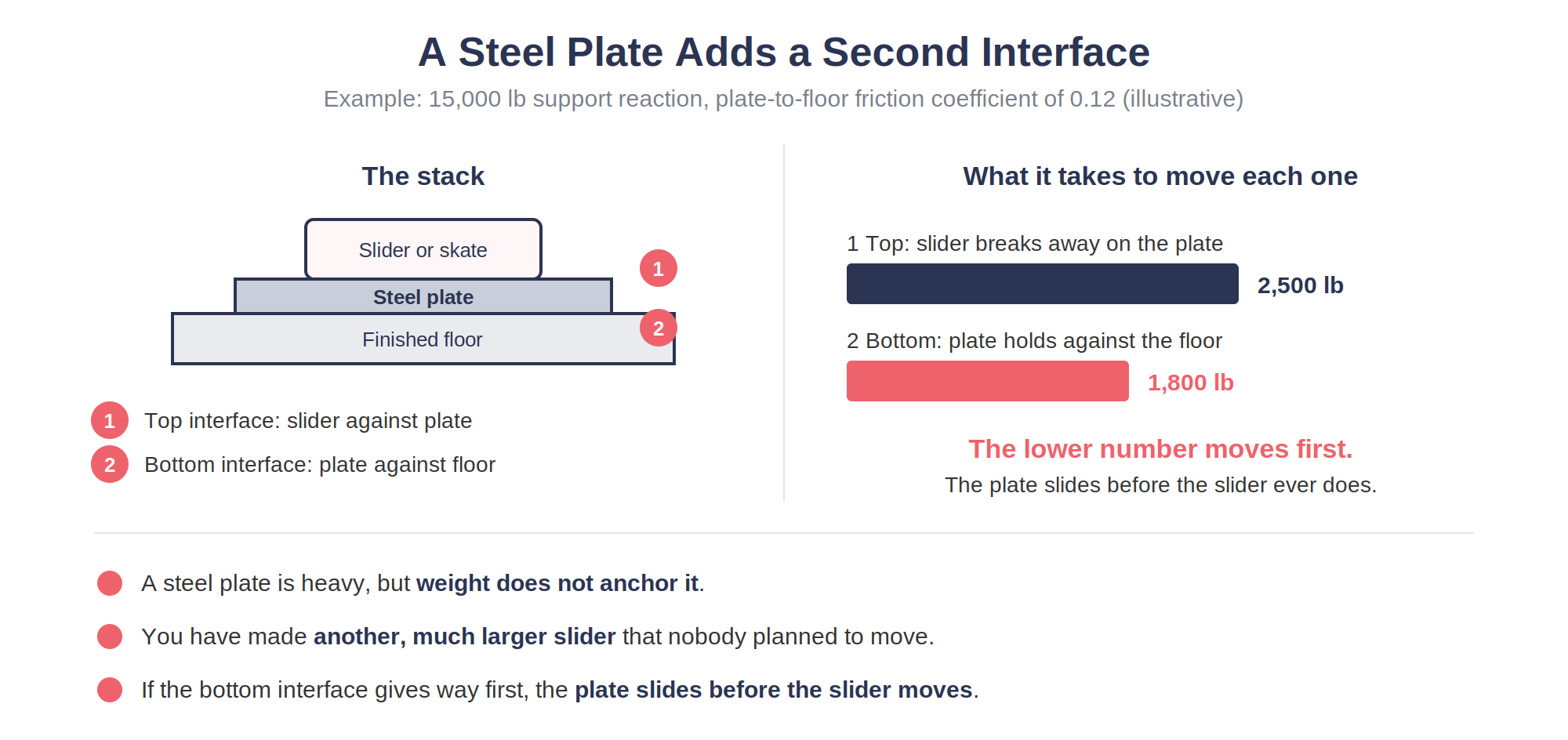
Placing a steel plate under moving equipment to protect a finished floor creates two friction interfaces, not one: the moving equipment against the plate, and the plate against the floor underneath it. If the bottom interface offers less resistance than the top one, the whole plate can start sliding across the floor before the machinery skate or slider ever moves relative to the plate. You’ve effectively created another, much larger, unintended slider — heavy, sharp-edged, and nobody planned for it to move.
Weight Doesn't Mean the Plate Is Anchored
A steel plate feels permanent because it’s heavy, but mechanically it’s just another object resting on the floor — and the machine sitting on top of it is often exactly what supplies the horizontal force capable of moving it. The system will move at whichever interface offers less resistance, and that isn’t necessarily the one you intended.
Worked example: a support reaction of 15,000 lbs sits on a steel plate. Using an illustrative plate-to-floor friction coefficient of 0.12, the estimated resistance holding the plate in place is 0.12 × 15,000 = 1,800 lbs. If the Machinery Slider itself needs 2,500 lbs to break away across the plate’s top surface, the plate reaches its sliding threshold first — at 1,800 lbs, before the intended top interface ever engages. The plate moves. The slider doesn’t.
Contamination You Can't See Anymore
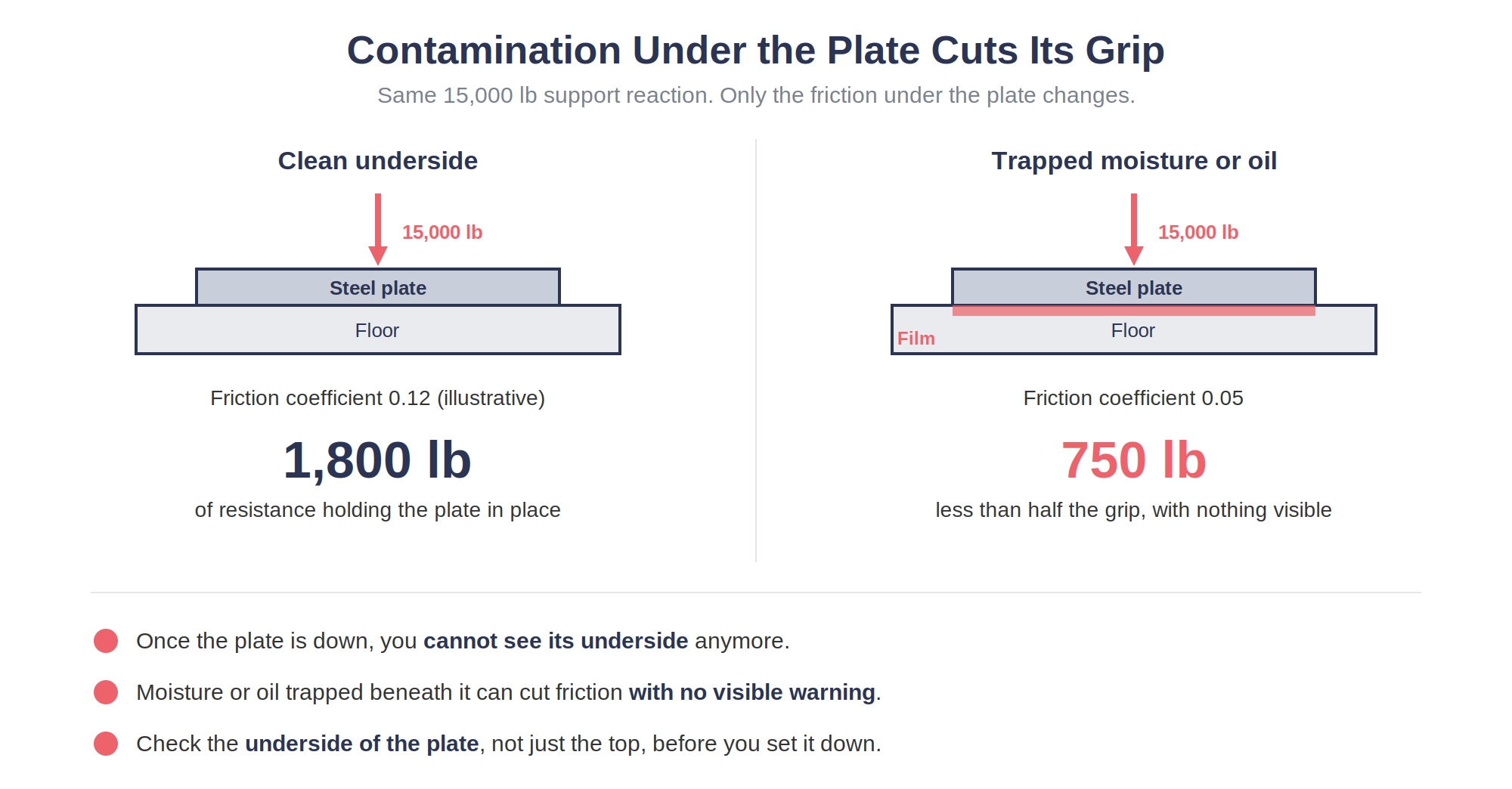
Once the plate is down, the floor underneath it is hidden for the rest of the move — a few drops of oil or leftover moisture from mopping can sit trapped beneath the plate with no way to spot it visually. This connects directly to our page on why a dry-looking floor can suddenly change machine behavior, except here you can’t even see the floor to suspect a problem.
Worked example: using the same 15,000 lb reaction, if trapped moisture or oil drops the effective friction coefficient from 0.12 to 0.05, resistance falls to 0.05 × 15,000 = 750 lbs — the plate becomes dramatically easier to move, with nothing visible to warn you it happened.
A Plate Can Rotate, Not Just Slide Straight
If horizontal force doesn’t act through the plate’s effective center of resistance, the mismatch creates a turning moment — the same force-times-distance relationship covered on our page about why a heavy machine can rotate during a straight pull. A 2,500 lb force acting 10 inches off-center creates roughly 2,000 lb-ft of turning tendency on the plate itself. This produces a genuinely strange failure mode: a single-direction Machinery Slider can stay perfectly aligned and straight relative to the plate, while the plate underneath it rotates or slides sideways across the floor — the machine still ends up moving sideways, and directional control at the slider level gets completely defeated one layer down.
Friction and Bearing Pressure Are Different Problems
It’s tempting to assume a bigger plate automatically resists sliding better, but that’s not quite right. Friction resistance is roughly proportional to the normal force pressing down, not the plate’s surface area — doubling a plate’s footprint mainly reduces the average bearing pressure on the floor (helpful for avoiding floor damage), but it doesn’t proportionally increase the plate’s resistance to sliding. A bigger plate that does break loose is also harder to control: more mass, more edge length, more area that can strike something nearby.
One Plate Moving Can Cascade Into Several
With multiple plates laid end to end, one sliding plate can overlap or push into the next, creating an unexpected step, or plates can separate and open a gap where the route plan expected a continuous surface. If one plate carries most of the horizontal demand and moves first, the machine’s geometry changes, which can shift load onto the next plate and start the same problem there — see our page on how a level machine can still redistribute load for the same underlying cascading pattern.
Every Added Layer Is Another Unknown Interface
Plywood or rubber matting placed beneath steel plate doesn’t simplify the problem — it adds a third interface with its own friction behavior, compression, and potential to shift independently. Know what’s actually stacked beneath the machine and which layer is genuinely expected to move; a random sandwich of steel, wood, and rubber without understanding each interface just multiplies the number of things that could slide instead of solving the original one.
Restraining a Plate Means Designing an Anchor
If a plate needs to be positively secured rather than relying on friction alone, that restraint has to actually be engineered for the real horizontal load — a wall or door frame the plate happens to push against isn’t automatically suitable, and bolting the plate down creates a genuine anchorage question with the same considerations covered on our page about why a pulling anchor is only as strong as the structure behind it. Never use a person’s foot or body weight to hold a plate in place, and never hammer or pry a loaded plate back into position — if it’s carrying real machine reaction, repositioning it is a genuine load-transfer event, not a quick fix.
Watch the Steel Plate, Not Just the Machine
Simple reference marks — one where the machine meets its support, one where the support meets the plate, one where the plate meets the floor — can reveal exactly which interface is actually moving, since guessing from the machine’s behavior alone can easily mislead you. If pulling force suddenly drops, that could mean the slider finally broke free as intended, or it could mean the plate did instead — the two look identical from the machine’s perspective but mean very different things about what’s actually happening underneath it.
Before Using a Steel Plate for Floor Protection: A Checklist
- What are the two (or more) friction interfaces involved, and which one is actually supposed to move?
- Is the underside of the plate — not just the top — clean of oil, debris, and old contamination?
- Could moisture or oil be trapped beneath the plate before it’s set down?
- Could the top interface’s resistance exceed the bottom interface’s resistance, making the plate move first?
- If multiple plates are used, can they overlap, separate, or move independently of each other?
- If positive restraint is needed, what structure will actually resist that load — and has it been evaluated for it?
Stop and reassess if: a plate moves relative to the floor, plates begin overlapping or separating, a plate edge lifts or buckles, scraping is heard beneath the plate, or the machine yaws unexpectedly while crossing it. Don’t respond by standing on the plate, kicking it back into place, or hammering it while it’s still loaded — find out which interface actually moved before touching it.
Learn More: Frequently Asked Questions
Yes, if the friction between the plate and the floor is exceeded before the intended top interface engages.
Not necessarily. Machine reaction increases plate-to-floor friction, but it also increases the horizontal force that could move the plate.
Yes. Contamination hidden beneath a plate can dramatically reduce its resistance to sliding with no visible warning.
Yes. This is a genuinely important failure mode — directional control at the slider level doesn’t control what the plate itself does on the floor.
Not simply because of its larger area. Friction resistance depends mainly on the normal force and the surface condition, not plate size — a larger plate mainly helps reduce floor bearing pressure.
Yes. A moving plate can overlap or separate from neighboring plates, and changed machine geometry can shift load onto the next plate in sequence.
Not automatically. Whatever stops the plate becomes part of the structural load path and needs to be evaluated for that force.
Final takeaway: the crew did something sensible — protecting a finished floor with steel plate. The mistake wasn’t using the plate. It was assuming the mechanical system ended at the top surface of it. There were always two interfaces: moving equipment to plate, and plate to floor — and sometimes the lower-friction surface isn’t where you intended movement to happen. The machine may not be sliding across the plate. Sometimes the plate is sliding underneath the machine.