
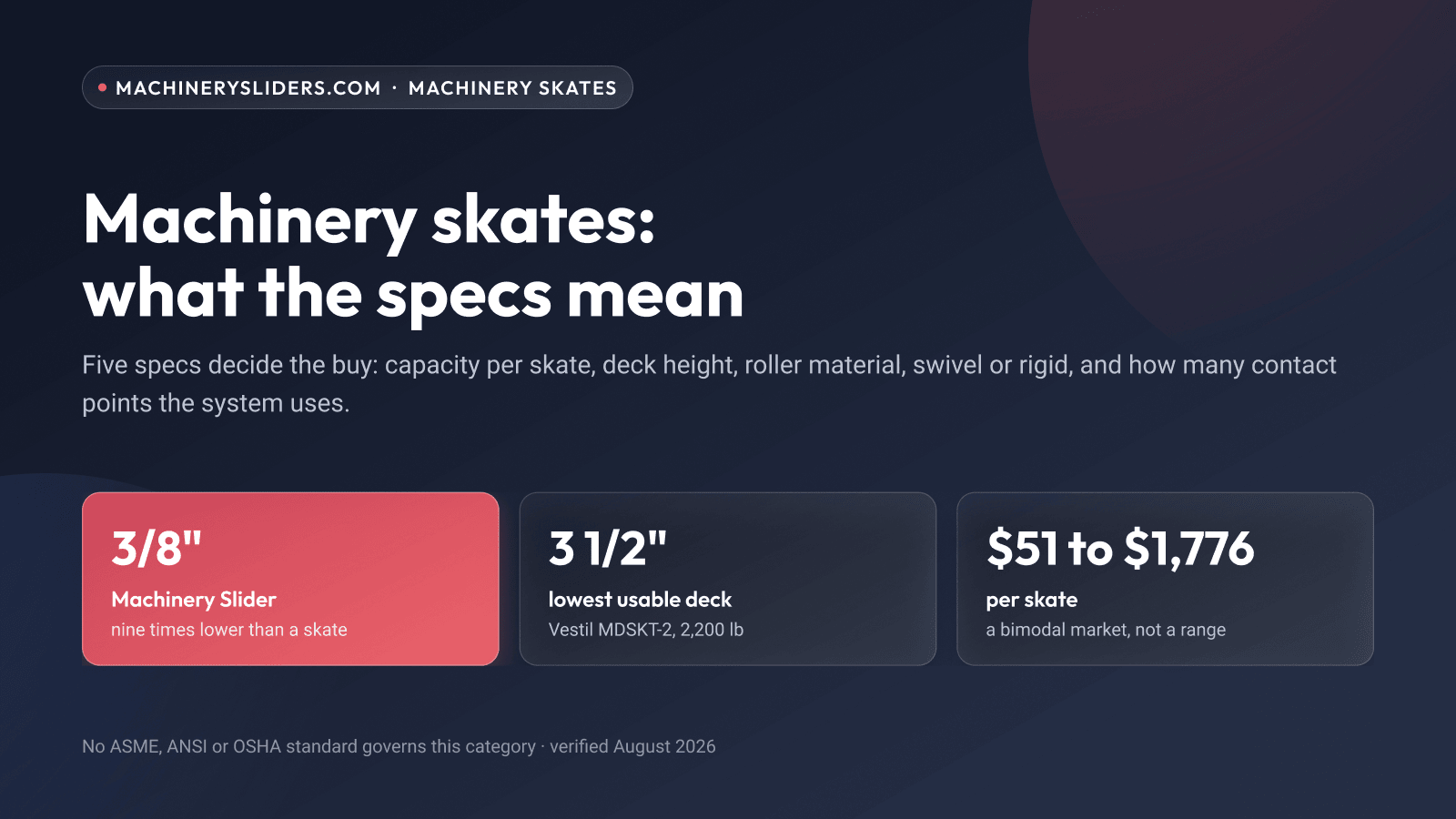
Direct answer Machinery skates are steel frames on rollers that carry a machine while you push or pull it. Per-skate ratings run from half a tonne to 100 tons, deck heights from 3 1/2 inches to 4 3/4 inches on mainstream models, and prices from $51 for a rebadged import to $1,776 for a 100 ton US-made unit. There is no ASME, ANSI or OSHA standard governing them, so every capacity figure is manufacturer-declared with no common test basis. Wheelless Machinery Sliders™ do the same carrying job at 3/8 inch of height, rated roughly 10 tons per pad, at $35.74 each.
What you are actually buying
A machinery skate is a welded steel frame with a row of rollers underneath and a load-bearing plate on top. The machine rests on the plate. You supply the horizontal force. The rollers turn. That is the entire mechanism, and it has not changed much since the product line started in 1938.
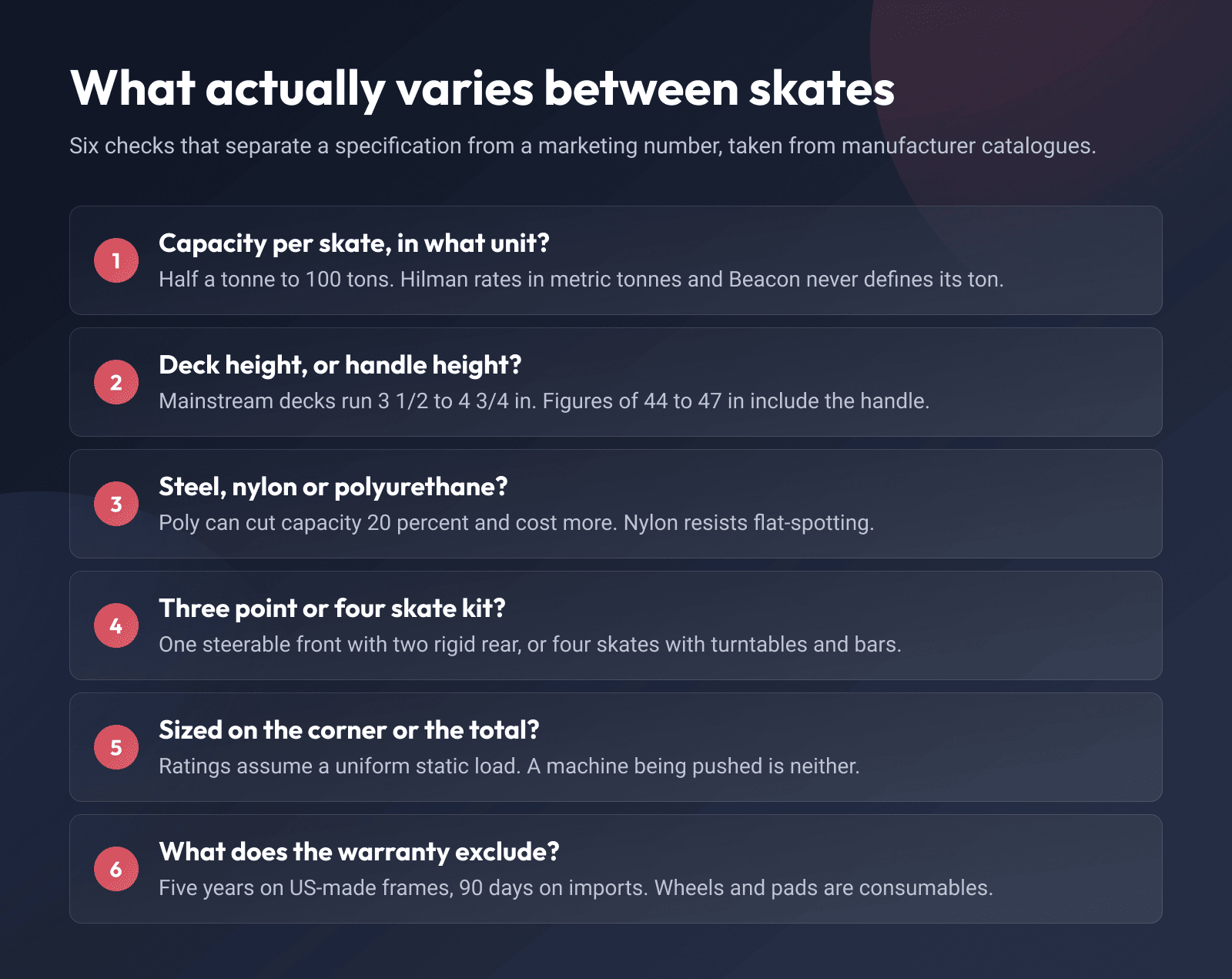
What varies between models is narrower than the catalogues suggest, and it comes down to five things: how much each skate carries, how tall the deck is, what the rollers are made of, whether the top swivels, and how many contact points the system uses. Get those five right and the move is straightforward. Get the second one wrong and you find out on the day, with the machine already jacked.
This page is the specification and buying reference. If you want the method instead, how the move itself is planned and executed, that is covered in the complete guide to machine skates.
Capacity: half a tonne to 100 tons per skate
The range on the market is far wider than most buyers realise, and the useful thing to know is where the tiers sit.
At the bottom, Hilman’s N.5-SP is rated half a tonne and Beacon’s BVHMS-2 is rated 2,000 lb. These are for pallets, cabinets and light machine tools, and they are the models where deck height gets lowest.
The working middle of the market is 2 to 12 tons per skate. Hevi-Haul’s ST-5 and CS-5 are rated 2.5 tonnes. Their CS-25 is rated 12.5 tonnes. Beacon’s BASKT-12 is rated 12 ton. This is where most shop and plant work lives.
At the top, Hevi-Haul’s TDM-200 is rated 100 tons per skate and sells for $1,776, which is a remarkable number when you set it against a $1,463 skate rated 24 ton from another brand. Hilman’s catalogue goes further, to 750 tons on the 750-XOT, though the tables for the 1,000 ton models say consult factory rather than publishing specifications. If you see a claim that Hilman skates go to 1,000 tons as a catalogue fact, that is not what the catalogue says.
Per brand, the ceilings are Hevi-Haul at 100 tons, TPX at 32 tonnes, Vestil at 24 tons, Beacon at 24 ton or 30,000 lb depending on the line, and H-Lift at 20 tonnes for a single skate.
One unit warning that costs real money. Hilman rates in metric tonnes, 2,204 lb per ton, and several large distributors convert at 2,000 lb and publish figures roughly 10 percent low. Beacon prints the word TON on its tables with no definition and no pound conversion, so for Beacon products the unit is genuinely ambiguous and worth a phone call before you commit.
Deck height: the real numbers
This is where published data in the category is least reliable, so here is what manufacturers actually print.
The lowest deck height on any machinery skate in a manufacturer catalogue is 3 7/16 inches, on Hilman’s N.5-SP at half a tonne. At a capacity most people can use, the lowest is 3 1/2 inches, on Vestil’s MDSKT-2 rated 2,200 lb and Beacon’s BVHMS-2 rated 2,000 lb. Step up to 6,000 lb and the lowest is 3 3/4 inches on the Vestil FMS-3.
Above that, the mainstream band is tight. Hevi-Haul’s TDM-7 is 4 inches. Every TPX series is 4.25 inches. Hevi-Haul’s CS-3 and CS-5 are 4 1/2 inches. Their UMS-HD-75 at 37.5 tonnes and TDM-200 at 100 tons are both 4 3/4 inches, which is worth noting: going from 12 tons to 100 tons of capacity costs you three quarters of an inch, not four inches.
Two traps in the published data.
First, Beacon’s own specification table lists its BSSKT-3 at 47 inches and its BMDSKT-2 at 44 1/4 inches. Those are overall heights including the steering handle, not deck heights. Vestil lists the identical MDSKT-2 at 3 1/2 inches because its handle detaches. If you see a machinery skate quoted with a 44 to 47 inch height, a spec scraper copied the wrong column. TPX handles this best by publishing deck height and handle height in separate columns, 4.25 inches and 36 or 45 inches.
Second, there is a live conflict on one popular model. Hevi-Haul’s own page gives the ST-5 a height of 3 7/8 inches, while a distributor lists 4 3/8 inches for the same skate. Take the manufacturer figure.
And the claim that needs retiring: a figure of 1.70 inches circulates as the lowest wheeled machine skate on the US market. The only place it can be sourced is an unbranded marketplace listing with no manufacturer, no datasheet and no catalogue behind it. It is not a defensible number. The lowest you can actually buy from a manufacturer with a spec sheet is 3 1/2 inches for a skate, or 1 3/4 inches if you drop the steering and buy a flat machine dolly like the Vestil MCD-10 at 10,000 lb.
Which is the honest way to frame the wheelless comparison. A single-directional Machinery Slider sits at 3/8 inch. Against the lowest catalogue skate that is nine times lower. Against the lowest wheeled thing of any kind it is still 4.7 times lower. The gap is real without needing an unverifiable number to make it look bigger. The clearance case is set out on the low clearance machinery moving page.
Roller material, and the derate nobody mentions
Three materials are genuinely available, and Hilman’s catalogue describes each in a single sentence worth taking literally.
Steel rollers “provide the best wear characteristics and are great for durable floors”. Hevi-Haul adds that steel handles extended resting loads, even permanent installation, and excels on rough or uneven floors.
Nylon is for “good floor protection and favorable wear”, and Hilman notes that nylon “will not set if left under load for a period of time”. Setting is flat-spotting. Hilman recommends nylon specifically for new concrete, epoxy coated surfaces, and painted or sealed floors.
Polyurethane is “a softer wheel that provide excellent floor protection on tile floors”. Hevi-Haul supplies the counterweight: poly rollers are not recommended for extended resting loads or on rough and debris riddled rolling surfaces.
Now the part that changes buying decisions. Polyurethane can cost you capacity, and it costs you money at the same time. Hevi-Haul rates the CS-25 at 12.5 tonnes with steel rollers and the CS-25-P at 10 tonnes with polyurethane, a 20 percent derate, and the poly version is priced higher at $690 against $575. The derate is not universal, their ST-5 keeps its 2.5 tonne rating on both roller types, so check the specific model. But if you are specifying poly for floor protection, verify the rating on that exact part number rather than assuming it matches the steel version.
One material to ignore entirely. Phenolic rollers appear in a lot of machinery skate guides. None of Hevi-Haul, Vestil, Beacon, Hilman, TPX or H-Lift offers them on a machinery skate. It is a caster material that gets copied across from caster articles.
On floor marking, the only product line explicitly marketed as non-marking is Hilman’s Nyton series. Enerpac states that metal rollers risk floor damage. Nobody publishes a marking test, a threshold or a standard, so the honest position is that material changes how much a roller marks and does not change the fact that a roller loads the floor along a narrow line.
How systems are configured
Two genuinely different architectures are sold in the US, and they are not interchangeable.
A three point system is one steerable unit at the front and two rigid units behind. TPX describes its SFT as one ST steerable unit plus tandem FT fixed models to make the complete three point system. H-Lift says its MSF fixed skates typically serve as rear skates in three point moving systems. Pake sells the same architecture as one front steering unit and two rear units. The front unit decides direction, the rear units follow.
A four skate box kit is a different animal. H-Lift’s MSK contains four roller skates, two turntables, two handles, connecting bars, levelling plates and a metal box. Every rebadged import kit on the market is a version of this. Hevi-Haul’s CS-20K is a third pattern again: four identical swivel skates plus a placement handle, no turntables, ten tonnes total.
On when three points is not enough, TPX’s manual is the only source that states the decision factors: it may be necessary to use three or more points of contact depending on the weight of the load, the length and width of the load, and the rigidity of the support structure under the load. That last factor is the one people forget. A long, flexible machine base does not behave like a rigid block, and it needs more support points regardless of what the weight arithmetic says.
What the swivel top buys you is steering under load, and Hevi-Haul publishes the best note on its limits. Their swivel skates carry a friction plate between the top frame and the swivel plate to “reduce swimming under load”, swimming being their word for the top wandering off your intended line. On Hilman’s Bull Dolly range every swivel top ships with a lock so the same unit can be run rigid for a straight haul and released for the placement.
What machinery skates cost
Published prices, current, arranged by capacity so you can see what the money actually buys.
- 2.5 ton, Beacon BFMS-2.5: $123.15
- 3 ton, Beacon BFMS-3: $174.70
- 2.5 tonne, Hevi-Haul ST-5: $375
- 2.5 tonne, Hevi-Haul CS-5: $395
- 6 ton, Beacon BFMS-6: $253.61
- 10 tonne, Hevi-Haul UM-HD-20: $605
- 12.5 tonne, Hevi-Haul CS-25 steel: $575
- 10 tonne, Hevi-Haul CS-25-P poly: $690
- 12 ton, Beacon BASKT-12: $695.50
- 12 ton steerable, Beacon BSSKT-12: $959.92
- 12.5 tonne, Hevi-Haul TDM-7: $995
- 37.5 tonne, Hevi-Haul UMS-HD-75: $1,095
- 24 ton, Beacon BASKT-24: $1,463.49
- 100 ton, Hevi-Haul TDM-200: $1,776
Complete kits: a Hevi-Haul CS-20K rated 10 tonnes total is $1,775. A Pake 24 ton steerable set is $3,099.99. A rebadged import kit advertised at 44,000 lb is around $210.
Three things that fall out of those numbers.
The market is bimodal, not a spectrum. US-made skates from Hevi-Haul, TPX and Hilman sit roughly five to ten times above the rebadged import tier at nominally similar capacity. Any average across the whole market describes a product nobody sells.
Price does not track capacity, even inside one brand. Hevi-Haul’s 12.5 tonne CS-25 at $575 undercuts Beacon’s 12 ton BASKT-12 at $695.50. Their 100 ton TDM-200 at $1,776 costs 62 percent more than their 37.5 tonne UMS-HD-75 at $1,095, for nearly three times the capacity.
Advertised kit totals need reading carefully. A 44,000 lb import kit is four 11,000 lb skates summed, on a kit whose steering geometry is three point. That total has no test basis behind it. Compare per-skate ratings and warranty terms instead: 90 days on the import tier against five years on a Hilman skate product, with wheels, pads and swivel locks excluded from that warranty as consumables.
As of this writing, for the same carrying job, four Machinery Sliders rated roughly 10 tons each are $142.97, or $35.74 per pad, dropping to $35.11 per pad in a 64 pack. All five sets are in the store.
Sizing a set
Beacon publishes the only manufacturer table I could find that puts numbers on this:
- 5,000 lb load: four skates rated 5,000 lb each
- 10,000 lb load: six skates rated 5,000 lb each
- 30,000 lb load: eight skates rated 10,000 lb each
Use it as a starting point, but notice what it implies. The margin drifts from 4.0 times the load at the first row to 3.0 at the second and 2.67 at the third. That is a rule of thumb, not a design method, and you should not back-derive a recommended safety factor from it.
Enerpac states the front and rear split without ambiguity: on a 70 ton load moved on a set, the weight shares between front and rear, so front and rear skates each need capacity for a minimum of 35 tons.
The deeper point is what the rating describes. Vestil’s own column header reads UNIFORM STATIC CAPACITY. Uniform means evenly distributed. Static means not moving. Neither condition holds during an actual move. No skate manufacturer publishes a derating factor for off-center loads, and the clearest engineering statement on the problem comes from the caster industry: Hamilton Caster writes that dividing the maximum load weight by four can lead to heavy miscalculations, because most loads do not maintain an even weight across the length and width of the vehicle, and an off-center load could overload even the most durable casters.
So size on the most heavily loaded corner. Find the true center of gravity, not the visual center, and rate the skate that carries the most.
TPX adds a handling consequence that is easy to miss when you are optimising cost: the closer the weight of the load is to the maximum carrying capacity of the skates being used, the harder it will be to turn, rotate and maneuver them. Buying tight to the rating makes the move physically harder, not just riskier.
For Machinery Sliders the arithmetic is simpler because every pad is identical. Each carries roughly 10 tons, so divide the machine weight by 20,000 lb, round up, and spread the pads around the true center of gravity. The manufacturer’s published example runs sixteen single-directional sliders under a 100 ton press on a 6 by 6 timber, which works out at 6.25 tons per pad.
How much force it takes to move them
Hilman publishes the only tested friction figure in the category, and the caveats attached to it are part of the figure. Their rollers “have been tested and demonstrate a coefficient of friction between 1% and 2%”, under stated ideal conditions: an evenly centered load, and a hardened steel rolling surface that is smooth, level and free of debris. The same catalogue quotes 3 to 5 percent depending on rolling surface for its chain skate line. Those figures are for chain-type rollers running on steel plate, not for wheeled skates on concrete, so do not transfer them.
The most useful practical figure comes from TPX’s manual, and it is explicitly labelled a broad rule of thumb: one person can move around 2 tons on a smooth, level, debris-free surface.
For sliding rather than rolling, the numbers and the method are worked through on the force to move a machine page, and the forklift version is on moving machinery with a forklift.
Floor requirements, and four numbers that do not exist
Beacon states the requirement plainly: the load must be moved on a smooth floor capable of taking on the point load of each skate. Suitable surfaces are concrete floors, epoxy warehouse floors and steel plates. Not recommended are soft surfaces, dirt or gravel, and heavily damaged floors.
TPX’s manual is more practical about imperfect floors. Rough but level is generally acceptable, though rough surfaces degrade urethane over time. Cracks wider than a standard concrete expansion joint need addressing, and the remedies given are crossing at an angle, filling, or thin metal plating. Abrupt ledges need plating or fillers, with transitions as gentle as possible.
Here is what does not exist, despite being asked for constantly:
- A floor flatness tolerance. No manufacturer publishes an FF number or a millimetres-over-length figure. All flatness guidance in this category is qualitative.
- A maximum gradient. Hilman footnotes one product as based on a flat level riding surface and no brand goes further.
- A tip-over angle or maximum center of gravity height. Not published by any manufacturer or safety body.
- A floor contact pressure in psi or kPa. Manufacturers make qualitative claims about spreading load and no numeric ones.
There is also no ASME, ANSI or OSHA standard covering machinery skates. ASME B30 governs below-the-hook lifting devices, and skates are not below-the-hook equipment. So when you compare a 12 ton rating from one brand against a 12 ton rating from another, you are comparing two manufacturer declarations produced by two different methods. That is worth knowing before you treat the numbers as equivalent.
Only one segment publishes operating limits at all, and it is the budget end. Import kits state that moving speed should not exceed 5 metres per minute and give a minimum turning circle of 3 metres. Nobody at the premium end publishes either figure.
When a skate is the right call
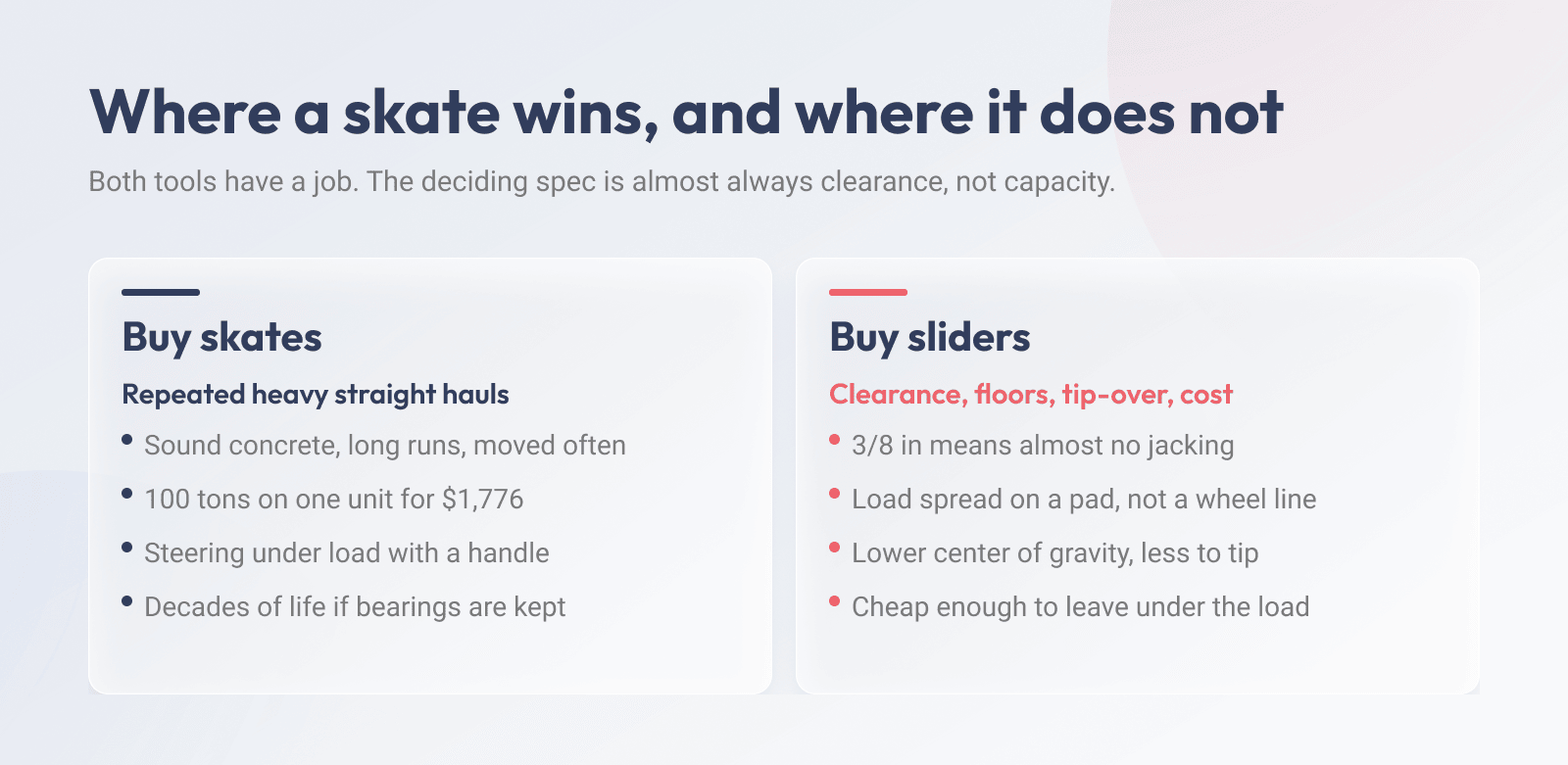
Machinery skates are the correct tool for repeated, heavy, straight-line moves on sound concrete. The mechanism is efficient, the products last decades if the bearings are maintained, and at the top end nothing else carries 100 tons on a single unit for $1,776. If that is your work, buy skates and buy them from a manufacturer that publishes real specifications.
They are the wrong tool in four situations, and each traces back to the two specs at the top of this page.
When clearance governs. A 3 1/2 inch deck at best means jacking the machine at least that far, plus working room. Under a header, inside a trailer, or under a machine with almost no gap beneath it, height decides the job before capacity is considered.
When the machine is top-heavy. Raising the center of gravity by 3 1/2 to 4 3/4 inches narrows the tip-over margin exactly when horizontal force is applied. The argument for keeping the load on the floor is set out in how Machinery Sliders reduce risk.
When the floor is the problem rather than the weight. Rollers load a narrow line. On tile, wood, epoxy, dock plates or damaged concrete that line is where the damage happens, which is covered on moving over floors and truck surfaces.
When the mover has to stay under the load. Nobody abandons a $600 skate inside a packed shipping container. A $35.74 pad can be left in place, which is why crews use them for loading machinery into shipping containers and in clean room machinery moving.
Most crews that do this for a living carry both, and choose per job rather than per preference. The side by side on height, capacity, cost and floor marking is on the Machinery Sliders versus dollies and skates page, and the dolly-specific detail is in machinery dollies.
Frequently asked questions
What are machinery skates?
Steel frames with rollers underneath and a load plate on top, used to carry a machine while it is pushed or pulled. Per-skate ratings run from half a tonne to 100 tons, and mainstream deck heights run from 3 1/2 inches to 4 3/4 inches.
What is the lowest profile machinery skate available?
3 7/16 inches on Hilman’s N.5-SP at half a tonne, or 3 1/2 inches at a usable capacity on the Vestil MDSKT-2 and Beacon BVHMS-2. Claims of 1.70 inches trace only to an unbranded marketplace listing with no manufacturer datasheet. Dropping steering entirely, a flat machine dolly like the Vestil MCD-10 gets to 1 3/4 inches at 10,000 lb.
How much do machinery skates cost?
From $123.15 for a 2.5 ton Beacon BFMS-2.5 to $1,776 for a 100 ton Hevi-Haul TDM-200. Rebadged import skates start around $51. The market is bimodal, with US-made units running five to ten times the import tier at similar nominal capacity, so an average across the market is not meaningful.
How many machinery skates do I need?
Beacon’s published table gives four 5,000 lb skates for a 5,000 lb load, six for 10,000 lb, and eight 10,000 lb skates for 30,000 lb. Treat it as one manufacturer’s rule of thumb, since the implied margin drifts from 4.0 to 2.67 times across those rows, and size on the most heavily loaded corner rather than the total.
Do polyurethane rollers carry the same load as steel?
Not always. Hevi-Haul rates the CS-25 at 12.5 tonnes with steel rollers and the CS-25-P at 10 tonnes with polyurethane, a 20 percent derate, and the poly version costs more. Their ST-5 keeps the same rating on both, so the derate is model specific and needs checking on the exact part number.
What floor do machinery skates need?
Beacon specifies a smooth floor capable of taking the point load of each skate, and names concrete, epoxy warehouse floors and steel plates as suitable. Soft surfaces, dirt, gravel and heavily damaged floors are not recommended. No manufacturer publishes a numeric flatness tolerance or a maximum gradient.
Is there a safety standard for machinery skates?
No. There is no ASME, ANSI or OSHA standard for the category. ASME B30 covers below-the-hook lifting devices and skates fall outside it. Capacity ratings are manufacturer-declared with no common test basis, which is why two identically rated skates from two brands are not necessarily equivalent.
What is the difference between a machinery skate and a machinery dolly?
The words overlap and manufacturers use both for similar products. What matters is whether the top swivels and how tall the deck is. Swivel tops allow steering under load and add roughly 1 to 2.23 inches of height compared with a rigid top in the same range.